
In today's daily market updates, we are going to look at what has happened in the fixed income, money market, commodities and U.S. equity markets yesterday (29 June 2022), and discuss what these would carry for the crypto market.
Treasury, bond, equity and commodities markets all turned red yesterday as everyone is waiting for the release of important economic indicators, namely initial jobless claims, personal consumption expenditures (PCE) price index and Chicago purchasing manager index (PMI) later today.
Fixed Income and Money Market
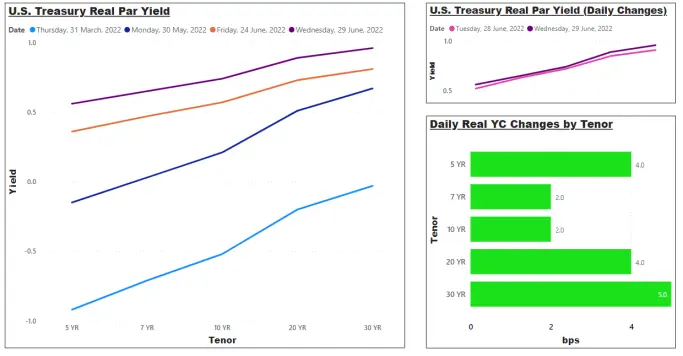
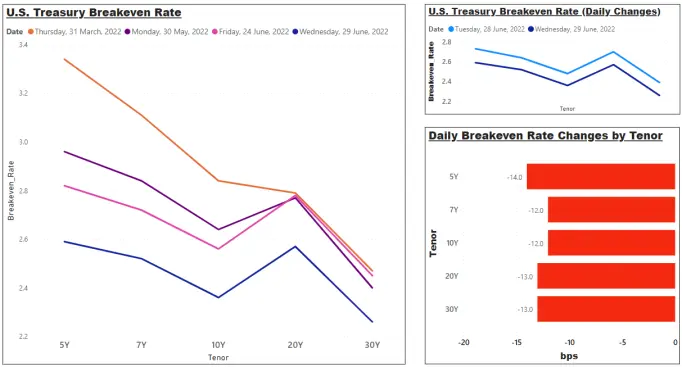
Breakeven Rate= Nominal Par Yield - Real Par Yield
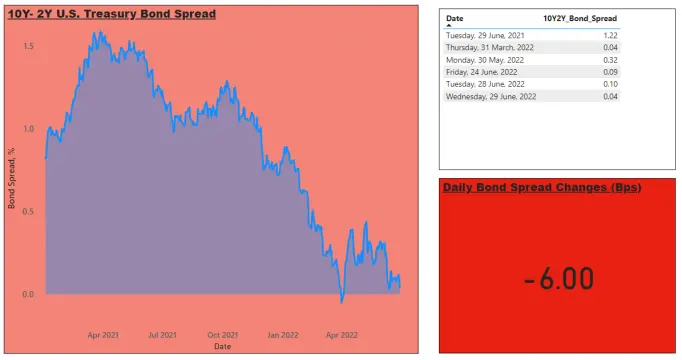
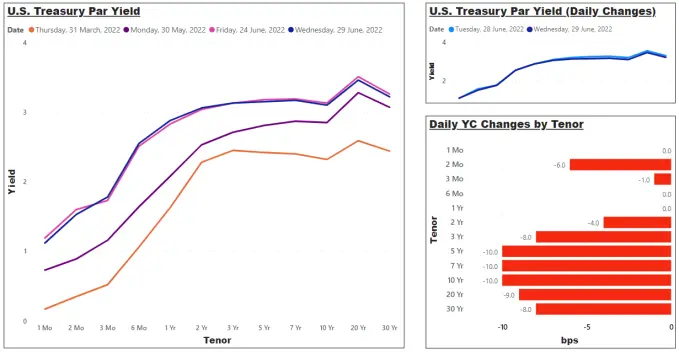
U.S. treasury par yield curve continues to flatten with its intermediate tenors (5-year to 10-year tenors) falling by 10 bps and near-term tenors (anywhere shorter than 2-year tenor) falling by a lesser degree. On the short-end of the curve, the largest fall is just 6 bps as observed on the 2-month tenor. This has resulted in a 6 bp fall in the 10-year - 2-year bond spread, risk of inverting the yield curve at any time soon. Yield curve inversion is often viewed by the market as a predictor of impending economic recession.
While the nominal par yield curve was falling, the real par yield curve, which is usually priced as nominal par yield minus expected inflation by the market convention was rising. Breakeven rates were all falling by double-digit bps across all tenors, signifying a greater chance of deflation.
(Note: 1 basis point (bp) = 0.01%)
2 main components that would impact bond market performances are interest rate decisions by the Federal Reserve (Fed) and the credit profile of the bond issuer.
A hawkish environment (an economic period where there are aggressive rate hikes, e.g. the year 2018) would exert downward pressure on corporate bond prices as borrowing costs are getting more expensive, and investors would prefer to park their money in the safe-haven government securities which now offer a higher yield. On the other hand, if rate hikes are the result of inflationary pressure due to an improving economy, the credit profiles of many bonds issuers are becoming better, hence, this would be positive for the corporate bond prices.
On the other hand, a dovish environment (an economic period where there are aggressive rate cuts, e.g. the year 2020 when there is a Covid-19 outbreak) would exert upward pressure on corporate bond prices as borrowing costs are getting cheaper, and investors would prefer not to park their money in the safe-haven government securities which now offer a very low yield due to rate cuts and would not mind taking some risks on corporate bonds in exchange of higher yield. On the other hand, if rate cuts are the result of an economic recession, the credit profiles of many bond issuers worsen, hence, this would be negative for the corporate bond prices.
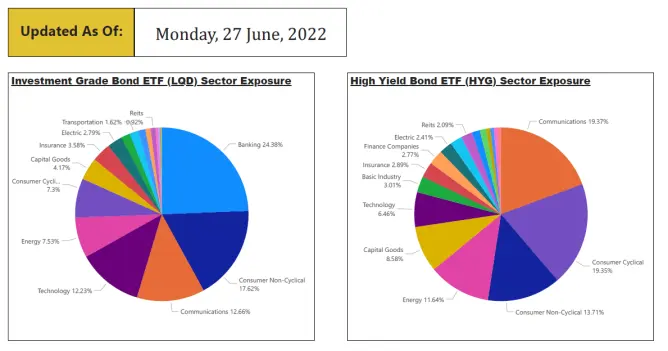
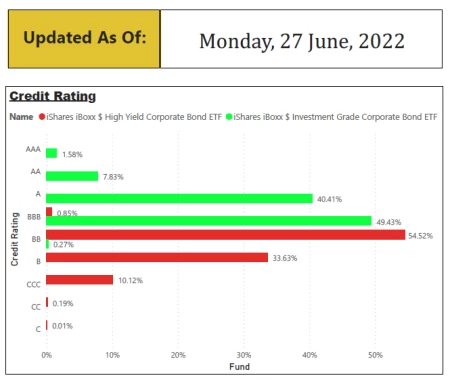
As shown above, the high-yield bond ETF (NYSEARCA: HYG) is exposed to more cyclical sectors and has more exposure to bonds that are rated BBB and below than the investment-grade bond ETF (NYSEARCA: LQD), therefore, subjected to a higher probability of default and hence more sensitive to the credit component. Investment-grade ETF is exposed to more stable sectors and has more exposure to highly rated bonds, hence less sensitive to the credit component but more sensitive to Fed's rate hike decision. When the economy is booming, high-yield bonds would usually outperform investment-grade bonds and the opposite would happen during a recession.
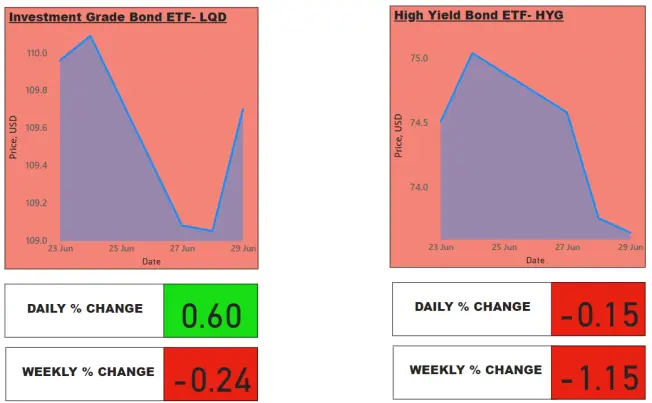
Investment-grade bond ETF, LQD increased by 0.60% as the yield curve fell and fixed income investors are reducing high-yield exposure while increasing their investment-grade exposure as a credit risk mitigation strategy in the bear market. On the other hand, the high-yield bond ETF, HYG fell by 0.15% as the market was pricing in worsened credit profiles and tightened cash flows across corporate bond issuers.
Commodities
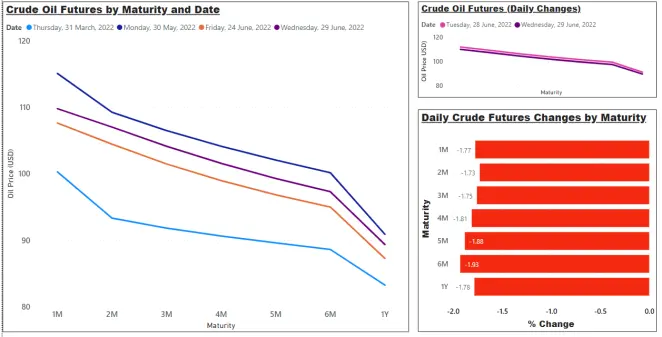
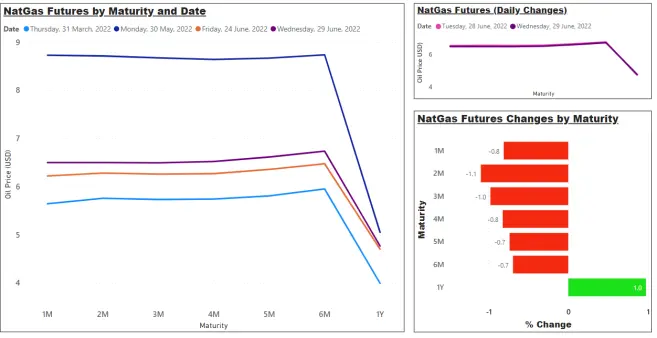
Both crude oil futures and natural gas futures suffered losses yesterday as the market is expecting an economic recession which would reduce the energy demand.
Equities
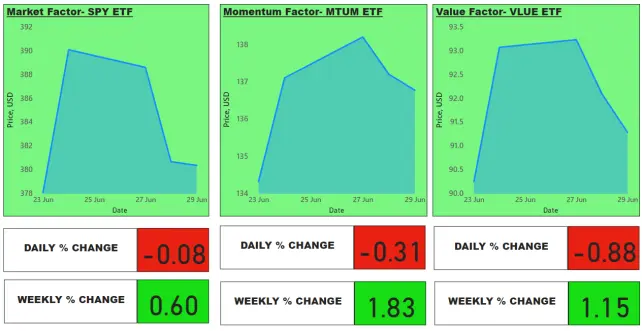
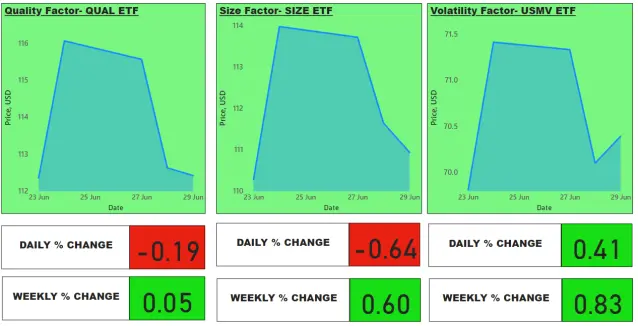
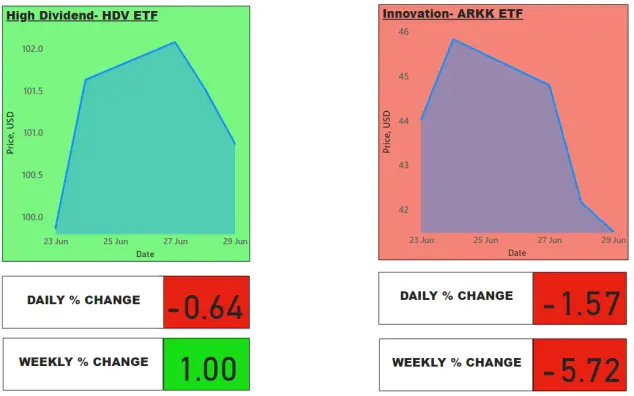
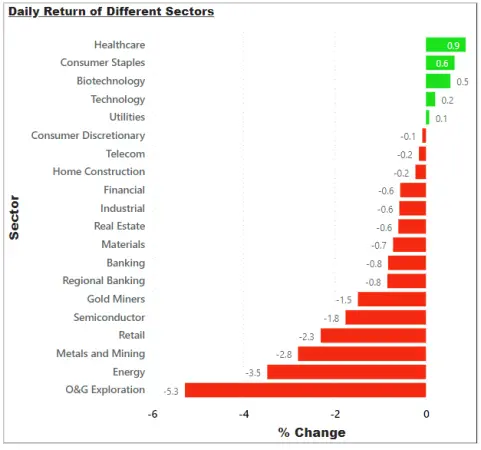
All factors are down except the volatility factor (represented by low-volatility iShares MSCI USA Min Vol Factor ETF, BATS: USMV) as investors fleeing high-risk stocks to relatively safer low-volatility stocks and low-volatility sectors (healthcare, utilities and consumer staples) amidst the bear market to reduce their downside risk. The innovation factor (represented by ARK Innovation ETF, NYSEARCA: ARKK) has fallen to a price level that is lower than its starting price a week ago.
Crypto
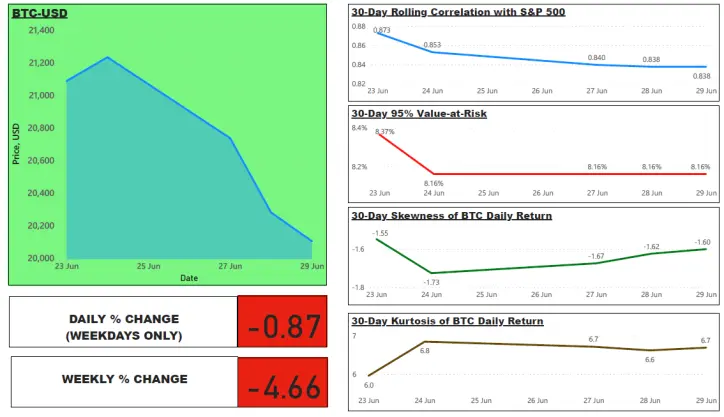
Bitcoin continued to fall by 0.87% yesterday. Although its correlation with S&P 500 index has decreased, it is still not a risk-off asset as its downside risk remains elevated with high values of negative skewness and being fat-tail (indicated by an increased kurtosis value over time).
Crypto news of the day:
1. Grayscale files suit against SEC following rejection of GBTC conversion bid
Source: The Block
Grayscale Investments has filed a lawsuit against the Securities and Exchange Commission, the United States regulator. The company announced on June 29 that it would challenge a decision by the watchdog to deny its bid to convert the Grayscale Bitcoin Trust (GBTC) into a spot bitcoin exchange-traded fund.
2. Hong Kong's OSL becomes the latest crypto exchange to cut jobs
Source: The Block
OSL, a licensed crypto exchange based in Hong Kong, has become the latest crypto exchange to cut jobs. The company has trimmed between 40 and 60 jobs, or about 15% of its workforce, two people familiar with the matter told The Block.
3. MicroStrategy scoops up 480 Bitcoin amid market slump
Source: Coin Telegraph
MicroStrategy (NASDAQ: MSTR) has added to its Bitcoin holdings, reaffirming CEO Michael Saylor’s bullish outlook on the digital asset despite its recent struggles. The business intelligence firm is scooping up Bitcoin during a period of extreme market volatility. With the purchase, MicroStrategy now holds 129,699 BTC, making it the largest corporate holder of Bitcoin. The total value of its holdings is roughly $3.98 billion.
4. Singapore-based Three Arrows Capital fails to pay debts – now under liquidation due to insolvency
Source: Vulcan Post
Three Arrows Capital has been ordered into liquidation by a court in the British Virgin Islands. Teneo has been appointed as “joint liquidators” of Three Arrows Capital through the court order. The fund had over US$3 billion worth of cryptocurrencies under management.
That's it! That's the market updates from me today, happy trading!
Connect with me at:
If you like my analysis and articles, you could follow me at @quantdoge for daily market updates like this.
Reference:
1. Thumbnail image here was downloaded from Unsplash, where credit is given to Ussama Azam, the creator of this photo.
2. https://www.cnbc.com/2022/06/30/us-bonds-treasury-yields-in-focus-amid-economic-data-auctions.html






