
It's that time again, where the US Congress bickers among themselves to try to agree on another increase of the debt ceiling to enable a spending plan on the order of $3.5 trillion. Depending on which side of the fence you fall on, the spending plan is either a way to build infrastructure and get the economy going again after Covid, or it's cash being spent on political and pork-barrel projects.
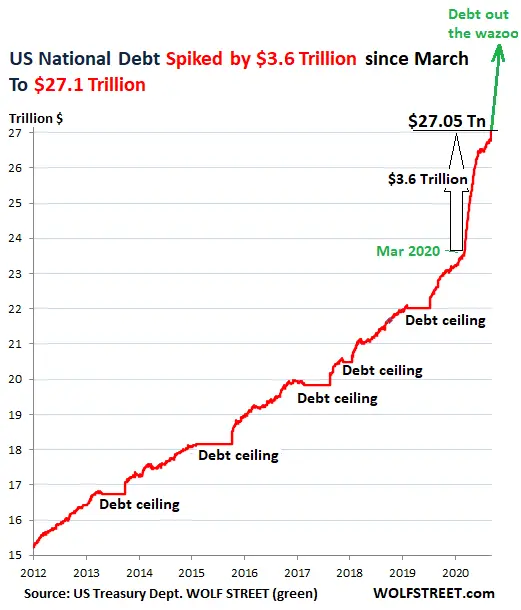
The debt ceiling itself is made of a combination of government and public debt, and represents the amount of debt which is allowed to be accrued by the US government. It is currently supposed to be about $22 trillion, but "Extraordinary Measures" (in other words, the need to cater for the costs of Covid) led to it being suspended for the last two years, until it was reinstated on 1st August, by which point it had grown to about $28.5 trillion. That's about $85,000 for every man, woman and child in the United States.
Below is a graph showing how fast US National Debt grew from 2012 to 2020 (so a little out of date already...).
The Congressional negotiations happen every two years, and it has become a bit of a ritual for the party that is not in power to try to block the inevitable increase unless they can get certain concessions. This time around, there is an additional twist as the two wings of the Democrat Party appear to also want to cut or include funding for certain programmes.
If there is no agreement to raise the debt ceiling, it means that the US government is not allowed to borrow any more money. At that point, payment of salaries of government employees and the military may be delayed, as well as payments to industry for government contracts, and payment of benefits and social services. So far, a very short period of this has been enough to get the two parties to agree, as public pressure and disapproval of the bickering builds up.
If the parties couldn't agree, then the Treasury would be unable to pay interest on it's borrowings and wouldn't be able to honour government bonds as they came due. At that point, the US would technically be in default. In the past, just the threat of this happening has led to the cost of government borrowing spiking (after all, who wants to lend money to someone who may not be able to pay it back) as well as significant falls on the Stock Exchange. If it actually happened, it would be the first time the US has ever defaulted on it's debt, and unless the situation was resolved incredibly fast (i.e. by the government finding a way to turn the money-printing taps back on), we'd be in uncharted territory.
But here's the interesting thing. Most of the US Dollars in circulation (around 30%) have been created out of thin air over the last 18 months or so. In crypto circles, we're used to nice deflationary assets, but out in the real world, governments seem to have no hesitation in creating huge amounts of inflationary pressure. Here's a graph showing growth in the US M2 money supply (scale in Billions of USD).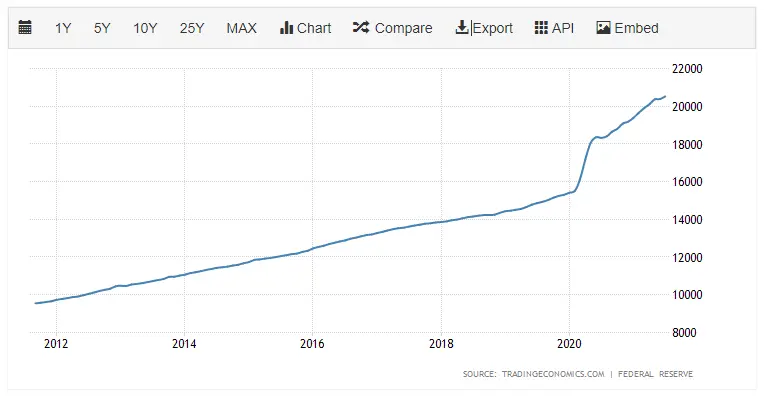
But here's the interesting thing; if you overlay the two graphs, the rate of debt growth is closely mirrored by the growth in the money supply.
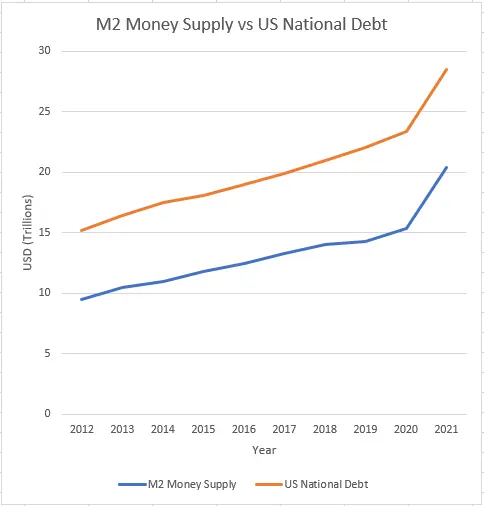
So the reality is that (again depending on your viewpoint) the government has successfully inflated away the growth in debt, or alternatively that the US dollar has devalued so fast that the debt in unchanged in real terms. This certainly doesn't bode well for the US dollar as a global reserve currency; I suspect the only thing saving it right now is that most other fiat currencies have been pumped up just as fast.
All of which just gives us even more reasons to get away from US dollars and stack deflationary crypto !






