
Transaction fees are going to become vital part of miners rewards (income) as the block rewards halves every four years. It is a reality that on-chain fees will continue to go up in order to compensate for lower block rewards for the miners. Transaction fees will incentivise miners to keep their machines on in the future. So we can say that transaction fees will play a big role in securing Bitcoin in the future as block rewards continue to go down every four years. So it is important to understand how fees work and how can you reduce them as a user.
Every bitcoin transaction must be added to the Bitcoin public ledger to be considered valid. The miners who employs specialised equipment (super computers) and electrical energy are responsible for recording all transactions on the Bitcoin public ledger. Miners are rewarded with block reward (currently 12.5 BTC per block) and all the fees on that specific block as they validate the transactions.
Bitcoin block has a limited capacity of 1 megabytes so there is a limited number of transactions that can be added at any given block. When a Bitcoin user sends a transaction it gets broadcasted on the network and then it will sits in the memory pool (mempool) for miners to pick for building blocks (validation).
It is worth knowing that Bitcoin transaction fees are determined by free market. Bitcoin users are free to set the fee rate that they are willing to pay. As indicated above, Bitcoin block space is limited and that makes it valuable, so when we pay fees we are buying permanent space on Bitcoin blockchain. So the fees do not depend on the value transferred but space consumed by the transaction. Below i will illustrate this with 3 simple sketches:
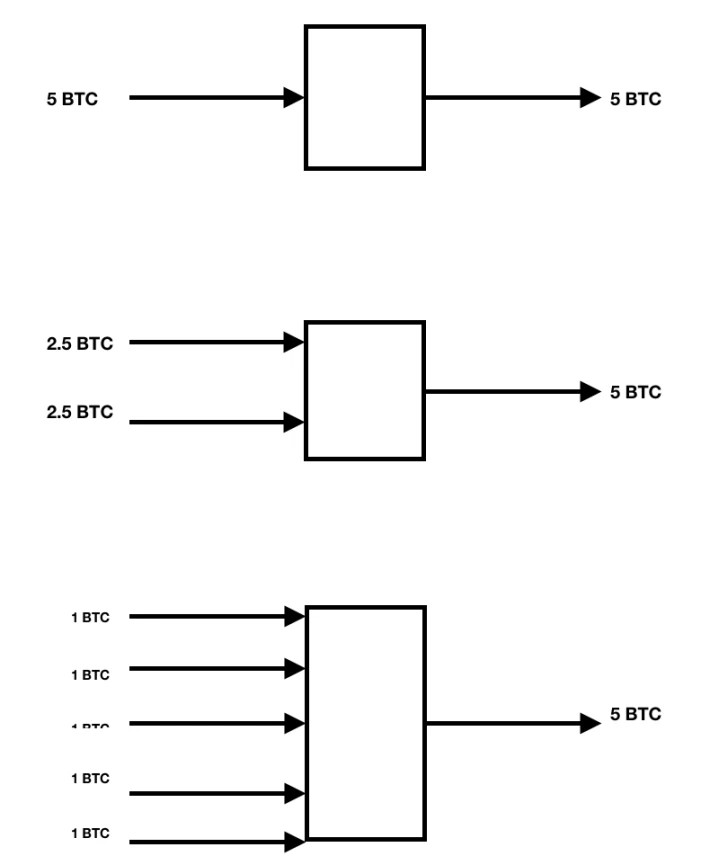
In these 3 scenarios I will assume that we are using the same type of a wallet address. In all 3 scenarios 5 BTC was sent from the address, so exactly the same value has been transferred. Arrows behind the box shows the way how the 5 BTC came into the address. These are called inputs. In this case, scenario 1 will pay less in fees compared to scenario 2 and 3, scenario 3 will pay the highest fees of all. The way it works is that all the inputs are combined first then a new transaction is made, so each input consume space.
Miners will always prioritise the transactions that are willing to pay high fees, that i where the free market comes in. If your transaction is urgent you can select to pay high fees to get high priority and if not then you can select low fees and wait.
So it is possible that a Billion dollar transaction can pay less in fees compared to a 100 dollar transaction.
Tips to reduce fees:
- Always make sure to check the current fees using a service like:https://www.buybitcoinworldwide.com/fee-calculator/
- Make sure that you use a wallet that you can specify the fee rate that you want to pay
- Combine small transactions when the mempool is low. You can achieve this by sending bitcoins that you have received in small chunks to yourself. Always do this process in advance before you need to do an urgent transaction. Select lower fee rate for this type of transaction.
- Use native segwit address to save up to 47% in fees.
- Have a lightining network wallet to use for small transactions






