
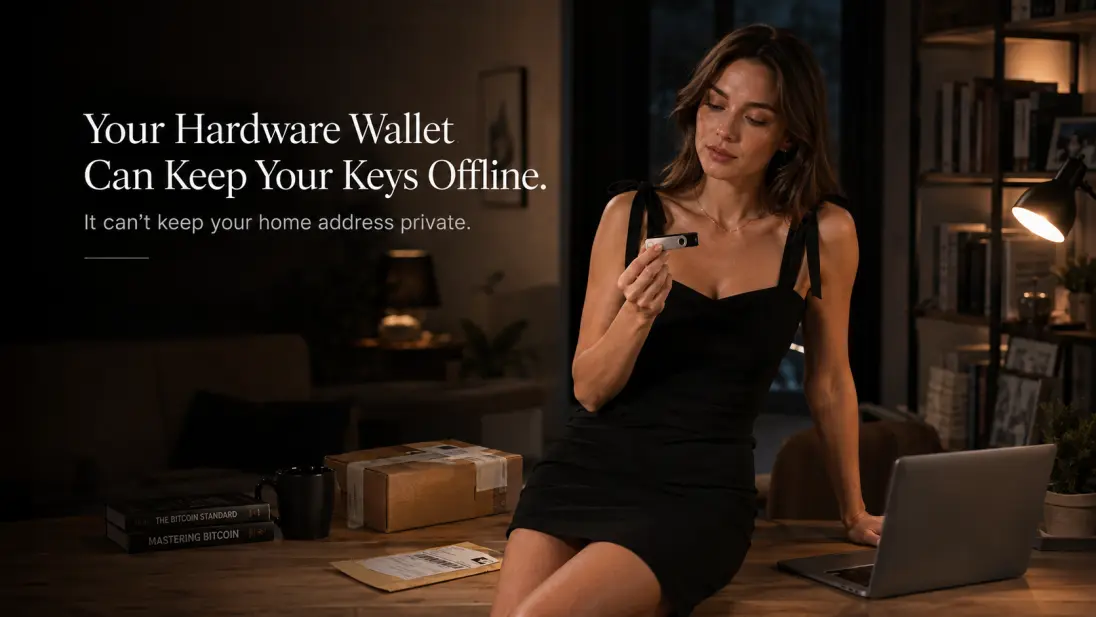
Nearly 14,000 Trezor customers just learned that self-custody has a security perimeter far bigger than the device in their hand.
The strange thing about hardware-wallet security is that we spend almost all our time thinking about the device.
Private keys.
Secure Elements.
Firmware.
PINs.
Recovery phrases.
Transaction verification.
Then something happens that has almost nothing to do with cryptography—and suddenly the entire threat model changes.
That happened this month.
Trezor disclosed that one of its shipping providers, ShipMonk, suffered a data breach exposing customer order information.
The Trezor devices themselves were not compromised.
The private keys were not extracted.
The recovery phrases were not leaked.
And yet this may still be one of the most important hardware-wallet security stories of the year.
Because for 11,742 customers, the exposed information included their name, email address, phone number, and shipping address. Another 1,947 customers had more limited information exposed. Trezor says approximately 13,689 customers were affected in total.
Think about what that means.
Someone may now know:
who you are.
where you live.
how to contact you.
And, by implication, that you bought a cryptocurrency hardware wallet.
No seed phrase required.
The Trezor Wasn’t Hacked
This distinction matters.
Trezor says the breach occurred at third-party fulfillment provider ShipMonk, not within Trezor's own systems. According to the company, no Trezor system, product, or service was affected, and its devices remain secure.
So describing this as:
“Hackers broke Trezor wallets”
would be inaccurate.
The hardware-wallet security model did not suddenly collapse.
But something adjacent to it did.
The logistics system responsible for delivering the hardware wallet contained information about the people buying those wallets.
And that raises a much broader question:
Where does the security boundary of self-custody actually end?
I don't think it ends at the hardware device.
Your Shipping Address Is Part of Your Crypto Threat Model Now
Imagine two databases.
Database A contains:
John Smith
123 Example Street
[email protected]
Not ideal if leaked.
But fairly ordinary personal information.
Now imagine Database B contains exactly the same information, except the context strongly suggests:
John Smith recently purchased a cryptocurrency hardware wallet.
That context changes the value of the information.
It does not reveal how much cryptocurrency John owns.
It does not prove he owns any cryptocurrency at all.
He could have purchased the wallet as a gift.
He could hold $50.
He could hold nothing.
But from an attacker's perspective, the information can still become a targeting signal.
Trezor itself warned that affected customers could face more sophisticated phishing through email, telephone calls, or even physical mail, including attackers impersonating Trezor, banks, or cryptocurrency exchanges.
That is a very different problem from trying to brute-force a hardware wallet.
Phishing Gets Much More Convincing When the Attacker Knows Who You Are
Generic crypto phishing is often terrible.
“Dear customer, your wallet has been suspended.”
Easy to delete.
Now imagine this instead:
“Hello Michael, we're contacting you regarding the Trezor order delivered to your address in June.”
The email contains your real name.
Maybe your real phone number.
Maybe your city.
Maybe it references a recent security breach.
Then it tells you that your wallet must be “secured.”
Or “migrated.”
Or “verified.”
And finally:
Enter your recovery words to protect your funds.
That message feels different.
The attacker is no longer guessing.
They possess enough accurate information to manufacture credibility.
This is why data breaches can be dangerous long after the original intrusion is over.
The stolen data becomes infrastructure for the next attack.
The Most Dangerous Scam May Arrive After the Real Security Warning
There is another problem.
Once a real breach becomes public, legitimate customers expect communication.
That creates an unusually useful environment for attackers.
The customer knows something happened.
The customer is already concerned.
The customer expects Trezor to contact them.
So imagine receiving another email tomorrow:
URGENT: Additional action required following the ShipMonk breach
Now the scammer does not even need to invent the security incident.
The incident is real.
They only need to invent the solution.
That is why urgency is such a useful social-engineering tool.
Fear reduces verification.
And crypto creates the perfect fear:
“Act now or lose your funds.”
Trezor's actual guidance is much simpler: affected users should remain alert for sophisticated phishing and never share or type their wallet backup online.
No legitimate data-breach response requires handing someone the words that control your wallet.
Then There Is the Physical Risk
This is where the story becomes more uncomfortable.
Crypto security is increasingly not only a cybersecurity problem.
Chainalysis reported earlier this month that approximately $30 million had already been stolen through violent crypto-related attacks in 2026. Through late June, it documented 46 such incidents globally.
Home invasions accounted for 37% of documented incidents in 2026, while kidnappings represented 52% under Chainalysis's classification.
And attackers increasingly appear to conduct reconnaissance.
Chainalysis says victims are often local residents rather than tourists, suggesting criminals may identify targets through leaked information, social media, blockchain analysis, insider information, or other intelligence sources.
That does not mean Trezor customers affected by this breach are about to face physical attacks.
There is no basis for making that claim.
But it does mean that the combination of:
real identity + residential address + crypto-related context
deserves to be treated as sensitive security information.
That is an inference supported by a threat environment in which exposed personal information is already being used to identify cryptocurrency holders.
A Perfect Hardware Wallet Cannot Fix an Information Leak
Suppose your hardware wallet is flawless.
The private key never leaves the device.
Your recovery phrase exists only offline.
Your PIN is strong.
You verify every transaction.
Excellent.
Now imagine someone knows:
your name,
your phone number,
your email,
your home address,
and that you probably own a hardware wallet.
Which hardware-wallet feature fixes that?
None.
Because this is no longer primarily a cryptographic problem.
It is an operational security problem.
That is what makes this incident interesting.
It exposes a security layer that hardware-wallet comparisons rarely discuss:
the metadata created by buying and owning the device.
Self-Custody Does Not Eliminate Third Parties
We often describe self-custody using a simple idea:
Remove the middleman.
Cryptographically, that can be true.
You control the keys.
The exchange does not.
The bank does not.
The custodian does not.
But buying a physical hardware wallet can still involve:
a payment processor,
an online storefront,
a logistics provider,
a courier,
email infrastructure,
customer-support platforms,
and other services.
Your Bitcoin may have no custodian.
Your shipping label still does.
That distinction matters.
Self-custody reduces one category of dependency.
It does not erase the ordinary commercial infrastructure surrounding the product.
Data Minimization Suddenly Looks Like a Security Feature
One detail in Trezor's disclosure deserves more attention.
Trezor says its fulfillment partners are required to delete or anonymize order information after 90 days. The company says this retention policy limited the amount of information available during the breach.
That is a useful lesson far beyond this specific company.
A database that no longer contains your information cannot leak that information later.
We normally think of privacy as:
“I don't want companies knowing things about me.”
Crypto gives privacy another dimension:
“I don't want unnecessary databases permanently connecting my real-world identity to cryptocurrency ownership.”
Data minimization becomes part of physical security.
Trezor Is Already Changing the Delivery Model
Trezor says it plans to introduce an “Anonymous Delivery” option using features such as locker pickup, neutral packaging, generic sender details, and deletion of shipping identifiers after delivery.
The company currently says it aims to introduce the option in the EU by September 2026 and in the United States by the end of 2026.
That is interesting because it reflects a broader realization:
Hardware-wallet privacy begins before the wallet arrives.
Not after setup.
Not after the recovery phrase is created.
At checkout.
If You Were Affected, Don't Panic
The worst response to a security incident is panic-driven wallet activity.
The fact that contact information was exposed does not mean your seed phrase was exposed.
It does not mean you need to immediately restore your wallet.
It does not mean you need to generate a new seed simply because your name appeared in the breach.
Trezor says affected customers were contacted from its official help address, and that customers who did not receive the notification were not affected according to its current investigation.
The immediate security problem is therefore primarily targeting and impersonation, not evidence that wallet keys were stolen.
For an affected user, I would think about the next few months like this:
- Treat unexpected Trezor-related emails, calls, texts, and letters as potentially hostile.
- Never enter the wallet backup into a website or send it to “support.”
- Do not install software because an unsolicited message tells you to.
- Verify unusual security notices through independently accessed official channels.
- Avoid publicly connecting your identity with wallet balances or large cryptocurrency holdings.
- Reconsider whether information visible on social media makes your home, family, or holdings unnecessarily easy to profile.
The important rule is:
The breach is real. That does not make every message about the breach real.
Your Home Address Cannot Be Rotated Like a Seed Phrase
This is the part I find most uncomfortable.
A compromised seed phrase has a technical response.
Generate a fresh wallet.
Transfer the assets.
Retire the old seed.
A leaked email address can sometimes be replaced.
A phone number can be changed.
But a residential address is different.
For many people, it is not something they can simply rotate tomorrow.
That makes prevention particularly valuable.
Once physical location data leaves your control, no firmware update can make everyone forget it.
Maybe We Have Been Defining “Cold Storage” Too Narrowly
When people say cold storage, they usually mean:
Keys offline.
That's important.
But perhaps long-term self-custody needs a broader definition.
Your security system also includes:
your physical location,
your privacy,
your public blockchain footprint,
your recovery storage,
your purchasing metadata,
your family,
and the information that connects all of those things together.
A hardware wallet protects a key.
It does not erase your identity.
The Question I Would Ask Before Buying My Next Wallet
Not:
Which device has the best chip?
Not:
Which wallet supports the most coins?
Not even:
Which wallet has the best interface?
I would add another question:
What information must I reveal simply to acquire this product?
Who receives it?
How long is it stored?
Which third parties receive it?
Can I use a pickup point?
Can unnecessary data eventually be deleted?
Those questions may sound like privacy obsession.
In 2026, I think they increasingly belong in the same conversation as seed phrases and Secure Elements.
Because the security objective is not merely:
keep attackers away from the private key.
It is also:
give attackers as little reason and information as possible to target the person holding it.
The Most Important Lesson From the Trezor Breach
Trezor's hardware was not the thing that failed here.
That is precisely why this story matters.
It reminds us that a hardware wallet lives inside a much larger system.
Cryptography.
Software.
Recovery.
Logistics.
Identity.
Physical security.
Human behavior.
You can secure one layer exceptionally well and still discover that another layer matters more than you expected.
Your private keys can remain completely offline.
And somebody can still learn where you live.
That is not a reason to abandon self-custody.
It is a reason to understand it more completely.
One question for the comments:
When you buy cryptocurrency hardware, do you think about the privacy of the purchase itself—or only about security after the device arrives?
I'm curious whether this incident changes how anyone here plans to order hardware wallets in the future.
Please don't share your address, holdings, wallet addresses, recovery phrase, or physical storage locations.
Security disclaimer: This article is for educational purposes only. The ShipMonk incident did not compromise Trezor hardware wallets or expose users' wallet backups according to Trezor's current disclosure. Never provide a recovery phrase, private key, PIN, or passphrase in response to an unsolicited email, phone call, text message, letter, website, or support request.






