
Subtitle:
It sounds like cutting corners. For standard English BIP39 recovery phrases, it is actually part of how the wordlist was designed.
When I first saw a metal seed backup that stored only four letters of each recovery word, my reaction was immediate:
That sounds risky.
If my recovery phrase says:
abandon
why would I intentionally store only:
ABAN
Why throw away information from something as important as a wallet backup?
It feels backwards.
Crypto security normally tells us to preserve everything exactly.
But then I went back to the actual BIP39 specification.
And this is where the idea becomes much more interesting.
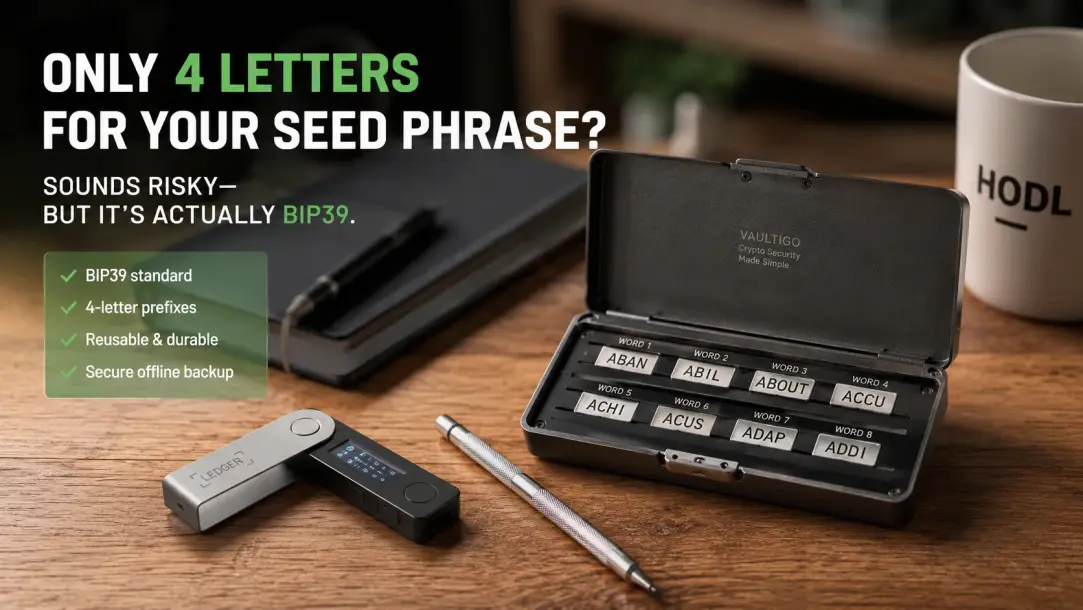
The First Four Letters Are Not an Arbitrary Shortcut
BIP39 is the standard behind many familiar 12- and 24-word wallet recovery phrases.
Its wordlist was deliberately designed so that words can be identified unambiguously from their first four letters.
So with the standard English BIP39 list:
ABANDON → ABAN
ABILITY → ABIL
ABOUT → ABOU
Those prefixes are enough to distinguish the intended words inside that wordlist.
That means a four-letter physical backup is not necessarily “half a seed phrase.”
It is a compact representation of the same BIP39 recovery information.
That distinction matters.
But There Is an Important Limitation
This is not a rule I would blindly apply to every wallet.
The four-letter method only makes sense when you know what recovery format you are dealing with.
Different wallet systems can use:
- different wordlists,
- different languages,
- proprietary recovery formats,
- or recovery systems that are not BIP39 at all.
And even within BIP39, I would never assume that a shortcut designed around one wordlist should automatically be used for every language or implementation without checking it first. The BIP39 project itself documents language-specific considerations.
So the rule is not:
“Always store four letters.”
It is:
“For a confirmed standard English BIP39 phrase, four-letter prefixes can uniquely identify the words.”
Much safer wording.
Word Order Still Matters Completely
There is another misconception worth avoiding.
Suppose your recovery phrase contains the correct 24 words.
But word 6 and word 7 are swapped.
That is not the same recovery phrase.
The four-letter method does nothing to change that.
You still need:
the correct prefix
in the correct numbered position
for every recovery word.
This is why a physical backup system needs more than a pile of letters.
It needs an unambiguous ordering system.
Why I Started Looking at This in the First Place
Most metal seed backups fall into a few familiar designs.
Some require a hammer.
Some require letter punches.
Some require engraving.
Some use a grid where you mark positions.
Those systems can work well.
But they also introduce a very human problem:
permanent mistakes.
Hit the wrong letter?
Stamp the wrong row?
Misalign a character?
Now you are deciding whether to live with the error or start again.
That is one reason the four-letter system interested me.
Fewer characters means fewer things to physically record.
And a reusable design changes the setup experience further.
The Product We Built Around This Idea
At CryptoSafeKit, our VAULTIGO 4-Letter Metal Seed Phrase Backup uses this exact approach.
It is designed for standard English BIP39 recovery phrases and uses reusable metal letter tiles rather than requiring users to permanently punch or engrave every character.
The idea is simple:
- identify the first four letters of each BIP39 word,
- place them in the correct numbered position,
- verify the sequence carefully,
- close the backup,
- keep it offline in an appropriate secure location.
The product uses stainless-steel construction and a lockable physical structure, but I think it is important to be precise about what that means.
It is a physical recovery backup.
It is not a hardware wallet.
It does not generate private keys.
It does not connect to a blockchain.
It does not make phishing impossible.
And it does not make a stolen recovery phrase harmless.
That separation matters.
VAULTIGO 4-Letter Metal Seed Phrase Backup
Metal Solves a Different Problem Than a Hardware Wallet
I think this is where crypto marketing often gets confused.
A Ledger, Trezor or another hardware wallet is primarily trying to improve the security of key generation and transaction signing.
A metal recovery backup is trying to solve another question:
What happens when the hardware wallet disappears?
Paper is cheap and simple.
But paper can also be:
- soaked,
- torn,
- faded,
- burned,
- misplaced,
- or accidentally discarded.
A metal backup can improve physical durability compared with ordinary paper.
But metal does not prevent someone from stealing or reading the backup.
That is why storage location and access control still matter.
The Four-Letter Design Does Not Make the Seed Stronger
This is another point I would never exaggerate.
If you take:
ABANDON
and store:
ABAN
you have not increased the cryptographic strength of the seed.
You have changed how the recovery information is represented physically.
The security of the seed still depends on how it was originally generated.
The four-letter format is primarily about:
compactness
organization
physical recording
and reducing unnecessary characters
—not stronger entropy.
CryptoSafeKit's own current seed-backup guide makes the same distinction: a four-letter metal system can simplify the physical workflow, but it does not somehow create a “stronger” recovery phrase.
The Real Advantage May Be Fewer Setup Mistakes
This is actually the part I find most compelling.
People often compare seed backups using dramatic claims:
fire.
flood.
crushing.
extreme temperatures.
Those things can matter.
But many users will never experience a house fire.
Every user has to correctly record the recovery phrase.
That means usability itself becomes part of the threat model.
A system that is theoretically durable but easy to record incorrectly may create its own failure mode.
For me, the question becomes:
How difficult is it to create an accurate backup the first time?
Fewer characters and a correctable tile-based workflow are interesting for exactly that reason.
Would I Throw Away My Original Backup Immediately?
No.
If I were changing an existing recovery system, I would not destroy the old backup five seconds after assembling a new one.
I would first verify that the new physical backup has been recorded accurately using an appropriate offline verification process.
Security transitions deserve caution.
A backup should be treated as untrusted until you have verified it.
That applies whether the backup is:
paper,
steel,
titanium,
a capsule,
or four-letter tiles.
There Is Also a Privacy Question
A compact backup is easier to store.
That can be useful.
But smaller does not automatically mean safer.
You still have to decide:
Who can access it?
Does anyone know what it is?
Is it stored beside the hardware wallet?
Could one burglary expose both?
Could someone photograph it without removing it?
A metal object can survive water and still fail because someone copied it.
Again:
durability and secrecy are different security properties.
I Think We Overcomplicate Recovery
Crypto users love elaborate security setups.
Multiple wallets.
Passphrases.
Hidden wallets.
Multiple locations.
Secret labels.
Complex recovery instructions.
Sometimes that complexity is justified.
Sometimes it simply creates more ways for the legitimate owner to fail.
That is why I increasingly prefer recovery systems that are:
offline
durable
easy to audit
simple to understand five years later
The most sophisticated setup is not automatically the safest setup.
The safest setup is often the one you can still recover correctly when you are tired, stressed and using replacement hardware years from now.
Four Letters Sound Wrong Until You Understand Why
That is probably the reason I like this topic.
If someone simply tells you:
“You only need four letters.”
it sounds reckless.
Once you understand the structure of the BIP39 wordlist, it becomes logical.
Not magical.
Not universal.
Just a compact way of representing known recovery information for the right format.
And that is how I think security products should be discussed:
Explain the limitation first.
Then explain the benefit.
One Question for the Comments
I'm genuinely curious about this one:
Would you trust a four-letter BIP39 metal backup, or would seeing only four letters make you uncomfortable even after knowing how the wordlist works?
And if you already use metal:
Do you prefer stamping, punching, engraving, tiles, or index-based systems?
I'm interested in what people actually trust with a 10-year recovery plan.
Please don't post real recovery words, private keys, wallet addresses, passphrases, or backup locations in the comments.
Security disclaimer: This article is educational. The four-character approach discussed here is intended for recovery formats where the relevant wordlist supports unique prefix identification; the VAULTIGO product discussed is specifically designed around standard English BIP39 recovery phrases. Always confirm your wallet's actual recovery standard before relying on an abbreviated physical backup. Never enter a recovery phrase into CryptoSafeKit, a product-registration form, cloud document, direct message, or unsolicited website.





