
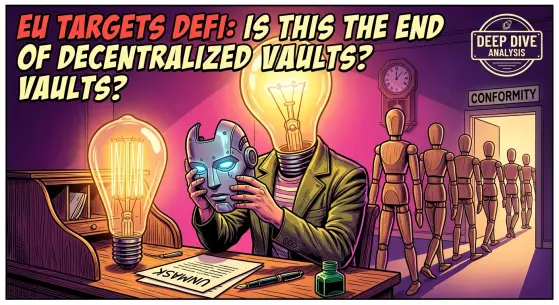
The European Commission has launched a crucial public consultation to evaluate expanding the MiCA (Markets in Crypto-Assets) framework over sectors originally left outside its initial scope. At the top of their target list are crypto lending and liquidity vaults within the DeFi ecosystem. The core problem troubling regulators in Brussels is straightforward yet highly complex: how can capital requirements, licensing, and CASP rules be enforced on autonomous smart contracts and lending vaults where no centralized entity exists?
The Challenge of "Pure Decentralization" Under MiCA
The MiCA framework was created to impose strict compliance standards on service providers (CASPs) and token issuers. However, lending vaults operate via immutable code. Regulators are struggling to determine who should be held accountable: the original core developers, governance token holders voting on parameters, or the front-end user interfaces?
European authorities are attempting to define the boundary between "fully decentralized" protocols and those merely using decentralization as a marketing facade. If a protocol retains admin multisig keys or concentrated governance control, regulators are unlikely to view it as pure DeFi, bringing it directly under MiCA's regulatory enforcement.
Practical Impact for Investors and DeFi Protocols

Bringing lending vaults into scope introduces immediate consequences for market liquidity and yields:
-
Collateral and Stablecoin Pressure: As non-compliant stablecoins face restrictions in the European market, lending vaults accepting unapproved collateral may restrict EU users.
-
Front-End Compliance (KYC & Geofencing): Protocol interfaces may be compelled to enforce identity checks (KYC) or geofencing to avoid severe administrative penalties.
-
Ecosystem Bifurcation: The market will likely split into institutional-grade CASP-compliant protocols and hyper-strict, immutable vaults operated solely by DAOs without human intervention.
4. CONCLUSION & FINAL INSIGHTS
Brussels' push to encompass DeFi lending vaults under the MiCA umbrella will test the physical reach of state regulation over immutable smart contract code. Over the coming months, legal clarity regarding who bears responsibility for an autonomous vault will determine how institutional capital flows across Europe.
What are your thoughts on this regulatory move? Will regulating DeFi lending bring the compliance needed for institutional capital to enter, or will it destroy the core ethos of decentralization? Share your thoughts in the comments below and follow our profile on Publish0x for daily crypto insights!






