
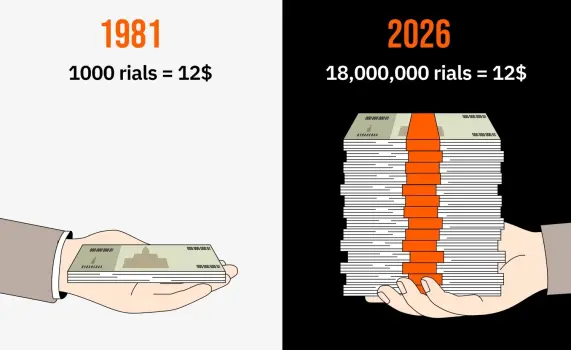
With inflation at 52% and food prices rising by 75%, the Iranian rial is in free fall. According to the Financial Times, the country is now printing 10-million-rial notes to replace the 5-million-rial notes. The new note, worth roughly $7, is already in circulation as long queues form at ATMs, many of which are running dry. This is a sign of hyperinflation, as the currency's ongoing collapse.
The Hidden Cost of State Violence B
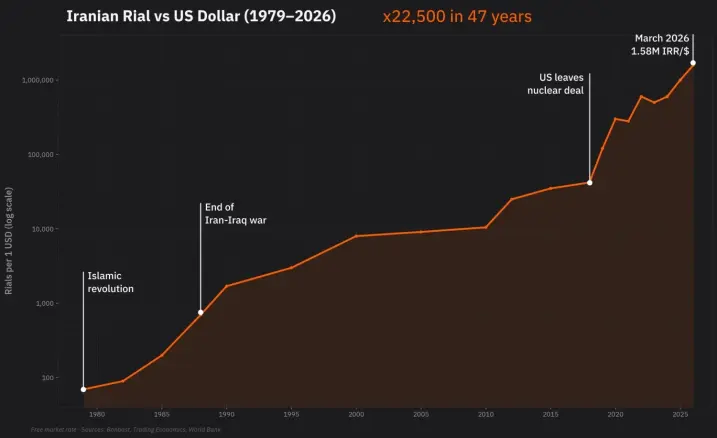
ut the fall of the Iranian rial cannot be explained solely by the collapse of oil revenues, international sanctions, or the financial stranglehold caused by war and diplomatic isolation. The Iranian economy was already on the brink of collapse even before the conflict with Israel and the United States began. For over forty years, the Mullahs' regime has massively printed local currency to finance weapons, militias, and the security apparatus. This money creation erodes purchasing power through inflation and the depreciation of the rial, which we see today in high inflation, a black market for dollars, and the collapse of the national currency.
In Iran, the war is no longer financed by accumulated wealth, but by the systematic dilution of monetary value, turning every Iranian household into an unwitting contributor to a permanent war effort. This paradox lies at the heart of the regime's survival: while the real economy is suffocating under sanctions and civilian infrastructure is withering away, the military apparatus of the Revolutionary Guards and regional militias continues to thrive. It is no longer citizens' savings that fuel the guns, but rampant inflation acting as an invisible wealth transfer mechanism.

Fiat Money as an Infinite Budget Line
The shift from a physical standard to fiat money has radically altered the grammar of state violence. Since fiat money can be created at virtually no cost, it allows authorities to transform what should be an extraordinary national effort into a mere administrative formality. This strategy is not new in Iran; it has its roots in the survival tactics of the Iran-Iraq War in the 1980s, which set the precedent for financing through monetary expansion rather than real production. In a constrained system, financing a war would require either massively raising taxes — a politically explosive decision — or borrowing on global markets. Here, fiat currency acts as a silencer on the political friction of the conflict. By monetizing the deficit, the regime appropriates the residual value of the economy without ever having to justify the real cost of its military ambitions.
For authoritarian regimes, this capacity for unlimited money printing is a lifeline. It keeps intelligence services and the Revolutionary Guards afloat, even when oil revenues collapse. War then becomes a dehumanized expense, a column of numbers disconnected from the material reality of citizens.
Inflation: The Hidden Tax on Citizens
If the state does not collect money directly through taxes, it recoups it through the loss of purchasing power. This is the brutal socialization of the cost of war. The government spends the new rials first, at full price, to buy weapons or pay militias. By the time these bills reach the citizen's pocket, prices have already skyrocketed, and the value of their labor has evaporated. The rial's collapse against the dollar is no mere hiccup, but outright plunder. In the streets of Tehran, anxiety is written on people's faces as they look at the black-market exchange rates, where Iranians see their life savings melt away in a matter of weeks. This "shadow tax" is a silent expropriation that hits the kitchen table directly.
The victims of this system are the pillars of civil society:
- Wage earners: Whose fixed incomes become mere accounting fictions in the face of daily increases in the prices of basic goods.
- Savers: Punished for trusting the national currency, watching their assets turn into worthless paper.
- Small business owners: Caught between import costs pegged to the dollar and a local customer base whose purchasing power has been wiped out.
This mechanism allows the government to finance repression and foreign conflicts without seeking the consent of a population that, overwhelmed by the daily struggle for survival, no longer has the energy to challenge the financial cost of these policies. Bitcoin: A Refuge from the Printing Press In contrast to the infinite flexibility of fiat currency, Bitcoin offers an alternative based on mathematical scarcity. With a supply strictly limited to 21 million units, it imposes a constraint that governments cannot ignore: Bitcoin cannot be printed to plug a military budget hole.
If a state decided to finance a prolonged conflict using Bitcoin, it would lose its usual opacity. To obtain funds, it would have to either tax its citizens explicitly and visibly or convince lenders in a transparent market. Thanks to on-chain traceability and public addresses, the financing of war would become subject to perpetual audit. Bitcoin's public ledger acts as a financial watchdog that even an authoritarian regime cannot censor or corrupt.
Bitcoin does not eliminate war, but it strips governments of the ability to finance it through opacity and surprise inflation.
Furthermore, by offering citizens refuge, Bitcoin limits the state's ability to capture all domestic wealth. If part of wealth escapes the national banking system, the regime has fewer levers to dilute private savings for the benefit of its security apparatus. The Iranian Paradox: Between Citizen Survival and Sanctions Evasion In Iran, Bitcoin is not a theory; it is a battlefield. According to CoinDesk, the country has built a $7.8 billion crypto ecosystem — and the recent conflict has thrown it into the spotlight. There, we observe a fascinating duality where technology simultaneously serves the oppressor and the victim.
- On one hand, the regime has seized the opportunity. By exercising a monopoly over the national energy infrastructure, the state and the Revolutionary Guards divert the country's resources to fund cryptocurrency mining. This digital "war chest" generates direct revenue to circumvent sanctions. Moreover, the use of stablecoins for foreign trade provides the regime with financial channels that are more stable and just as opaque as the traditional banking system for their strategic transactions.
- On the other hand, for the population, Bitcoin is a "barometer" of collapse. As Wired reports, Iran's crypto sector has been a lifeline through sanctions — but war could shut it down. It is the ultimate bulwark against a central bank whose priorities are purely military. It is a tool of silent resistance that allows value to be stored beyond the reach of inflation. Bitcoin has thus become, paradoxically, both the survival tool of the dispossessed citizen and the circumvention tool of a state in a crisis.
Conclusion: Toward a Currency of Peace?
Fiat currency acts as a catalyst for violence in Iran by enabling opaque financing of conflicts, the real cost of which is socialized through inflation. By severing the link between the war effort and real savings, it makes violence administratively easy. Conversely, Bitcoin reintroduces a rigor that makes the costs of violence explicit, visible, and, consequently, politically risky. While Bitcoin offers an individual escape route and imposes a new transparency, it remains a fragile tool during a complex battlefield — Operation Epic Fury has shown how quickly geopolitical events can reshape the crypto landscape in the region.
One question remains: could the separation of money and the state — by making war terribly expensive and impossible to mask through inflation — one day render large-scale conflicts obsolete? Or will brute force always find a way to circumvent the constraints of monetary scarcity to impose its will? Go deeper with Plan ₿ Academy** These topics are explored in depth in free, open-source courses on Plan ₿ Academy — the largest Bitcoin education platform in the world, with 47 courses in 30+ languages:
Are you an educator? Want to teach your students about hyperinflation with real-world examples? Browse the Hyperinflation Bill Collection — a free teaching resource shared by the community. You'll find more slides, lesson plans, and workshop materials on Educator Content, all free and open to reuse.






