Imagine this: You open your crypto wallet one day and find your assets haven’t just dipped in value — they are gone. Transferred out. Empty.
Your first reaction might be shock. Many people subconsciously believe this won’t happen to them, or that it’s just a case of “bad luck” for specific projects.

But to be honest, in today’s landscape, explaining on-chain theft as “bad luck” is becoming naive.
Today, we need to have a serious conversation about a reality that is becoming increasingly severe: On-Chain Fund Security.
To be more precise: Hackers are treating the entire crypto world as a long-term, operational ATM.
A Figure We Must Confront
First, let’s look at a glaring statistic.
In 2025 alone, the scale of stolen crypto assets globally exceeded $3.4 billion. These funds weren’t pilfered by countless small-time hackers in scattered incidents; they were drained in a few concentrated, high-intensity attacks.
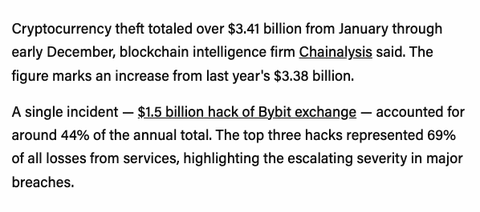
Even more alarming is that approximately $2 billion of this has been explicitly attributed by on-chain security firms to state-sponsored hacking groups linked to North Korea.
What does this mean? It means that in today’s Web3 world, the entity attacking your assets is no longer just a solo tech geek. It is likely an organized, planned, state-level adversary with long-term objectives.
The Hacker’s Strategy Has Shifted
If you compare on-chain attacks over the past few years, a clear trend emerges. Hackers in 2025 have not become more frequent; they have become more “disciplined.”
They no longer expose themselves for a few million dollars from minor bugs. Instead, they deliberately reduce attack frequency, waiting for the real opportunity to strike hard. Simultaneously, their targets have fundamentally shifted. They are moving away from surface-level smart contract bugs toward:
- Core Exchange Permissions
- Multi-Sig Management Processes
- The Human Element — the most overlooked and fragile link.
The Real Vulnerabilities Are Rarely On-Chain
Yes, often the problem isn’t the code; it’s the people.
Your email security habits, how you store private keys, or a tiny oversight in internal processes can all be the starting point for a total asset drain. This is why you often see projects emphasizing after the fact: “Our contracts were safe.”
But the reality remains: The users’ money is gone. Because the real problem was never on-chain.
If we zoom out to the entire DeFi ecosystem, the situation is equally grim. Since 2022, direct losses from security issues in DeFi platforms have exceeded $7 billion.
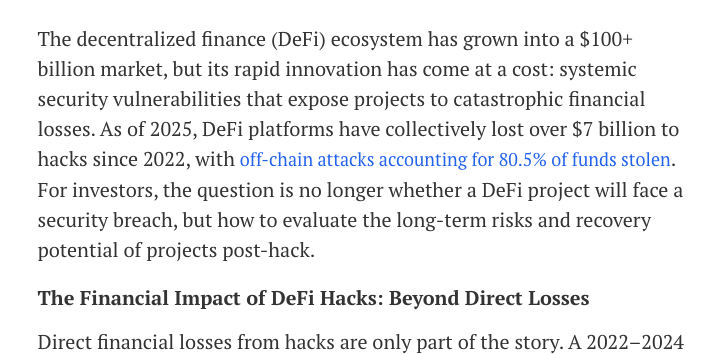
Over 80% of these attacks were not due to errors in the smart contract code itself. They were typical off-chain issues that were amplified and eventually settled on-chain. For example:
- Flawed multi-sig permission design.
- Over-reliance on centralized servers for key management.
- Key personnel falling victim to social engineering.
The result can be summarized in one sentence: Off-chain errors, on-chain consequences.
It’s Not Just Money That Destroys Projects
Often, what truly destroys a project is not the stolen funds, but the loss of Trust.
In the crypto market, once trust collapses, it triggers a chain reaction: token price crashes, TVL drains, users panic, and regulatory pressure mounts.
Frequently, the value evaporated due to the market’s loss of confidence exceeds the amount the hacker actually stole. This is why we say on-chain security is never just a technical issue; it is a trust issue.
Attacks Are Still Evolving
Entering 2025, attack methods continue to evolve. Social engineering is combining with technical exploits. Multi-sig permission paths are being systematically studied. We are even seeing attacks utilizing AI to automatically generate phishing content.
To put it bluntly: Hackers are not just upgrading their tools; they are upgrading their understanding of human nature.
What Should We Do?
This reality makes Web3, which already has a high barrier to entry, increasingly difficult and risky for the average investor.
If you haven’t truly stepped into this field yet, perhaps the best move before acting on impulse is to keep your wallet closed for a moment. Learn the basics of Web3. Understand the fundamental logic of on-chain security, risk control, and governance.
This is exactly why, in Synbo’s design philosophy, we have always placed on-chain security and governance at the forefront. This includes:
- Multi-level Governance Structures
- Multi-Sig Security Mechanisms
- Traceable, Verifiable, and Auditable On-Chain Behavior
- Economic Models that Bind Incentives with Constraints
Our logic is simple: We don’t expect a world without risk, but we must ensure that risk does not spiral out of control.
Survival Is the Core Skill in Web3
Looking back at the string of hacking incidents in 2025, a conclusion becomes increasingly clear: In the Web3 world, living long is becoming more important than running fast.
True Alpha often comes from risk controls that aren’t written in the whitepaper. So next time, when you are hesitating about whether to participate, ask yourself:
If the hackers really come, are you ready?
This is Synbo. We care about growth, but we care even more about whether the ecosystem can develop over the long term, healthily and safely.
(By the way, if reading this made you subconsciously check your wallet — congratulations. You have started thinking in the Web3 way.)