
Compared to the slow, saturated network that Ethereum is circa early 2021, using ZKSwap feels magical - it feels like you're using early generation ETH or what ETH was intended to be.
Disclaimer: Author is not a financial advisor and as an investor, is long on ZKS. While the author is not associated with the ZKSwap Organization, the author is biased in favor of ZKS.
Correction: L2 Gas Fees for transactions are free! There's a 0.3% transaction fee but no gas fees once you move your funds from L1 ETH to L2 ETH.
Today I'll be providing the world's first review of the ZKSwap App and DEX (Decentralized EXchange), which is the front end for the first Ethereum Layer 2 DEX/AMM built on ZK-Rollup technology. It's based on a ZKSwap protocol that is open source and available for use by others that has had the benefit of having proprietary development work performed on it by the ZKSwap Organization. This organization is a loose confederation of Defi entrepreneurs, programmers, and engineers with plans for decentralized governance via a DAO and utility coin called ZKS.
Launched two days ago on Valentines Day as a Version 1.0 DEX/AMM, ZKSwap is meant to be a very high speed ETH "side chain" and marketplace that features much higher Transactions Per Second (TPS). This higher throughput is combined with much lower fees than a typical Ethereum transaction on a DEX such as Uniswap, Sushiswap, or even 1inch (using CHI tokens to reduce gas fees). ZKSwap currently supports 30 different tokens, with support planned for 100 tokens.
While Ethereum 2.0 is meant to eventually help with the scaling and network congestion issues seen on the ETH network, high gas fees have become consistently problematic for DEXs and Defi, with no relief in sight in the near term. This problem has become so big that it has become an existential threat to all DEXs and it curtails further Defi adoption and use until this issue is fully addressed.
Enter ZKSwap
For active traders using Layer 2 supported tokens such as UNI, ETH, and ZKS, repetitive trades (or moves) of L2 tokens can cost as little as 1 to 2% of the cost on the Layer 1 Ethereum mainnet, for that same transaction.
ZKSwap is one solution that addresses high gas fees that's available today, and not in a year or two. What's different about this solution is that being feature complete: it's both production ready and available today, unlike ETH 2.0 which won't be complete for multiple years. For active traders using Layer 2 supported tokens such as UNI, ETH, and ZKS, repetitive trades of supported tokens can cost as little as 1 to 2% of the cost on the Layer 1 Ethereum mainnet, for that same transaction.
Like many investors in Defi, I allocate or reallocate my funds based on new or existing opportunities, which means that to do these trades I must incur high gas fees (or wait for slower periods when gwei prices are lower). I'm not a day trader, but I also don't sit idle when there's crypto to be made during a bull run. I'm not afraid to take profits or cut my losses from time to time, and I'm active in both Cefi and Defi in about equal measure.
As a side-chain to Ethereum, ZK-Rollup technology allows an L2 DEX like ZKSwap to match or exceed the transaction speed of the entire Ethereum network on its own. It is also infinitely scalable via sharding, should the need arise.
Instead of spending 32% of my ETH on gas to buy about $151 worth of ZKS, I only spent 3.6% of my funds - or about one-tenth the percentage of a smaller Uniswap trade - by moving my ETH to ZKSwap and executing a larger ZKS trade there (vs. a ZKS trade at Uniswap.)
Below is a picture of an example of a proposed trade of $151 worth of ETH on Uniswap for 41.9 ZKS tokens. ZKS is the native utility and governance token of ZKSwap.
At this very early stage in the project's development ZKS is only available on a few select exchanges and DEXs, meaning that you're not buying this particular (potential) rocket ship microcap token on a CEX like a Coinbase, where you can purchase better known cryptos with minimal transaction fees. Nope, only Defi Degens and the lucky get access to new tokens such as these. Gas fees were about 105 gwei for standard speed transmissions at the time.
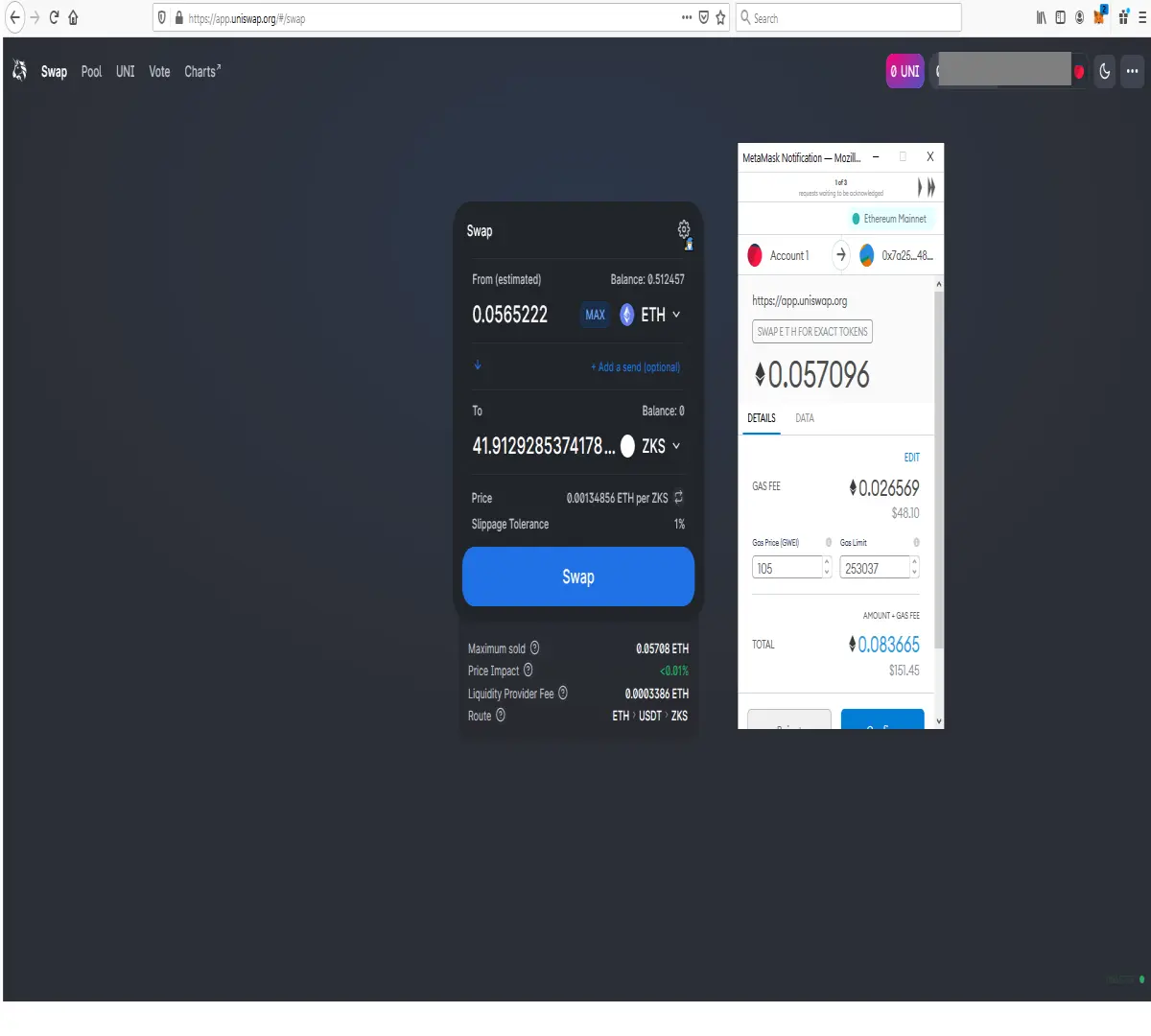
If I had gone through with this proposed trade on Uniswap, about one-third of my available ETH for this trade would have been taken up with gas fees instead of being used to buy more ZKS!
However, now that ZKSwap has officially launched, what if I could take advantage of the using an Layer 2 Ethereum solution to spend less on gas and more funds on actual tokens? This picture below shows that I even though I moved 5.5x more ETH than this proposed Uniswap trade, I was able to use about a third less in gas fees by moving my ETH over to ZKSwap first, and then using the much lower gas fees at ZKSwap to do my ETH-to ZKS trades.
Correction: The $2.54 I mentioned as a gas fee is actually a 0.3% transaction fee for using the DEX/AMM. There's zero gas fees once you transfer your funds from L1 to L2 at ZKSwap.
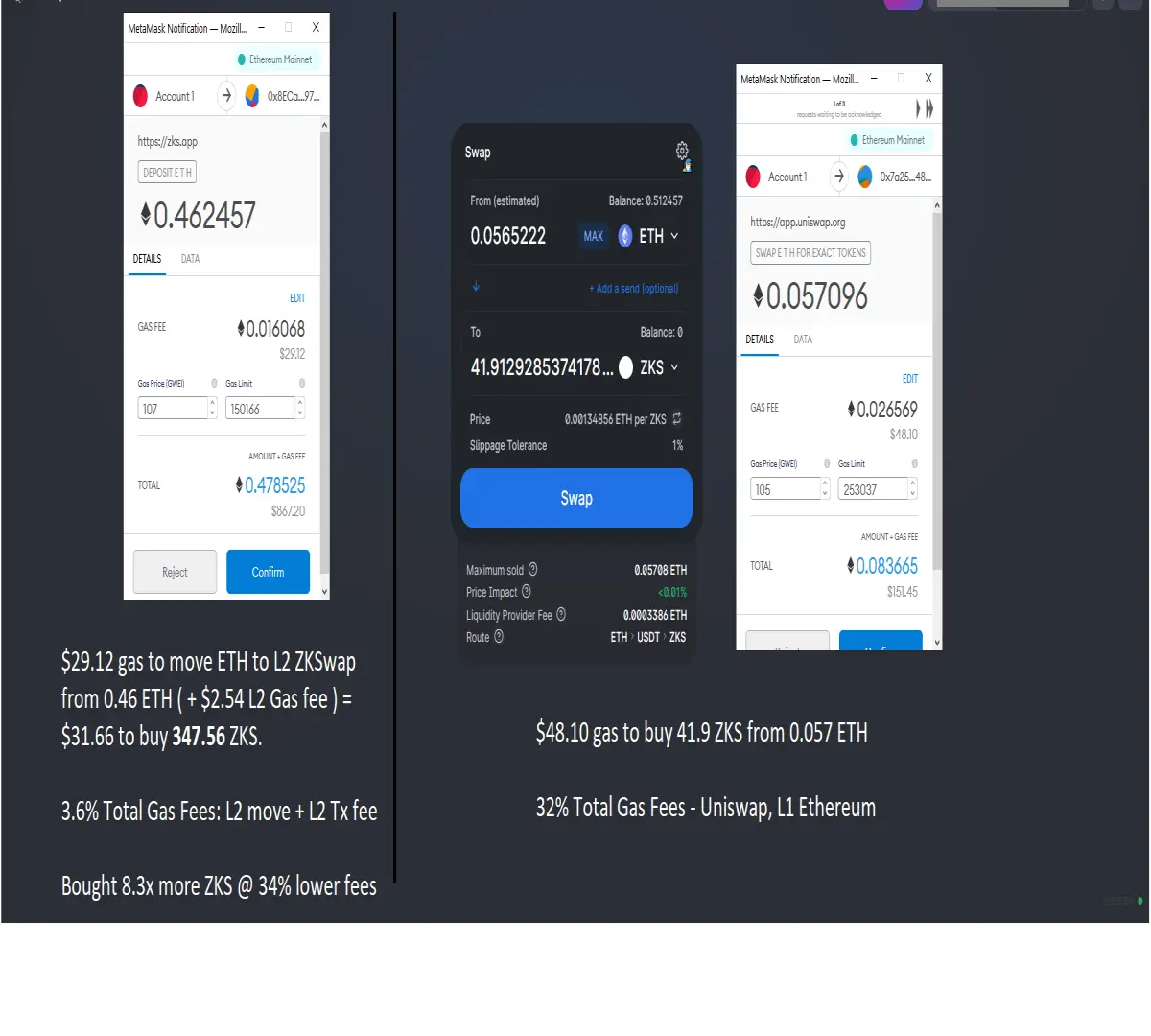
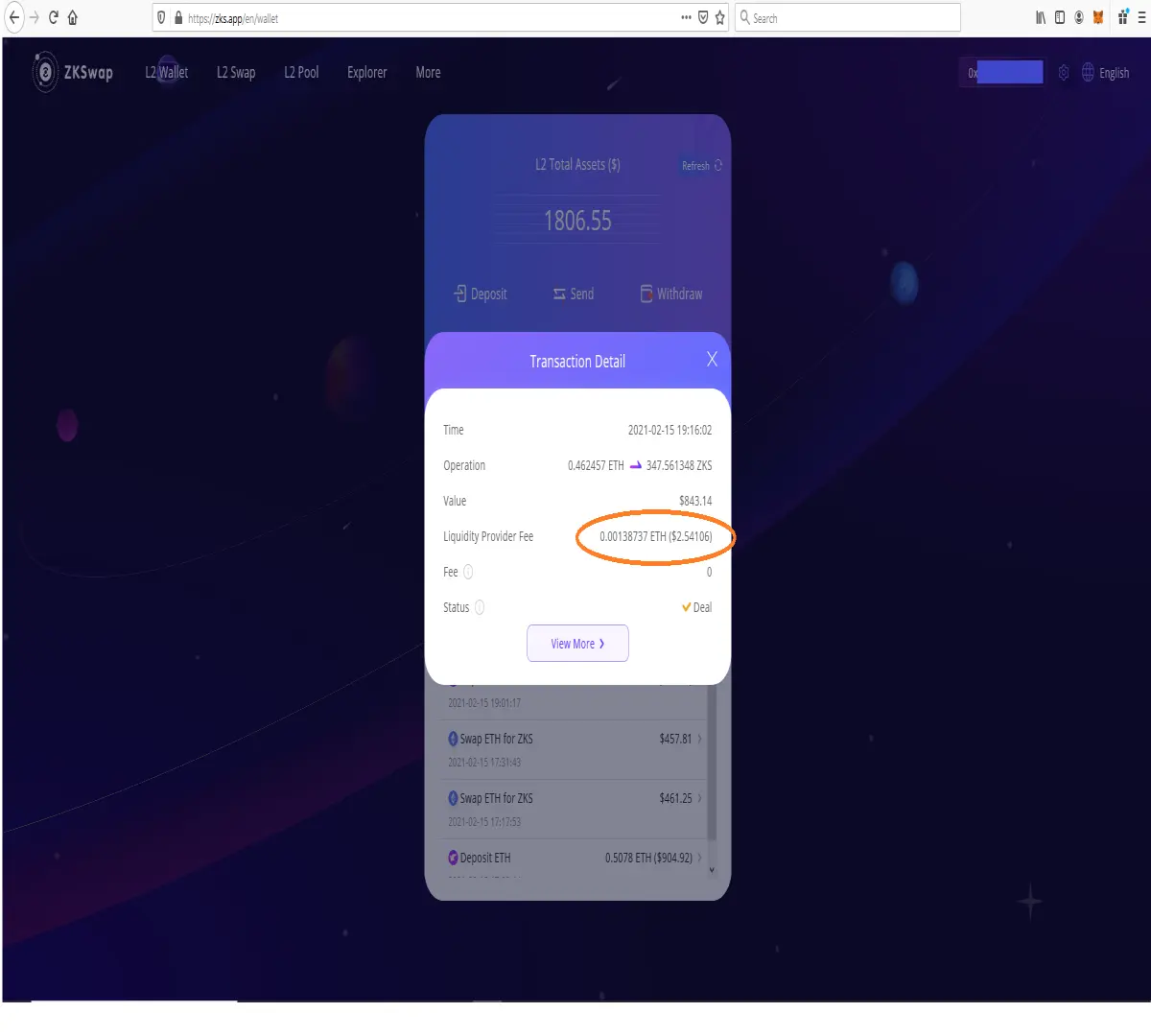 I spent $31.66 in total (about 3.6% of my funds) to buy 347 ZKS in this transaction at ZKSwap.
At the exact same time, I could have used $151 worth of ETH and spent 32% of my funds on gas fees for the opportunity to buy about 49 ZKS (while also paying a similar 0.3% transaction fee).
In the first example about 96.4% of my intended funds were used to buy tokens as opposed to using 32% of my funds to obtain ZKS at Uniswap. As a percentage, this is nearly 10 times the percentage of the funds I spent to buy ZKS at ZKSwap instead of at Uniswap (for a much smaller trade: $151 @ Uniswap vs. $860 @ ZKSwap).
Therefore: the ZKSwap method saved me from 50% higher gas fees in this example:
- $31.66 @ ZKSwap vs. $48.10 @ Uniswap, a 50% lower fee in comparison
- Purchasing 8.3x more ZKS while using about 1/10th less gas (percentage wise vs. Uniswap)
- While using 5.5x more ETH than this proposed $151 Uniswap trade.
Instead of spending 32% of my ETH on gas to buy about $151 worth of ZKS, I only spent 3.6% of my funds - or less than 10% the percentage of a smaller Uniswap trade by moving my ETH to ZKSwap and executing a larger ZKS trade there, instead of on Uniswap.
To attempt to do this exact same trade on Uniswap at the time of writing this article, cannot even be accomplished with $62 worth of ETH at 120 gwei (when it cost me $31.66 at 107 gwei to do it with ZKSwap yesterday).
At this time, the gas fees to move an ERC-20 coin to do a trade on ZKSwap are still much cheaper than using a Layer 1 DEX.
Fortunately, the ZKSwap Organization is working on reducing this move fee to zero. When this happens and when marketing agreements with partner DEXs are made and continue to be made, this process will be seamless and transparent to the user. If and when this happens I think that's when ZKS protocol adoption will really take off.
While I purchased 8.3x more ZKS than this Uniswap trade, as a percentage of funds used, the total gas fees were still more than 10 times cheaper than this proposed smaller Uniswap trade.
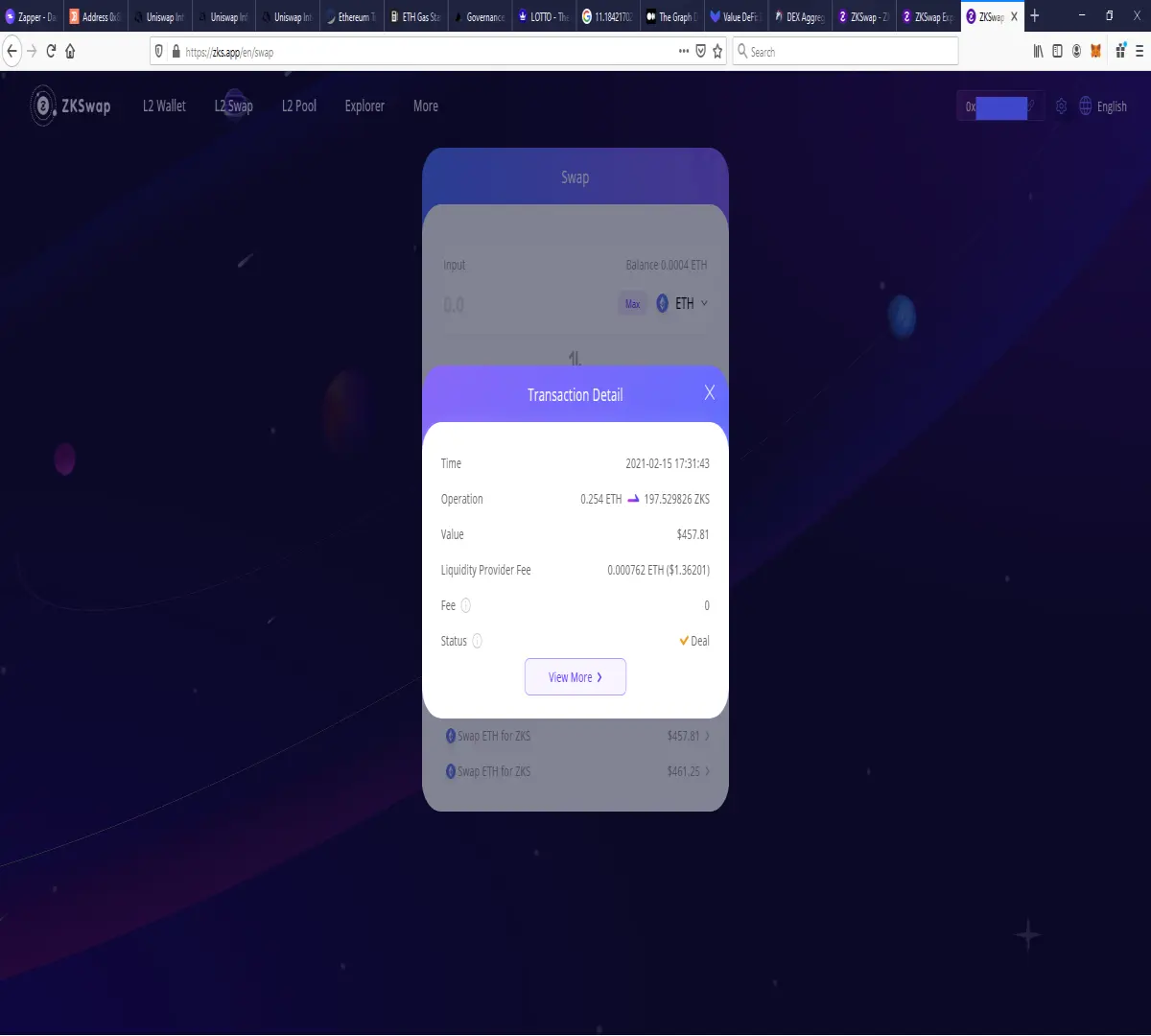
Traders and Investors are keen to cut operating costs which improve profitability and the odds of having profitable trades and investments. To give you an example of how much gas fees can be saved: on a day where Gwei prices fluctuated from 88 to 306(!) Gwei, I executed 3 separate ETH trades to buy ZKS on ZKSwap yesterday.
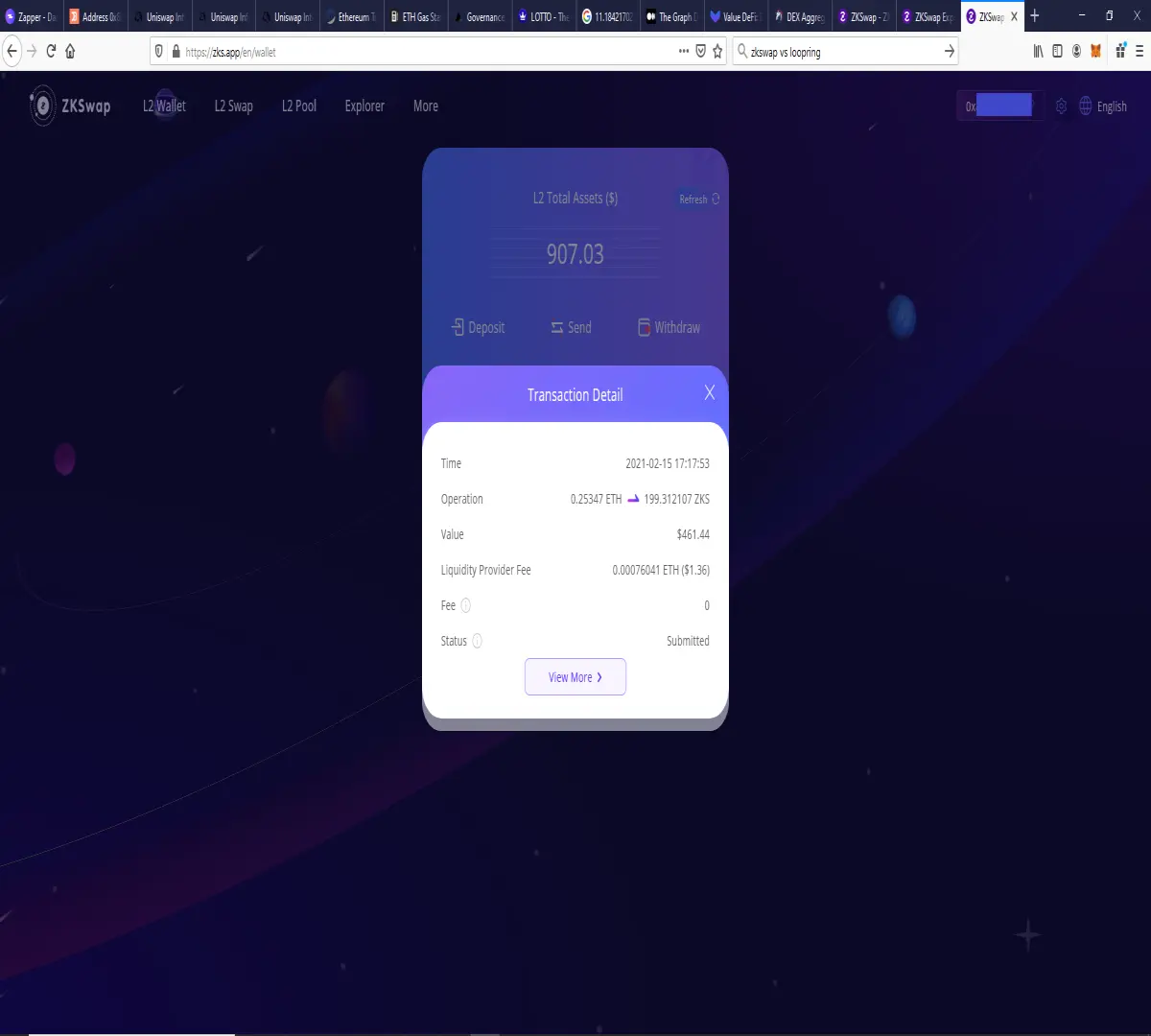
I incurred gas fees each time I moved ETH into ZKSwap - which is where the bulk of the fees come from, but once the funds were on ZKSwap, my L2 gas fees to purchase about 200-350 ZKS per trade were very low. All three transactions cost me only $5.26 total in gas fees:
- $1.36
- $1.36
- $2.54 (which cost $29.12 worth of gas to move to ZKSwap, for reference purposes. This move fee amount seems to scale in size with your deposit size)
Pros:
- Save a ton on ETH gas fees once you get funds into the L2 system
- Fast. L2 ETH transactions feels like using early ETH or when using ETH during low network congestion
- Slick Product. Front end and backend services and GUI are smooth and well-designed
- Quickly make DEX trades and move funds around into and out of staking and liquidity pools with very minimal gas fees
- Liquidity Mining and Staking incentive programs launch tomorrow
- Even with accounting for the gas fees associated with L1 ETH mainnet fund moves to L2 ZKSwap, it's still cheaper to do a ZKSwap trade vs. a normal DEX.
- It's both a developing protocol and token that others can use as well as it's own dApp / AMM Exchange that's meant to be governed as a DAO soon
Cons:
- You have to set up a separate L2 wallet (which fortunately can be the same address as your L1 wallet)
- You must move funds to this L2 wallet to use your coins or tokens at lower gas fees. As mentioned below, these are not insignificant costs at this point, but it's still lower than comparable L1 DEX fees.
- To set up or to add funds for each coin and for each coin type that you want to use costs gas fees each time that you add that coin or coin type. (Note: This is being addressed by a Proof Of Gas liquidity incentive program and project improvements to remove this move fee)
- At this current time as a Version 1.0: this is still not a "silver bullet" to high gas fees. It helps a lot but this project will not be at its full potential (meaning: full savings) until it costs zero fees to move funds from L1 wallets to L2 wallets.
- Until the process to onboard funds is both seamless, free, and transparent to the user, an L2 solution such as ZKSwap will never fully take off (Note: this is being addressed by current and future DEX partnerships and project improvements)
- Dealing with L1 to L2 transactions, or viceversa, is still somewhat slow. Most of that wait time appears to be related to waiting on L1 ETH mainnet to be available; there's still only so much you can do to reduce this as an L2 ETH solution provider since the problem is at Layer 1 ETH network itself due to how slowly ETH 2.0 has been developed and launched.
Conclusion:
Compared to the slow, saturated network that Ethereum is circa early 2021, using ZKSwap feels magical - it feels like you're using early generation ETH or what ETH was intended to be.
Even when taking into account that it costs gas fees to move your funds over to ZKSwap before you can trade: comparable ZKSwap moves and trades are still much cheaper than at an L1 DEX such as Uniswap and its competitors. 4 out of the 6 Cons on my list will be addressed by future project improvements and DEX partnerships, so most of the negatives on my list will be addressed as time goes on. The other 2 Cons are more systemic issues regarding Ethereum at its current state, for which the ZKSwap Organization can't be blamed.
I think that the the future of Ethereum lies in both Layer 1 and Layer 2 solutions. The ETH ecosystem is broad enough and diverse enough to support multiple solutions to address scaling and congestion issues.
Due to consistently high gas fees, DEXs must adapt - using solutions like Binance or ZKSwap - or they will wither away or be absorbed by DEXs that embrace both L1 and L2 solutions. The fundamental "arbitrage"-type advantages of saving immense amounts of fees on an L2 solution like ZKSwap protocol can no longer be ignored because the added profitability of using less gas to accomplish the same tasks is too much of a competitive advantage to ignore.
ZKSwap is feature complete, production ready, and most importantly available today to address high gas fees. As a lifelong tech investor since the early days of Amazon, Apple, BTC and ETH I think that the ZKS Organization has launched a very, very good Version 1 product and launch, regardless of the product or industry.
If this was a gymnastics or diving competition: They've nailed the flying spins and twists required to succeed at this level, now all they have to do is nail the landing, which would be to launch and finish their liquidity incentive programs without any major hitches or hacks.
Score:
I give ZKSwap a 10/10 for a well-designed and well-executed Version 1.0 product and launch.
ZKSwap's Future
The future of ZKS is bright. However, at this stage of the project's development, I can only recommend ZKSwap to semi-active / active traders, or those intending to buy coins that can only be accessed through a DEX, such as ZKSwap or Uniswap. If you're going to do DEX trades, the opportunity to save money on gas fees if your coin(s) are supported are hard to ignore.
Once a solution like this is seamless to the user, it becomes a fundamental foundational improvement that can improve the ETH trading experience for everyone. This promising project is just one solution, albeit one that while it is not yet finished it is fully functional and available today compared to its competitors.
Now - besides lower gas fees and transaction costs - why would one go through all this trouble to set up a Layer 2 wallet and app? Astute Defi investors know by now that potentially profitable opportunities exist when a promising project launches with liquidity incentives. It's a new frontier in the world of Defi, and high risk investors like me are willing to be the world's guinea pigs for these kinds of projects, for potentially greater rewards...or losses...
Tomorrow on February 17, the ZKS Organization is launching a generous liquidity program featuring mining and staking pools of 5 Million ZKS for 5 different programs. One promising sign of a Defi project with potential is an adequate and well designed marketing budget. The ZKSwap mainnet launch is both well funded and well designed. The current value for these coins meant as liquidity incentives is well over $12 Million at current ZKS prices.
More details of this program launch can be found at their official ZKS Medium blog.
Feb. 17 Article Update: Staking via two methods is now live, including an innovative "Proof Of Gas" pool that burns your ETH as ZKSwap needs to use it to execute trades on L1, but you are compensated back in ZKS at the compensation rate of 125%
Correction: I was wrong about L2 fees, so you save even more money / gas compared to doing trades at Layer 1. There is a 0.3% transaction fee on swaps but: It seems that all L2 transactions are gas free, which means that it's a trader's dream once you move your funds over. The official answer regarding ZKSwap fees is below:
3. Are all transactions gas-free?
All transactions executed on layer-2, including sending, swapping, adding/removing liquidity, are gas-free. Depositing from layer-1 (the Ethereum native chain) to layer-2 and withdrawing from layer-2 to layer-1 requires gas-fees, but ZKSwap subsidizes the withdrawal gas).
Source: Official ZKSwap Blog






