
Modular blockchains have been all the hype recently, a hot trend which everyone in the web3 and crypto space is talking about. Many novel modular designs are implemented, and new blockchains are being introduced (Celestia, Fuel, etc.) and joining the team of previous modular networks (Cosmos, Ethereum 2.0, etc.)
The modular architecture has been (and is being) discussed from different points of view, but ‘the elephant in the room’ in this story, seems to be investing approach. In this article, I will answer whether the modularity necessarily offers better ROI or not? Will the modular blockchains knock out their cousins in terms of market cap?
Where the story began!
Let’s take a brief look at why the modular design was born. As you know, every blockchain is supposed to maintain three features, i.e. security, decentralization, and scalability. It didn’t take so long that developers found out they may need to sacrifice one, to keep the other two alive. This challenge, is dubbed “The Blockchain Trilemma.”
To name a few examples, we have Bitcoin and Ethereum sacrificing scalability, Ripple, Binance Smart Chain and Solana losing decentralization, and Cosmos that lacks security.
The fact that increasing one thing, may decrease something(s) else was not acceptable for the developers. To make adoption and usecases of blockchains at the level they’ve always dreamed of, they must push scalability without losing the other two. To make a long story short, many of them decided to migrate from monolithic to modular design, decoupling the components of a blockchain.
As you may know, each blockchain includes these layers (components):
- Execution (Computation): Where the transactions and smart contracts run, and the changes to a blockchain’s state occur.
- Settlement: This is an optional part of the design, where the validity proofs are verified and disputes are resolved. You may think of it as the US Supreme Court.
- Consensus: Where the network nodes agree on the verifiability of data. Here you can see what is true and valid.
- Data Availability (Storage): This is where the history of the network lies. This layer provides you with information about what has happened so far.
Projects like Polkadot, Cardano, and Cosmos are among those using modular architecture.
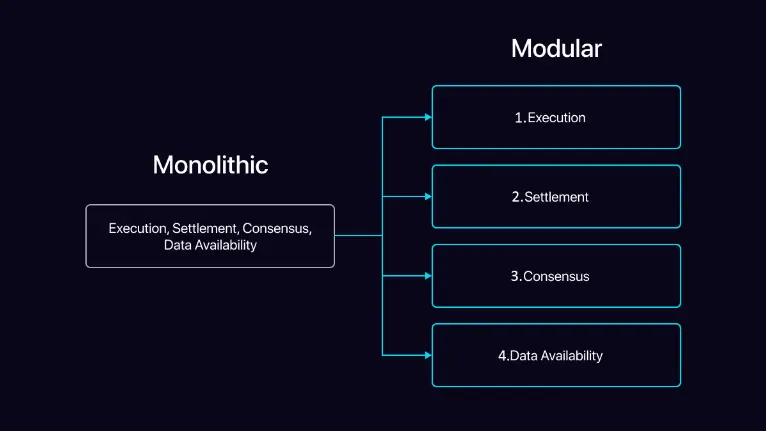
Modular vs. Monolithic Architecture
To Be Monolithic or Modular, That is the Question
Well the question is a hard one to answer, since there is no “Ultimate Blockchain” to be the hero. Despite all the hype around the modular ones, each family of blockchains has its own positives and negatives. Modular blockchains are more flexible (easier to customize the rules and mechanisms) and more scalable, while their monolithic relatives are simpler to design and more secure. The latter also has another advantage which is underrated, and that is its token has more potential to gain value, at least in the long run. This is due to the fact that a monolithic blockchain has one native token for all the layers, while in a modular one it totally differs. For example one token is used for rewarding the network participants, one for paying the fees, and so on.
Wearing the Investing Glasses
Now it's time to discuss the value flowing into the blockchains, and the potential ROI each token offers. When betting on a token, to assess the profits you may gain as an investor, you need to consider two main factors:
1. Technical Design:
The better the architecture fits a blockchain’s goals, the more value comes into its token(s). As an example, if a blockchain’s main purpose is to serve as a DeFi-focused network, it would be better to choose a monolithic design, since it offers higher security. On the other hand, when it comes to high-TPS usecases like in decentralized social platforms, gaming, or DePIN projects like Helium, a modular design takes the priority.
2. Economical Design:
This is crystal clear: the more demand for a token, the more value it gains. This demand mainly comes from the utilities a token has, and the incentives that make different players want it. For example if token A is a means of both paying fees and validators’ staking, and token B is just used in execution layer (fees payment), the former has better chances for a higher ROI.
Closing Thoughts
The race to become the dominant blockchain platform is picking up speed. There have been many solutions introduced in the decentralized world to tackle the blockchain trilemma. But as we're speaking today, there is (and perhaps will be) no single key to make it possible.
If you're going to invest on a token, don't get tricked by the hype, be smart. When considering betting on a token, always remember to assess 1. What its parent blockchain is going to do (protocol design) and 2. How much demand for the token(s) will be (economical design)?





