
As a beginner in the crypto world, we often make the mistake of jumping and buying coins without even understanding their fundamentals. All we care about is how they sound; Woah, Chainlink, the name looks cool. I shall buy it. I have made this mistake, and I admit it.
So let me help you understand its fundamentals so that you can look out for yourself and decide whether you need to have it in your portfolio or not.
Before we dive into it, we need to understand what Oracle means.
Oracle: To be honest, it simply means source of the truth.
What will happen if you go to a decentralized exchange, say Uniswap, and there you find out that the current price of BTC is $38K, whereas, on PancakeSwap, the price is $45K. Will this make sense? No, right? How does the Pancakeswap or Uniswap get the current price? How do they remain in sync across the whole web 3.0? They need some entity who will tell these decentralized exchanges that look the price of BTC is $40K, and you both are wrong, so you better correct yourself. The $40K is the truth.
A more formal definition would be: An Oracle is an entity which let the information (truth) pass through the real world to the decentralized world and vice versa.
Now you might be having more curious questions like:
- How is it decentralized if we depend on such an entity?
- What if that entity goes down?
- What if that entity is part of a centralized system?
And this is precisely where Chainlink comes into the picture. Chainlink acts as a decentralized oracle; it provides valuable information like Trading Prices, 24 hr Volume, etc.
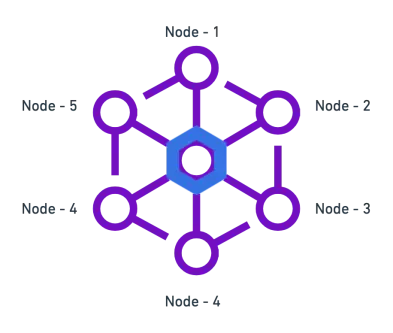
We call it a Decentralized Oracle Network or DON. It takes input from multiple independent oracle nodes and gives us a decentralized result. In this way, even if one oracle goes corrupt, we still have other oracles to validate. Thus it makes things more robust.
How does Chainlink get the data?
Think of Chainlink as a chain of Oracles or, let us say, nodes. These nodes provide the data to Chainlink.
How do we know whether the data provided by these nodes are genuine?
To be a part of the chainlink node, you need to lock up some of your money into it. So if any node misbehaves or provides false data to fool the system, all their locked-up money will be lost.
Why would any node lock up their money?
To earn money. You see, users on a decentralized network pay these nodes to have reliable data. This money is then distributed amongst the nodes (oracles)





