You've been there: Bitcoin pumps 15% and you didn't buy. Then it crashes 20% and you panic sell. Your portfolio looks like an EKG readout—volatile, unpredictable, anxiety-inducing. You're told to "HODL" through the pain, but watching your capital swing 30% monthly isn't a strategy—it's emotional torture.
What if there was a way to profit regardless of whether crypto goes up or down? That's exactly what cryptocurrency arbitrage offers: exploiting price differences across exchanges to make consistent returns while the market does whatever it wants. While retail traders guess market direction, arbitrageurs simply profit from mathematical inefficiencies. Platforms like ArbitrageScanner have made this institutional strategy accessible by monitoring 50+ exchanges and 40+ blockchains simultaneously—turning what was once a manual nightmare into automated opportunity detection.
What Is Cryptocurrency Arbitrage?
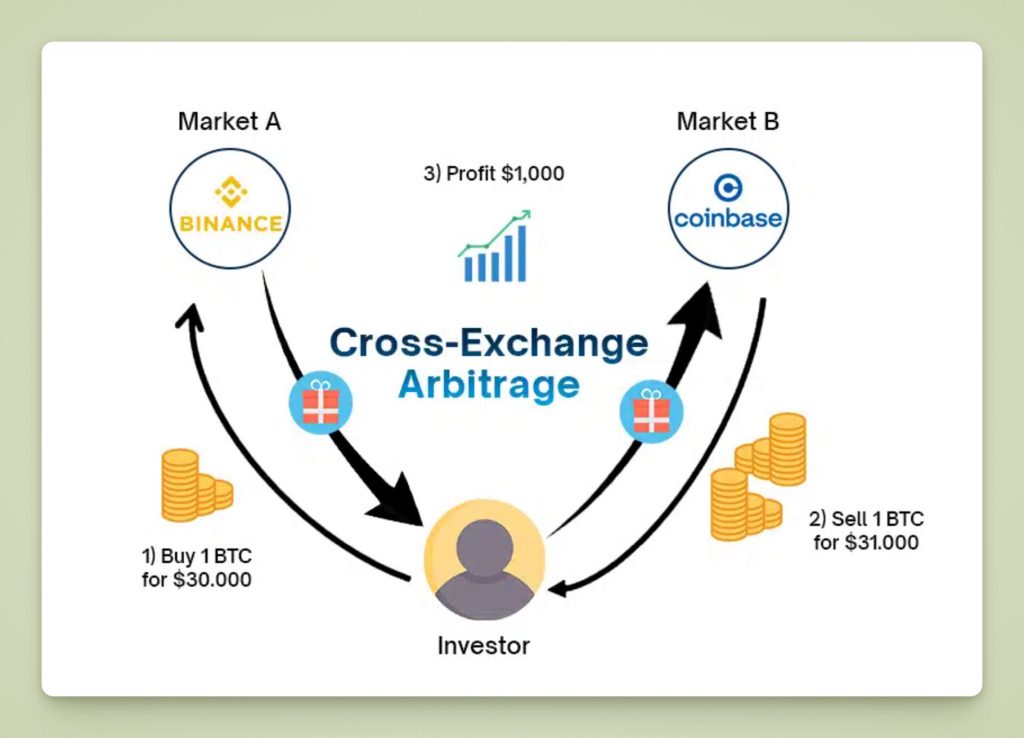
Cryptocurrency arbitrage is buying a digital asset on one exchange where it's cheaper and selling it on another where it's more expensive—capturing the price difference as profit.
Simple example: Bitcoin trades at $43,800 on Binance but $43,950 on Kraken. Buy on Binance, transfer to Kraken, sell. That $150 spread (minus fees) is your profit—regardless of whether Bitcoin then goes to $50k or crashes to $40k.
Unlike directional trading where you're betting on price movement, arbitrage is market-neutral. You're not predicting the future; you're exploiting the present.
Why Arbitrage in Cryptocurrency Works
Traditional markets (stocks, forex) have minimal arbitrage opportunities—prices sync almost instantly. But cryptocurrency markets are uniquely inefficient:
- Fragmented Liquidity: 500+ exchanges, each with independent order books and pricing
- Cross-Blockchain Complexity: The same token exists on Ethereum, BSC, Polygon—each with different prices
- 24/7 Global Markets: No market close means continuous price dislocations
- Varying Regulations: Exchange restrictions by country create isolated pricing pools
- Technology Gaps: Not all exchanges have equal trading technology or liquidity
These structural inefficiencies create arbitrage opportunities constantly—dozens per hour across the crypto ecosystem.
The Fear: Why Most Traders Avoid Arbitrage

Despite its advantages, most traders never attempt arbitrage trading cryptocurrency. Their fears:
- The Complexity Paralysis: "Do I monitor 50 exchanges manually? How do I know where opportunities are right now?" Without tools, arbitrage feels overwhelming.
- The Speed Terror: "By the time I transfer coins between exchanges, won't the price difference disappear?" Transfer times are a real concern—and a solvable one.
- The Fee Anxiety: "What if trading fees, withdrawal fees, and gas costs eat all my profit?" One miscalculation and your 2% spread becomes a 0.5% loss.
- The Capital Trap: "Don't I need $100k spread across multiple exchanges?" Starting capital concerns are legitimate but often overestimated.
- The Scam Suspicion: "If arbitrage is so profitable, why isn't everyone doing it?" The classic "too good to be true" mental block.
These fears keep retail traders stuck in the directional trading grind while arbitrageurs quietly accumulate consistent returns.
The Dream: Predictable Profits in Unpredictable Markets
What makes cryptocurrency arbitrage attractive:
- Market Direction Irrelevant: Bull market? Bear market? Crab market? Doesn't matter. Arbitrage works in all conditions.
- Defined Risk: Unlike leveraged trading where you can lose 100%+, arbitrage risk is limited to execution delays and fee miscalculations.
- No Chart Analysis Required: Forget candlesticks, indicators, and "resistance levels." Arbitrage is pure math.
- Scalable Strategy: Works with $1,000 or $100,000. Larger capital = larger absolute profits.
- Sleep-Friendly: Set up monitoring alerts, execute when opportunities appear. No need to watch charts 16 hours daily.
The dream: consistent 10-20% monthly returns while avoiding the emotional roller coaster of directional speculation.
Cryptocurrency Arbitrage Strategy: Types That Work

- Spatial Arbitrage (Cross-Exchange) Buy low on Exchange A, sell high on Exchange B. The classic approach.
Challenge: Transfer times between exchanges Solution: Maintain balances on multiple exchanges, arbitrage in parallel
- Triangular Arbitrage (Same Exchange) Exploit rate inefficiencies between three trading pairs on one platform.
Example: BTC→ETH→BNB→BTC cycle yields more BTC than you started with Advantage: No transfer delays, instant execution
- Cross-Chain Arbitrage (DEX-CEX) Buy USDC on Ethereum DEX, bridge to BSC, sell on PancakeSwap.
Opportunity Size: Often 1-5% spreads Complexity: Requires understanding cross-chain bridges and gas costs
- Statistical Arbitrage Track historical price correlations, profit when they temporarily break.
Example: ETH usually trades at 0.062 BTC ratio. When it hits 0.058, arbitrage the difference. Risk Level: Higher—relies on mean reversion assumption
Real Cryptocurrency Arbitrage Online Success Stories
The DEX-CEX Play: During March 2024 volatility, Ethereum showed consistent 0.8-1.2% price differences between Binance and Uniswap. One trader executed 4 daily arbitrages with $30k capital, averaging $360/day profit—$10,800 monthly.
The Smart Wallet Strategy: A trader used wallet tracking to monitor an address that bought XRP one hour before Ripple's court victory announcement. By copying the wallet's pattern through arbitrage monitoring, they made $5,000 in two weeks—not from insider trading, but from systematic pattern recognition.
The NFT Flip: Using NFT arbitrage scanning, a trader caught a Pudgy Penguin listing mistake—seller meant $43,800 but listed at $4,380. Instant $39,420 arbitrage profit in one transaction.
These aren't lottery wins. They're systematic opportunity capture using proper cryptocurrency arbitrage online infrastructure.
Why Cryptocurrency Arbitrage Strategy Requires Tools
Manual arbitrage monitoring is theoretically possible but practically suicidal:
- 50+ exchanges × 500+ trading pairs = 25,000+ price points to monitor
- Opportunities last seconds to minutes
- Manual fee calculation for each trade is error-prone
- Transfer time estimation across blockchains is complex
Professional arbitrageurs use scanners that:
- Monitor all exchanges simultaneously (4-second refresh cycles)
- Calculate net profit after all fees automatically
- Alert via Telegram when profitable spreads appear
- Track successful trader wallets for pattern learning
- Filter by minimum profit threshold and available capital
The first missed $500 arbitrage opportunity costs more than months of scanner subscription. It's not about spending money—it's about not leaving money on the table.
Getting Started: The Realistic Path
Step 1: Start with triangular arbitrage on one exchange (Binance has great liquidity)
Step 2: Use a scanner's trial period to identify 3-5 opportunities
Step 3: Execute manually, document actual vs. expected profit
Step 4: Gradually expand to cross-exchange arbitrage as you build capital reserves
Step 5: Add DEX monitoring once comfortable with CEX arbitrage mechanics
Most successful arbitrageurs start small—$1,000-5,000—and scale up as they perfect execution. Expecting 50% monthly returns immediately? That's the old gambling mindset. Arbitrage is about consistent 10-20% with minimal drawdown.
The Bottom Line
Cryptocurrency arbitrage isn't a secret money glitch. It's a legitimate, low-risk trading strategy that requires infrastructure most retail traders lack.
While your friend is panicking about whether Bitcoin will hit $50k or $35k next, you're collecting 1.5% price differences that appear regardless of market direction. While Reddit debates bull vs. bear, you're executing your third triangular arbitrage of the day.
The opportunities exist. They're mathematical certainties in a fragmented, 24/7 global market. The only question: Will you keep gambling on directional trades, or start profiting from market inefficiencies?
One approach feels exciting. The other makes money consistently.






