The sector of decentralized financial applications (DeFi) has become one of the fastest growing in the crypto market in recent years. This allowed us to attract the attention of traditional financial institutions and private investors, who began experimenting with transferring value from the real world to blockchain solutions.
Thus, a separate category of projects appeared, called tokenized real world assets (RWA), the size of which exceeded $20.83 billion, according to Rwa.xyz on April 12, 2025.
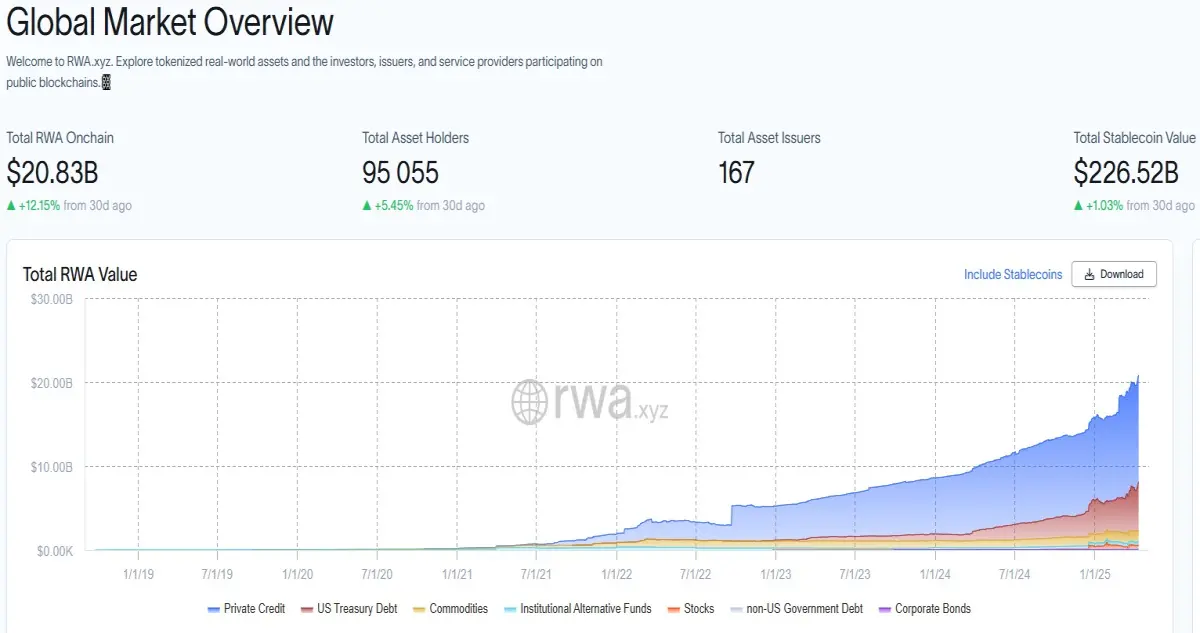
RWA is a sector of the cryptoeconomy, where project solutions allow tokenizing any "real" assets of value by placing them in blockchain applications. This category can include, for example, real estate, securities, national currencies, or even art objects.
Key categories in the RWA sector include tokenized U.S. Treasury bonds, private loans, commodities, stocks, real estate, as well as carbon credits and art, according to a report from Binance Research.
Despite the fact that stablecoins such as Tether's USDT are a classic RWA asset, that is, a tokenized version of the national currency, these tokens are not taken into account in the context of the total capitalization of assets classified as RWA.
It is also worth separating the volume of tokenized assets and the capitalization of native tokens that are issued by crypto projects for different purposes.
The cryptocurrency aggregator CoinGecko classifies dozens of projects into the RWA category, the tokens of which are traded on global crypto exchanges. These are often project management tokens, rather than assets that can be digitized and tokenized using its solutions.
Examples of large projects.
Ondo Finance.
Users of the platform get access to tokenized versions of US Treasury bonds. These bonds themselves are held by partner funds and custodial services working with Ondo.
Buyers of such tokens receive an Ethereum-powered OUSD token. So far, the service is available only to qualified investors. Tokenized dollar deposits in the form of the USDY token are available to ordinary users of the platform, which are charged a percentage.
The project's native token, ONDO, is available for trading on most major crypto exchanges, just like any other crypto asset.
Centrifuge.
The developers have created their own blockchain network in which tokenized versions of real assets can be issued in the form of non-interchangeable tokens (NFTs). This is convenient for tokenizing documents, certificates, or real estate.
Special bridges allow the Centrifuge network to interact with external blockchain projects and receive liquidity from them. Thus, assets issued in Centrifuge can, for example, be used as collateral in DeFi services such as Aave.
The project's native token (CFG) is also freely traded on crypto platforms, such as KuCoin or Kraken.
Parcel.
The platform allows you to invest in tokenized shares of real estate. It creates its own indexes that track real estate markets in specific regions (for example, in a single US city).
These indexes are presented in the form of synthetic assets that can be traded within the platform on the same principle as on decentralized trading platforms where users provide liquidity. The blockchain oracle Pyth ensures the relevance of data on real estate markets.
The project's native token (PRCL) has a relatively low capitalization, but it is already traded on major crypto exchanges such as OKX or Bitget.
Tokenized private loans (Private credit) issued by non-banking institutions remain another extensive and capitalized niche of RWA.
The largest projects providing such loans include Figure, Maple Finance, Centrifuge, TruFi and Goldfinch. The latter conducted an investment round of $11 million in 2021, led by Andreessen Horowitz.
Institutional companies.
In 2024, two large capital management companies worth more than $3.2 trillion, including Franklin Templeton and BlackRock, launched their RWA products in the tokenization category of US government bonds.
The total amount of bonds tokenized by these two companies exceeded $950 million. The essence of the work of such tokens is that their owners receive passive income from holding close to the real yield of the bonds that underlie the tokens. Digital assets are released on the blockchains of Ethereum, Stellar, Polygon, Arbitrum and Avalanche.
However, despite the public nature of the blockchain, on the basis of which products like BlackRock and Franklin Templeton operate, access to tokens is limited only to investors who meet the requirements of the issuer.
"Compliance is the cornerstone of RWA tokenization. Tokens must comply with the relevant regulations, including KYC/AML requirements. Protocols often implement whitelisted/blacklisted capabilities and support regulatory reporting. Some RWAs may require permissioned blockchains or hybrid models to restrict access and preserve privacy," the Binance Research report clarified.
BlackRock and Franklin Templeton are both operators of bitcoin and Ethereum-based cryptocurrency exchange-traded funds (ETFs), launched in January and July 2024, respectively.






