"After the approval of the bitcoin ETF last year, the market cycles in the crypto market have changed dramatically," experts from Signum Capital believe.
"Previously, the cryptocurrency market followed four-year cycles tied to the halving of bitcoin (BTC). However, with the advent of American exchange-traded funds (ETFs) based on the first cryptocurrency in 2024, it turned into an institutional asset, which provided BTC with more stable demand, reducing its volatility," analysts at Signum Capital investment company wrote.
Now the market does not move in rigidly set cycles, experts noted, and is characterized by short phases of growth and decline, depending on liquidity, investor positions and participants' attitude to risk. We can talk about the stabilization of the bitcoin price, altcoins have remained volatile.
ETFs for cryptocurrencies (Exchange-traded fund) are exchange—traded funds whose issuers can issue shares only if they have a sufficient number of digital assets on their balance sheet. Such trading products allow investors to invest in cryptocurrency without owning it directly.
"The idea of fixed four-year cryptocurrency cycles is probably no longer relevant. Instead, we are seeing shorter, more fragmented periods driven by the macro environment, regulatory changes, and rapidly changing narratives," the Signum Capital report says.
Halving is an event programmed into the bitcoin code that occurs approximately once every four years. This is a mechanism that reduces the inflation rate of new coins of the main cryptocurrency.
The first such event took place in November 2012, followed by July 2016, May 2020, and April 2024.
Initially, the rate of bitcoin issuance in the network was 50 BTC approximately every 10 minutes, but with each holding this number decreased by half.
Thus, since April 2024, the issue of bitcoin is 3,125 BTC every 10 minutes. Per day — about 450 BTC, or more than $45 million at the exchange rate on January 22.
In percentage terms, the inflation rate is about 0.85% per annum.
The history of quotations of the main cryptocurrency shows that between halving cycles, the price of bitcoin updated the maximum.
For example, at the end of 2013, about a year after the halving, bitcoin reached the level of $ 1.2 thousand.
In the next market cycle, at the end of 2017, the maximum price was $20,000 per bitcoin. At the end of 2021 — $69 thousand.
The statistics were violated in 2024: bitcoin exceeded the previous maximum for the first time before the halving, when in March the price of BTC rose to $ 73 thousand, which coincided with the investor excitement around ETFs launched in January for bitcoin in the United States.
If we compare the dynamics of the token quotations of individual blockchains, the coins of bitcoin and BNB Chain (BNB), affiliated with Binance, the largest crypto exchange, showed the greatest stability.
Experts explained the "strength" of BNB by the constant creation of incentives for BNB holders, innovation and deep immersion in the ecosystem of decentralized finance.
Signum Capital has been calculating prices in this cycle since the fall of global markets in early August 2024, which coincided with changes in the monetary policy of the Bank of Japan.
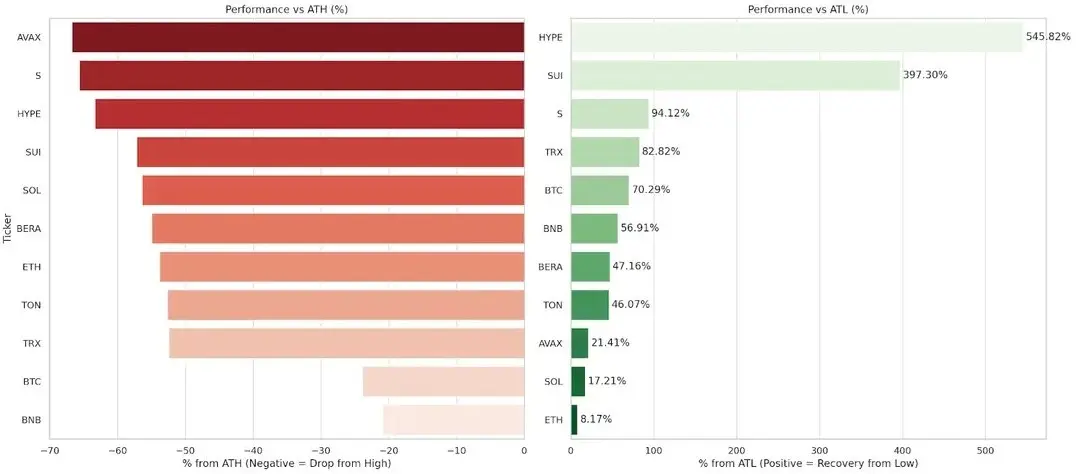
Price dynamics of native tokens of individual blockchain networks: On the left is the maximum drop from the price peak. To the right is the maximum increase from the price minimum. Source: Signum Capital.
The least "strong" coins were Ethereum and Avalanche (AVAX). According to experts, this was due to the lack of new, effective initiatives focused on user attention: "Without strong stories or updates that attract interest, they could hardly keep up with competitors."
As an example of successfully "capturing the attention" of users, experts identified the Solana (SOL) blockchain token, which dominated the memcoin market in this cycle. However, this also made Solana a speculative instrument, which led to a decrease in price as soon as the hype subsided.
Experts also noted crypto assets that have benefited from the approach of the new administration of US President Donald Trump to the crypto industry. One of the most striking examples was the XRP token, developed by Ripple.
The SEC, as the main US exchange regulator, has been suing Ripple Labs for several years. In 2020, the SEC accused Ripple of raising $1.3 billion through the sale of the XRP (XR) cryptocurrency, which, according to it, was an unregistered security. In August 2024, the court fined Ripple $125 million. In October, the SEC challenged the verdict, but dropped the appeal in March 2025.
"XRP has become one of the most effective traditional tokens, helped by favorable regulatory trends since Trump's election," the report noted.





