
Good day everyone,
I hope you are all well and had an excellent week, welcome to CryptoGod-1’s blog on all things crypto. Today I will be looking at how Venezuela’s national cryptocurrency, the Petro (PTR), is due to cease operations on the 15th of January 2024.
The Petro (PTR) Cryptocurrency
It has been announced that Venezuela will cease operations with its national cryptocurrency on the 15th of January 2024. The token, known as the Petro (PTR) was first introduced announced in a televised address on the 3rd of December 2017, and first circulated in February 2018. It had the aim of helping the country evade United States sanctions, although it never really took off and has repeatedly failed to gain adoption throughout its existence. The token was supposedly backed by the nations oil and mineral reserves, while it was also intended to supplement Venezuela's plummeting hard bolívar.
In January 2020 the Venezuelan president Nicolás Maduro made it mandatory that all government document services and airplane fuel for planes making international flights had to be paid for in the Petro (PTR) token. The announcement of its shutdown was made on a government-run website dedicated to the cryptocurrency, https://www.petro.gob.ve/en/.
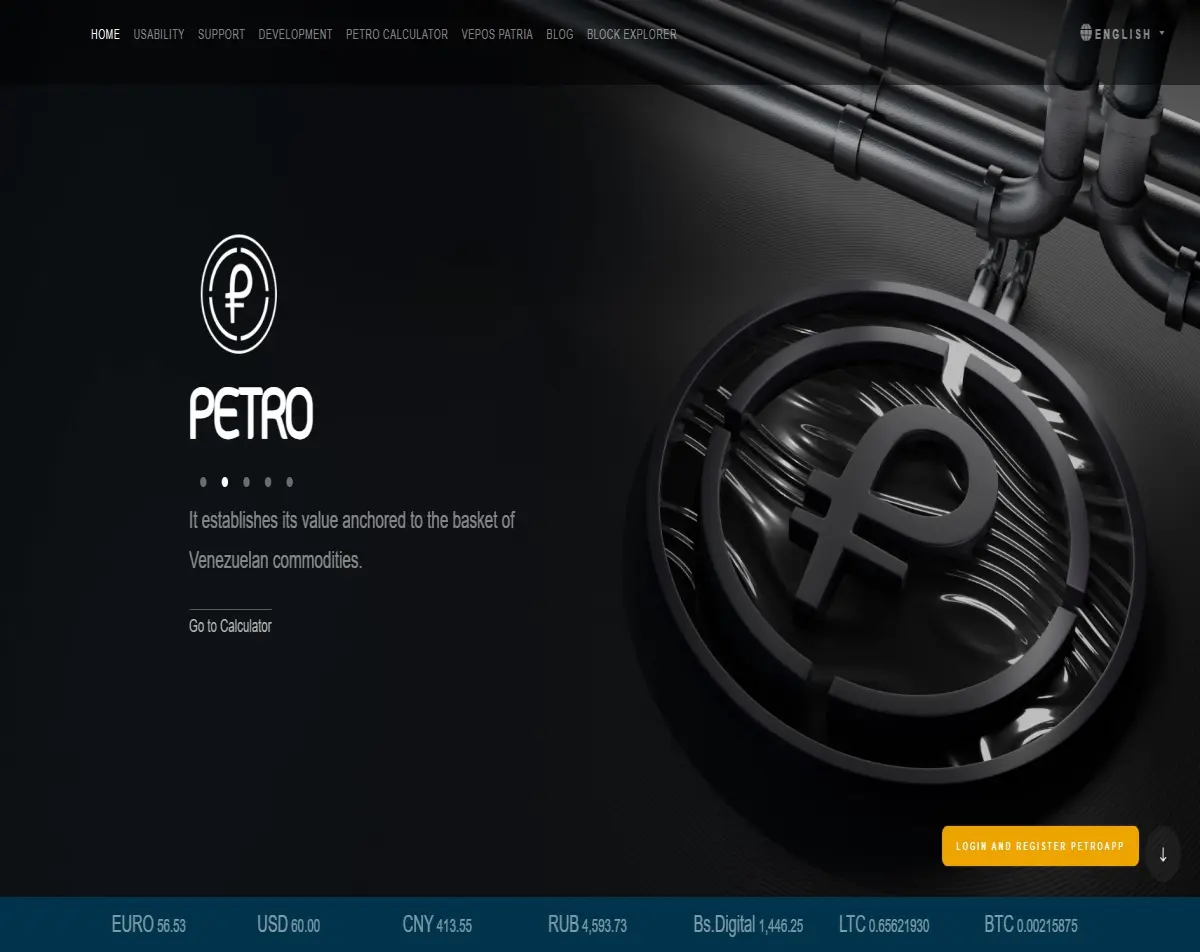
At the time of writing the Petro (PTR) was trading for $60 or €56.53. When first introduced the Petro faced opposition from the parliament in Venezuela, although it still managed to achieve full functionality in 2020. Bitcoin had already established itself with a strong presence within the nation at the time, but the Petro (PTR) token never managed to gain traction internationally.
At the time of its inception the Maduro government had noted that the Petro (PTR) token would "allow new forms of international financing." They made efforts to promote it to the ten member states of the Bolivarian Alliance for the Peoples of Our America but it failed at leading to widespread adoption. The design of the Petro (PTR) token was always controversial, with its white paper changing by the day even after its pre-sale. The entirety of the crypto's supply was "pre-mined" by the Venezuelan government, meaning that there could be no new token created. In October 2018 the token switched to an X11 algorithm based design, with was copied from the popular cryptocurrency Dash.
The Patria Platform is the only website where the Petro (PTR) token was tradable, but it will be closed on Monday the 15th of January 2024 with all remaining wallets and Petro's shut down and converted back into the local currency of Bolivar. Domestically the Petro (PTR) was never officially declared a legal tender which means its acceptance was not mandatory.
It is important to note that the nations largest bank, Banco de Venezuela, would not accept Petro (PTR) without a presidential order compelling it to do so. Similarly, citizens in Venezuela struggled to understand its use or function and it was labelled a "scam" by some risk rating bodies.
The situation escalated back in June 2020 when the U.S. Immigration and Customs Enforcement offered a $5 million bounty for the capture of Joselit Ramirez Camacho. He was the head of the National Superintendency of Crypto Assets and was responsible for overseeing the Petro (PTR). The accusations levelled at him included having ties to international narcotics trading. He was arrested in Venezuela in March 2023 on charges related to financial improprieties within the national oil industry. The agency was closed as reorganisation took place, and the closure has been extended until March 2024.
Another top level official, petroleum minister Tareck El Aissami, was also forced to resign due to the corruption scandal over irregularities in the management of funds from oil operations carried out with crypto assets. The scandal involved cryptocurrency wallets redirecting payments owed to the state-run oil company Petróleos de Venezuela. He, along with a number of officials were detained. This led to a crackdown on bitcoin mining operations within the nation along with a number of exchanges. This was extremely harmful for citizens as other cryptocurrencies like bitcoin are hugely popular and act as a guard against hyperinflation and the deflation of the bolivar. A survey from 2022 at the United Nations Conference on Trade and Development noted that 10.3% of Venezuelans own crypto compared to 8.3% of Americans.
It is also important to note that the Petro (PTR) was never a central bank digital currency (CBDC) and that the Central Bank of Venezuela had made plans to create an actual CDBC back in 2021, although nothing came of it. The Petro (PTR) was the one and only attempt by the nation at creating a cryptocurrency to help navigate the economic challenges facing Venezuela but it was a failed one.
Have a great day.
Peace. CryptoGod-1.
Referral Links and Follow Me:






