
Good day everyone,
I hope you are all having a good day, welcome to CryptoGod-1's blog on all things crypto. In this post I will be looking at the Senator Bill 1047 which looks to regulate the development and deployment of artificial intelligence (AI) models.
Senator Bill 1047
California State Senator Scott Wiener is currently in a heated debate with OpenAI over Senator Bill 1047 (SB 1074) which will look to regulate how AI is developed and deployed. The bill was introduced back in February and it would require all AI companies to conduct rigorous safety evaluations of their models before they can be released to the wider public. Back on the 21st of August Wiener made a press release where he noted that the bill is crucial for ensuring public safety and national security.
ChatGPT developer OpenAI have made a high profile objection to the bill, and they have expressed their concerns in a letter addressed to Wiener and California Governor Gavin Newsom. Their chief strategy officer Jason Kwon has stated in the letter that the bill has the potential to stifle innovation and drive talent out of California. The state has long been associated with being a global leader in the tech industry. Kwon also argued that the AI sector is still very much in its infancy and having an overly restrictive set of state regulations could stifle further development and growth of the sector. Kwon noted that federal legislation, rather than state laws, would be more appropriate for governing AI development. Kwon wrote:
“The AI revolution is only just beginning, and California’s unique status as the global leader in AI is fuelling the state’s economic dynamism. SB 1047 would threaten that growth, slow the pace of innovation, and lead California’s world-class engineers and entrepreneurs to leave the state in search of greater opportunities elsewhere. Given those risks, we must protect America’s AI edge with a set of federal policies – rather than state ones – that can provide clarity and certainty for AI labs and developers while also preserving public safety.”
In his press release senator Scott Wiener responded by saying that the AI start-up ‘doesn’t criticise a single provision of the bill’ and acknowledges it is implementable. He continued by stating that these concerns are a 'tired argument' at this stage and he likened them to the objections raised by the tech industry when California passed its data privacy law. Wiener believes that in an ideal world Congress would handle AI regulation but he also noted his disbelief of it happening given the previous lack of engagement from Congress with the tech industry over data privacy laws. Wiener also acknowledged that state-level action is necessary as, just like with data privacy, with “Congress’s lack of action, Californians would have no protection whatsoever.”

California State Senator Scott Wiener
Wiener finished his argument for the implementation of SB 1047 by stating the bill is a “highly reasonable” measure designed to ensure that large AI labs, such as OpenAI, adhere to their commitments to test their models against catastrophic safety risks. While some may consider it somewhat of a 'doomsday scenario' that Wiener is referring to, it is important for these companies to ensure all rigorous safety measures have been put in place. He noted the extensive collaboration with source advocates, Anthropic, among others when the bill was refined, and he stated the bill was “well-calibrated” and “deserves to be enacted.”
In his response to OpenAI Wiener also noted how the San Francisco start-up “doesn’t criticise a single provision of the bill” and acknowledges its core provisions as “reasonable and implementable”. However OpenAI is only one of many who oppose the bill, such as a number of US politicians and companies. Included among them are Nancy Pelosi and Anthropic. They oppose the bill on the grounds that it will do more harm than good. Pelosi, former speaker of the House of Representatives, called SB 1047 “well-intentioned but ill-informed”.
Y Combinator and a host of AI start-ups based in California are also against the bill, and they believe the new rules could stifle innovation in the sector within California. Back in June Y Combinator argued in a letter signed by more than 100 start-ups that the responsibility for the misuse of large language models should rest “with those who abuse these tools, not with the developers who create them”.
The bill also no longer allows for California’s attorney general to sue AI companies for negligent safety practices before a catastrophic event has occurred, which was an amended suggestion made to the bill by Anthropic. The attorney general can instead sue a company after a catastrophic event has occurred because of its AI model. They also have the power to request a company to cease a certain operation if it finds the operation dangerous.
A poll was conducted by the Artifical Intelligence Policy Institure (AIPI) between the 4th and 5th of August, and the results revealed that the public feels strongly in support of the bill. Around 1,000 Californian voters were surveyed. and 70% agreed that the bill is required. Many voiced their concerns that powerful AI models could be misused for cyber-attacks or developing biological weapons. Around 16% opposed the bill, noting that it could hinder AI innovation in California and accused its supporters of fear-mongering. Finally, around 23% felt the bill needs to be moderated to avoid potential chilling effects on AI innovation.
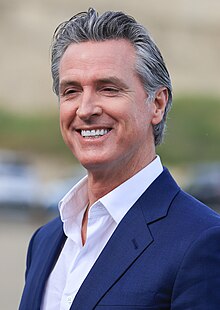
California Governor Gavin Newsom
Sb 1047 has officially passed the final votes in the state’s Senate and it is now up to Governor Gavin Newsom whether or not he signs it into law. He will have to weigh up the potential of the most extreme theoretical risks of AI systems against potentially going against California's AI boom. He has until the 30th of September to sign SB 1047 into law, or veto it altogether. While very few AI models currently exist which would be large enough to to be covered by the bill, its the future of AI which must be considered in the here and now.
If Newsom does sign the bill then the immediate impact will not be felt straight away. Tech companies would need to write safety reports for their AI models starting from the 1st of January 2025. From then the attorney general in California could request an injunctive order, requiring an AI company to stop training or operating their AI models.
The Board of Frontier Models would be created and start collecting safety reports from tech companies in 2026. This would consist of nine people, selected by California’s governor and legislature, to make recommendations to California’s attorney general about companies who do, or do not, comply. Auditors would need to be hired by AI model developers to assess their safety procedures from 2026 onwards, and from 2027 the Board of Frontier Models could start issuing guidance to AI model developers on how to safely and securely train and operate AI models.
Its an interesting time ahead for all interested in the development of AI models. Whether or not you agree with the bill, it will be fascinating to see if it gets signed and the overall impact that will have on future developments in the sector.
Have a great day.
Peace. CryptoGod-1.
Referral Links and Follow Me:






