
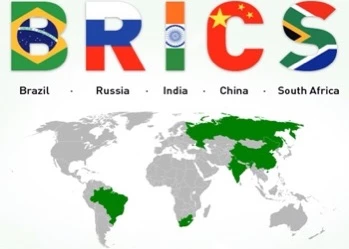
The BRICS (a name that identifies Brazil, Russia, India, China and South Africa) recently met to discuss the possibility of developing together a new payment system capable of facilitating trade and reducing US interference in international financial regulations, as well as clearly reduce the dependence of the new emerging economies on the American dollar. The Russian RBC reported this with an article that immediately aroused the interest of the major news sites, not only those dealing with cryptocurrencies but also those dealing with finance and economics; the official arrived instead following the statements of Kirill Dmitriev, general director of the Russian Direct Investment Fund (RDIF) which, according to what is learned, should take care of developing the new payment system. Nikita Kulikov, a member of the council of experts of the State Duma, has however specified to RBC that the solution currently under study is not a real cryptocurrency but a simple payment platform aimed at simplifying trade relations between the participating countries; more than a cryptocurrency, therefore, we are faced with the possibility that the BRICS decide to equip themselves with a blockchain platform through which to manage the flow of documents that characterize certain types of transactions.
Such a platform would make it possible to reduce the enormous quantity of documents, prepared and distributed manually up to now, reducing the time required for the management of a commercial transaction and allowing a real-time view of the agreements signed, which would obviously be visible to all thus also improving the transparency of the system and increasing trust between commercial partners. All this would work without a native crypt upstream, the new platform would continue to use the fiat currencies of the various countries to manage transactions and would still have an impact, to date not easy to measure, in reducing the dependence of the respective countries from the American dollar. It is Dmitriev himself who confirms that the BRICS countries have already reduced their recourse to the US dollar in mutual trade relations; the use of the dollar would in fact have fallen by almost half over the past five years while ruble-based transactions have increased from 3% to 14%. This shows once again how the impact of fintech technologies does not represent a systemic risk for global finance but constitutes a real risk only due to the hegemony of the dollar on global markets, a hegemony that, until now, has also produced effects politicians who, clearly, many countries no longer seem willing to accept; it will still take time but it now appears indisputable that the era of the US dollar is coming to an end and that soon on the global markets the US currency will no longer be considered the reference currency. If all this will happen as a result of the simple implementation of the blockchain technology or if instead it will result as a consequence of the unstoppable rise of bitcoin, it is still difficult to understand, but it seems quite obvious that many more countries decide to exploit the new technologies to free themselves from American superpower which is based precisely on the hegemony of the dollar.






