
Facebook has unveiled the first details of its project to become a bank. The key elements are the creation of a cryptocurrency, Libra, and the co-foundation of a non-profit organization, Libra Association, which will act as the central monetary authority.
The role of the Libra Association
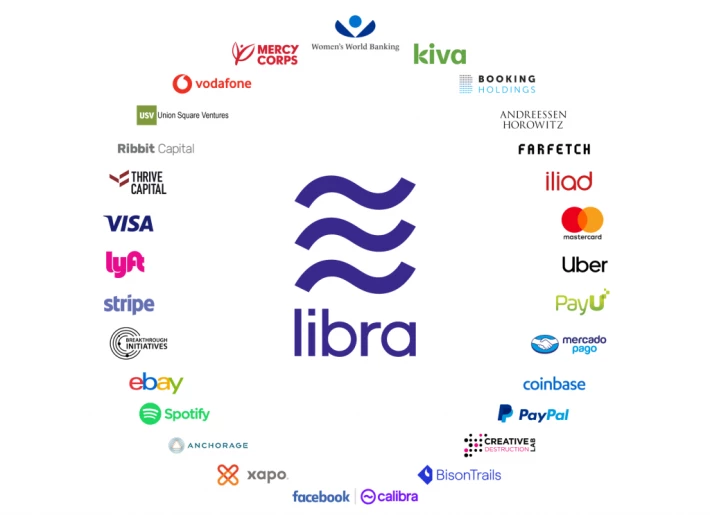
Within the Facebook association, through its company Calibra, it will have the same right to vote as the other participants, so far 28 but up to 100. These include Mastercard, Visa, PayPal, Vodafone, Spotify, eBay, Uber, Andreessen Horowitz . Their task will be to manage money, expand the network, promote the development of the open source programming language Move (at the base of the process's operation), involve companies to make them accept the new currency. Some of them, with particular characteristics, will also be able to manage transaction nodes (in the bitcoin model, instead, there is total decentralization). Whoever makes an investment of at least 10 million dollars will participate in a share, proportional to the investment, of the interests produced by the assets held by the association.
What is Libra and how does it work?
Libra, from the name of the monetary unit of ancient Rome, is a cryptocurrency that is a virtual currency that exploits the blockchain technology. It is called "stable coin" because, unlike bitcoins, its value is anchored to a basket of goods (including "bank deposits and government bonds in currencies from stable and respectable central banks"). This will guarantee the stability of the value or avoid the volatility due to speculative attacks.
Libra can be purchased through an electronic wallet with current currencies. The first digital wallet will be Calibra, created by the homonymous company of Facebook, usable from 2020 on its network. To register, just download the app, but you won't need a Facebook profile to use it. You will be asked to provide a valid ID, which will be verified.
With Calibra you can exchange "pounds" with other purse holders (which will be created according to the association's specifications). Surely this method of monetary transfer can take place through WhatsApp, Messenger, Facebook, Instagram, but also other platforms can integrate it.
David Markus, head of Calibra, specified that account information and customer financial data will not be used to improve the targeting of ads on the Facebook product family. However, they could be used to improve the service and meet legal obligations.

The advantages of Libra and the challenges
The new currency should be secure, easy to use and accessible even to those who do not have a bank account (over 1.7 billion people, especially in developing countries), because it should drastically lower the money transfer times and the transaction costs (it is not clear how much). Consequently it will also make it convenient to operate micro transactions.
The success of the initiative is not obvious: the Libra association must be able to involve new partners, convince developers to create apps to support the payment method, merchants to accept pounds and win all the technological challenges that this project implies (privacy , security, scalability).
Facebook wants to become a bank
Facebook wants to become a bank
Facebook, to overcome the current problems of trust, has promoted the entire initiative and will be the most fervent supporter, but does not want to be perceived as dominus.
Barclays expects it could get additional $ 19 billion in revenue by 2021. But how? The bet is that the adoption of this large-scale currency will increase the volume of transactions that will take place through its platforms. For a few pounds the boys will be able to buy virtual items (for example avatars to use on social media), we will instinctively buy goods and services, we will exchange money at a distance. Small companies can be encouraged to advertise more on Zuckerberg's networks (perhaps thanks to incentives).
But in the future Calibra could also offer all the other financial services we know, which is why there are no banks among the members of the association. And of course there are no big players like Google, Apple, Amazon, which certainly won't be watching.






