
The digital signature, the Bitcoin security mechanism
The value transfer system in Bitcoin is very simple.
If A wants to send 5 Bitcoins to B, it inserts this message in the Bitcoin network and each node that receives the transaction copies it on its own ledger and passes the message to the other nodes.
But how does a node make sure that the message is authentic? How does a node be sure that it was the real owner of Bitcoin (A) who sent the message?
Bitcoin uses a kind of password to unlock and send coins, this password is called digital signature.
Like a real signature, the digital signature proves the authenticity of the message.
The digital signature applies a mathematical algorithm to the transaction which prevents the digital transaction from being copied or counterfeited.
Each transaction requires a different digital signature, this is because since you are dealing with unknown interlocutors, you must not allow the recognition of a password that can be used by others to "sign" the transaction.
How the digital signature is made: public and private key
The digital signature works through the use of two keys, different but connected to each other: a private key, which is used to create the signature, and a public key, which is used for comparison.
In practice, the private key is like a password, while the public key is like an intermediary who proves that the password used is actually that but without having to reveal it.
Public keys are used in Bitcoin as the BTC reception address (short for Bitcoin currency).
When A sends money to B's address, he is sending it to his public key.
How the digital signature is created
When you spend money you have to prove that you are the real holder of a certain address.
To do this you need to create a digital signature, this is done using the transaction message and your private key.
The other nodes can use the digital signature you created and, through another function, verify that it corresponds with your public key.
Thanks to the mathematical properties of these functions, it is therefore possible to verify that the sender is actually using a certain private key without showing it.
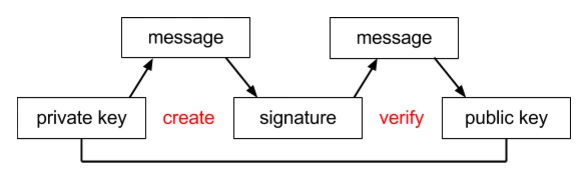
Another important thing, as we said earlier, is that the signature will be different for each transaction, precisely because the transaction message is used to create it, which is different every time.
This prevents this digital signature from being reused by others for different transactions.
The dependence on the message also means that nobody can actually change the message by passing it from one node to another without changing the digital signature (changing the transaction would invalidate the signature).
The mathematics behind these functions is very complicated, for those wishing to deepen these topics we recommend the search for:
- elliptic curve digital signature algorithm, e
- mathematical trap door.
Useful/Stonks link ALL TRUSTED:
My Exchange:
- KuCoin Exchange
- Coinbase
- Binance (YOU earn 10% for commission with this link)
Airdrop/Giveaway:
- WinPlay airdrop (multicrypto)
- Coinbase airdrop (50$): EOS- STELLAR
Faucet:
- Free BTC/ETH/DOGE multi-faucet (1 site, three crypto)
- Free Litecoin + Earn interest on holding
- Free Dogecoin + Earn interest on holding
- Free Bitcoin+ Earn interest on holding
- Free Bitcoin Cash + Earn Interest on holding
- Free Ethereum + Earn Interest on holding
- Free Monero + Earn Interest on holding
Cloud Mining FREE:
Earn for internet connection:






