
How to generate a Bitcoin address
Generating a Bitcoin address, or a public key, is completely anonymous and can also be done without connecting to the network.
The software wallets now allow the generation of an address simply by clicking a button that creates the key pair: public and private.
Why don't you need network access?
Since there are a very large number of addresses available, there is also no need to check that someone else already has the same address.
Unlike registering an email address, where most of the times we find ourselves trying to find addresses that are already taken, the number of possible Bitcoin addresses is so high (1.46 x 10 ^ 48 or 2 ^ 160) to avoid this problem and protect the Bitcoin network from other threats.
Let's quantify the possible addresses with a comparison
Some estimates of how many grains of sand are present on earth speak of a number equal to 7.5 x 10 ^ 18.
Even if each grain of sand represented a world with the same amount of grain of sand, the total number would be in the order of 10 ^ 36, which is always much less than the number of possible Bitcoin addresses which is in the order of 10 ^ 48. .
What is the level of security for Bitcoin transactions given?
Up to now we have talked about digital signature to confirm the actual ownership of a specific address and references to previous transactions to confirm that an address has enough money to spend.
Unfortunately, there is still a security problem that can blow up the process of checking unspent BTC, or the problem of the order of transactions.
We keep in mind the fact that transactions are passed from node to node across the entire network: there is no guarantee that the order in which I receive 2 transactions is the same order in which these transactions were created.
Furthermore, I cannot trust the timestamp (given on the computer) on the transaction because it is easily falsifiable by the person who creates the transaction.
Being unable to say whether one transaction comes before another gives way to possible fraud.
Let's take an example:
A user A could create a transaction to give BTC to B, wait for B to send the product and then create another transaction that reports the same input as the first to A.
Due to differences in the propagation of transactions on the network, some nodes may receive transaction 1 first and others may receive transaction 2.
All nodes that would receive transaction 2 first would consider transaction 1 invalid, since it is trying to use an already spent transaction as input.
So B would have sent the product but would not receive what was due to him!
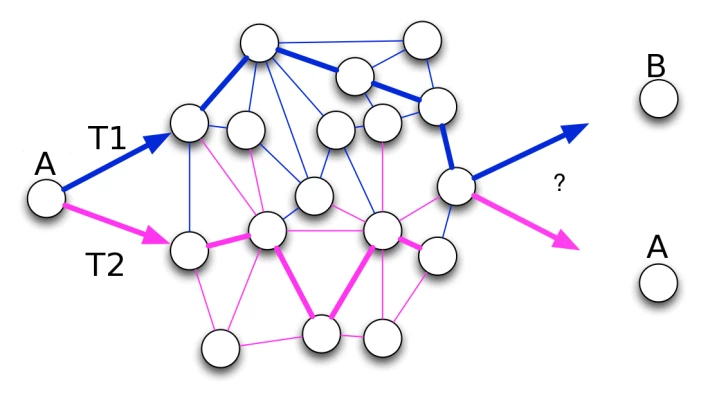
Moreover, on the network there would be no agreement on who actually has the money at this moment since the nodes that receive transaction 1 first connect the money to B (rightly) while those who receive transaction 2 first impute the money to A (which would have reported a fraud called Double Spending).
To solve the aforementioned problem, a mechanism must be set up that allows the nodes to agree on a unique order of transactions.
This is a not insignificant problem for a decentralized network.
The solution to this problem is called BlockChain and we will see how it works in detail in the next part.
Useful/Stonks link ALL TRUSTED:
My Exchange:
- KuCoin Exchange
- Coinbase
- Binance (YOU earn 10% for commission with this link)
Airdrop/Giveaway:
- WinPlay airdrop (multicrypto)
- Coinbase airdrop (50$): EOS- STELLAR
Faucet:
- Free BTC/ETH/DOGE multi-faucet (1 site, three crypto)
- Free Litecoin + Earn interest on holding
- Free Dogecoin + Earn interest on holding
- Free Bitcoin+ Earn interest on holding
- Free Bitcoin Cash + Earn Interest on holding
- Free Ethereum + Earn Interest on holding
- Free Monero + Earn Interest on holding
Cloud Mining FREE:
Earn for internet connection:






