
You are reading an excerpt from our free but shortened abridged report! While still packed with incredible research and data, for just $20/month you can upgrade to our FULL library of 50+ reports (including this one) and complete industry-leading analysis on the top crypto assets.

Becoming a Premium member means enjoying all the perks of a Basic membership PLUS:
- Full-length CORE Reports: More technical, in-depth research, actionable insights, and potential market alpha for serious crypto users
- Early access to future CORE ratings: Being early is sometimes just as important as being right!
- Premium Member CORE+ Reports: Coverage on the top issues pertaining to crypto users like bridge security, layer two solutions, DeFi plays, and more
- CORE report Audio playback: Don’t want to read? No problem! Listen on the go.
Will Solana ever recover and reclaim its status as a top-3 smart contract platform? Or will it fade away into irrelevance, much like EOS has over the last ~4 years? Let’s dig into their similarities and key differences to help find that answer.
Overview
Solana and EOS are both major layer 1 blockchains known for their high theoretical transaction speeds and emphasis on dApp development. Besides this similarity, interested users should consider other aspects to better distinguish the two blockchains. Solana and EOS differ regarding consensus mechanisms, tokenomics, scalability, and recent user/developer activity. Unfortunately, both blockchains struggle with decentralization. All of these factors affect the health of their dApp ecosystems.
EOS vs. SOL: Transaction Speeds
Transaction speeds are ultimately relative, so before identifying whether a protocol is “faster” from simply observing the TPS, it's necessary to gauge how safe and non-faulty the transactions are likely to be. Bitcoin, the most secure PoW-based protocol, has an average of 7 TPS, and Ethereum, a now PoS-based chain, can handle an average of 21 TPS. These transaction speeds are a function of the limited supply and higher demand of these tokens. Due to the congestion of demand, transaction and gas fees can be very high on these networks.
Solana unapologetically relies heavily on advancements in hardware to scale its blockchain. The Solana team is betting that the computer hardware industry will keep improving (Moore’s Law) despite this relationship showing signs of slowing down in the last five years.
In the monolithic blockchain approach, network scalability is constrained to what the single weakest node can process. This means the performance of the chain is thereby limited by hardware/computer performance, e.g., higher throughput is only achieved by more expensive, performant hardware. As of Q4 2022, Solana has been able to achieve a blazing-fast blockchain for today’s standards with a sufficient amount of nodes (relative), making it a great choice on the performance-decentralization spectrum.
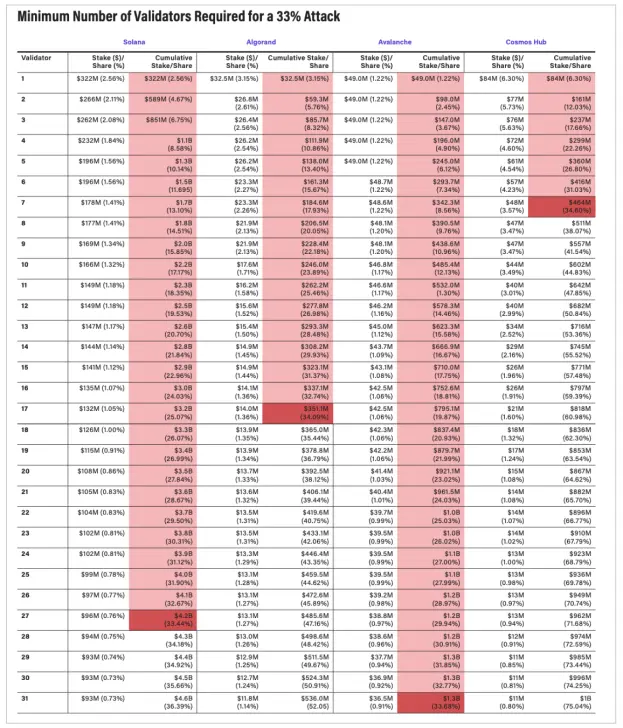
However, ~1,000 or even 50,000 TPS won’t be sufficient if adoption continues to grow and Solana delivers on some of its dApp and DeFi promises. Therefore, more specialized and expensive hardware will be required to run the chain. Therefore, if Solana continues to grow, network health and governance will be maintained by a select few that have the access, technical prowess, and capital to run these machines. Solana’s growth actually makes it more difficult to maintain the same performance and decentralization guarantees.
Solana has a notoriously low transaction fee of $0.00025 and a higher average TPS of 2,000+. Solana uses its “Turbine” mechanism to make the validating process faster. Leaders bundle transactions onto the “data plane,” where the rest of the validators can confirm that the entry is valid. Because the time it takes for nodes to synchronize is the square of the number of nodes, validator nodes in a cluster are separated into neighborhoods, and the leader sends different batches of transactions to the different neighborhoods. The validators in the neighborhood share their received data with all the other validators in the same neighborhood. Then, they each only share data with one single node in a different neighborhood.
Another reason for Solana’s high TPS is that most transactions on Solana take into account voting and validator synchronization transactions. Transactions on Solana can be divided into either consensus votes or token transfers and smart contract logic. Non-vote transactions are analogous to EVM transaction counts and represent the actual economic activity on the network. If validators on the network increase, then the number of vote transactions also increases regardless of any meaningful financial activity or adoption.
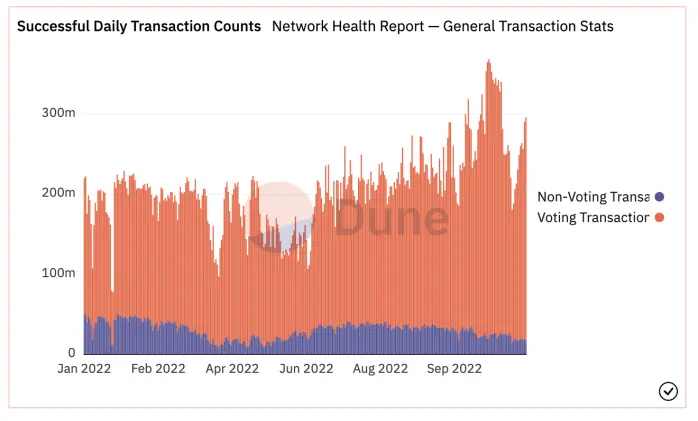
This means TPS numbers purported by Solana aren’t an “apples-to-apples” comparison with most other chains that don’t count such metrics. This is because Solana is (one of) the only blockchains that hold consensus votes on chain—a process that accounts for up to ~85% of the TPS numbers. Filtering for consensus votes, Solana operates much closer to 300-1,000 TPS, depending on the period.
Since EOS only has 21 BPs, its transactions can be verified very quickly (4,000 TPS in testnet environments). However, this doesn’t necessarily mean that all validated transactions are secure. PoW consensus mechanisms have rigorous built-in security as does a non-DPoS mechanism, where faulty validator nodes are “kicked” out, thereby increasing network security. If a major BP was validating invalid transactions, then the chain’s security is compromised writ large as invalid blocks of data could more likely be added to the chain in the future. In short, there's a tradeoff between the speed and validity of transactions.
Source: Kraken
EOS is currently inactive compared to Solana. Although EOS can potentially reach 4,000 TPS, its average TPS is below 10. Unfortunately, EOS’s blockchain uses aren’t being fully leveraged, as indicated by its low TPS and usage.
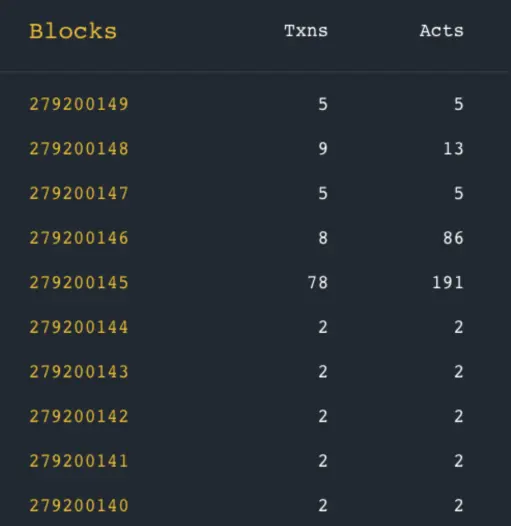
EOS blocks and number of included transactions, November 17, 2022. Source
Scalability
EOS uses separate layer 2 solutions and sidechains to offload specific use case transactions to other sub-chains with their own native tokens. Sidechains reduce the time to process a by redirecting transaction subsets to a separate processing network from the mainnet blockchain, thereby reducing network traffic. Sidechains use EOS tokens to conduct their processes and there's distributed processing that allows the sidechain to communicate with the mainnet. Sidechains involve having a subset of the validator nodes synchronously communicate when verifying transactions without having to communicate with all of the validator nodes. While EOS has the upside of incorporating separate sidechain architectures to reduce congestion, EOS is unable to prevent block provider centralization. EOS’s DPoS mechanism necessitates cannibalization by having only 21 BPs process and verify a transaction to create a block.
In some cases, EOS sidechains are used to prevent against this specific centralization issue by implementing consensus mechanisms that are more evenly distributed. Sidechains specifically handpick block providers from the mainnet to validate sidechain transactions. Examples of EOS-based sidechain solutions include Telos, a sidechain used to build decentralized applications (dApps) that use more distributing voting (similar to Solana’s architecture), and EOSForce, which also takes a similar stance in reducing centralization by having users vote for one BP per token. Even though some sidechains have tried to tackle the problem of EOS’ centralization, some propagate the presence of more centralized BPs. One example, Worbli, is a sidechain that maintains strict regulatory compliance and a vetting process for potential block providers.
The Solana network has been sustainable in furthering its growth by relying on its own innovative protocols to remove the congestion in hash processing while maintaining its decentralized nature. While Solana’s pure PoS format without any necessary layer 2 solutions to process transactions theoretically sounds ideal for stability, Solana has been plagued by repeated “degraded performance” and even six separate network outages in just two years.
While Solana’s monolithic design can be seen as a hindrance to its future scalability, even without the usage of side chains or sharding of chains, the chain can forgo a more complex distribution scheme. This includes having to facilitate communication between different chains and being more flexible in un-staking validator nodes to verify transactions if there were to be a network failure, causing nodes to become isolated and inactive.
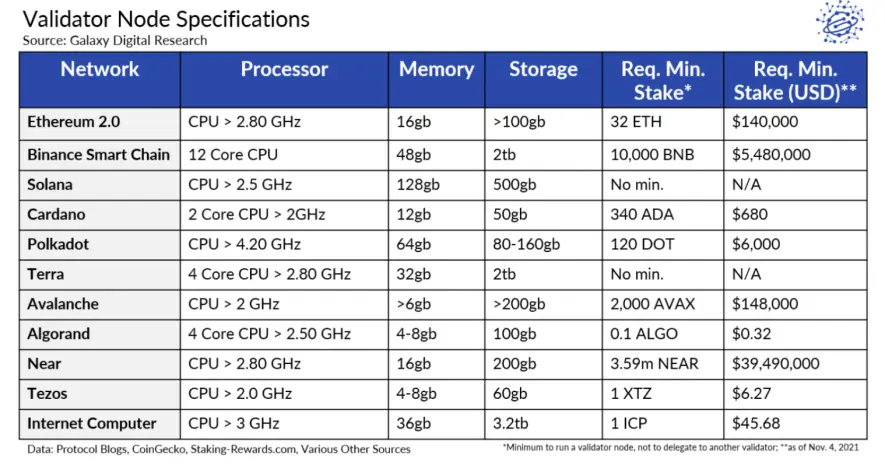
Another downside to monolithic blockchains is the validator cost to maintain a highly competitive blockchain. While there is no hard-coded minimum amount of SOL required to become a validator, it’s been stated that simply voting to agree with each block can cost up to 1.1 SOL daily. This could potentially cost 33 SOL per month or the equivalent of ~$10,000 per year based on Q4 2022 prices or ~$300,000 per year based on all-time high SOL prices. Due to the costs of running a validator (~50,000 SOL/$1 million delegated stake break-even cost), everyday users may choose to delegate their SOL.
For most of the population, this is simply already out of reach. Additionally, the hardware requirements for becoming a validator are also out of reach for many.
Source: Galaxy Digital Research
Blockchain throughput and node-sync comparison
Solana has also pumped out a variety of successful DeFi projects and protocols, such as Raydium, a powerful automated market maker (AMM) provider/exchange that provides liquidity for Solana-based projects and NFT collectible marketplaces. Because Solana reduces the resources necessary to stake and be on the network, there's a higher likelihood for more node validators to receive transaction fees. Also, more users can indicate increases in transaction demands, meaning there's a sustained stickiness to the Solana blockchain of which EOS doesn’t provide as much.
While Solana generally better prioritizes the availability of validator nodes by “kicking out” certain validator nodes and using other available nodes to lower transaction overhead, both Solana and EOS have experienced some exploitations of vulnerabilities that implicate future use and reduce privacy. An exchange on EOS verified and accepted tokens called “EOS” without making sure they were legitimate EOS tokens created by the system account. Decentralized applications built on EOS, such as EOSBet (a gambling dApp), have been hacked numerous times.
Regarding known Solana network vulnerabilities, in 2022, over 8,000 Solana hot wallets on popular wallets, such as Phantom, Slope, and TrustWallet were drained of over $5 million USD in SOL without the users’ knowledge. Additionally, Solana has suffered from several network outages that have lasted for hours due to network resource exhaustion and the reduction in the volume of blocks added to the chain. These examples of exploitation may pose as disincentives to potential developers in both ecosystems. The relatively low and restricted number of block providers and validators on the EOS network increases the risk of a network security compromise as there would be fewer validators that could verify new information being encoded into the newly produced blocks.






