You are reading an excerpt from our free but shortened abridged report! While still packed with incredible research and data, for just $20/month you can upgrade to our FULL library of 50+ reports (including this one) and complete industry-leading analysis on the top crypto assets.

Becoming a Premium member means enjoying all the perks of a Basic membership PLUS:
- Full-length CORE Reports: More technical, in-depth research, actionable insights, and potential market alpha for serious crypto users
- Early access to future CORE ratings: Being early is sometimes just as important as being right!
- Premium Member CORE+ Reports: Coverage on the top issues pertaining to crypto users like bridge security, layer two solutions, DeFi plays, and more
- CORE report Audio playback: Don’t want to read? No problem! Listen on the go.
Intro
“EVM Parallelization” is a top buzzword/narrative heading into 2024. Understanding the intricacies of blockchain states is foundational to appreciating the advancements in Parallel Ethereum Virtual Machines (EVMs). So, let’s start there.
A blockchain state is an immutable ledger reflecting all transactions ever made on the network. All blockchains start with a beginning/genesis/very first block. Once that has taken place, each subsequent block comprises transactions that advance the state forward. How the blockchain records those state transitions (blocks) varies among the different protocols. This choice has profound ramifications for the entire protocol moving forward but also for the wallets that will support it. Let’s look at a couple of approaches before we dig into what exactly a crypto “wallet” is.

This includes updating balances and smart contract storage, among others. Presently, the UTXO, Account-Based, and Object-Centric models are predominantly employed in managing states across various public blockchains like Bitcoin, Ethereum/Solana, and SUI, respectively. Let’s quickly look at each.
UTXO
The UTXO (Unspent Transaction Output) model is the foundational method of maintaining blockchain records and is utilized by cryptocurrencies such as Bitcoin, Zcash, and even new projects like Fuel. UTXO refers to the remaining amount of crypto unspent after executing a transaction. In the context of UTXO-modeled blockchain, individuals do not directly transact specific amounts of digital currency but instead transact in the denomination of UTXOs.
For a blockchain utilizing the UTXO model (like Bitcoin), there aren’t actually accounts or wallets at the protocol layer. Instead, bitcoin(s) simply exist as a list of unspent transaction outputs or UTXOs. Each UTXO has a quantity and a requirement for spending it. Transactions are generated by consuming current UTXOs and producing new UTXOs in their stead.
In the example below, Alice owns 1.2 BTC. She only needs to spend 0.2 BTC for her purchase. Therefore, because of the way the Bitcoin blockchain works, she will send all 1.2 BTC. 0.2 BTC will then go towards her purchase, and 1.0 BTC will be returned to her. It is very similar to only having a $20 bill and buying something for $5. You must hand over your $20 and get $15 returned to you.
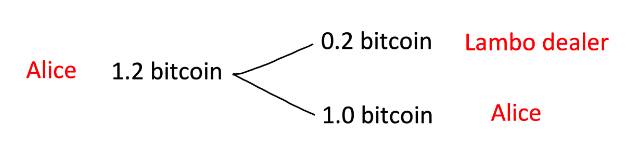
The UTXO (Unspent Transaction Output) model is similar to cash change in that it represents unspent funds but differs in that cash change has fixed denominations, while UTXOs can have fractional values. Additionally, cash change transactions are not recorded, while the record of UTXOs is permanently recorded on the blockchain ledger. The balance of an address can be determined at any point in time by tracing its recorded UTXOs.
The UTXO model has both advantages and disadvantages for Bitcoin-based wallets. On the one hand, it promotes privacy-preserving behavior as it is difficult to link digital assets to a specific wallet due to the creation of new addresses with each UTXO. On the other hand, it poses challenges in terms of user interface and experience as users are accustomed to the concept of accounts, whereas the UTXO model operates without the concept of an account, requiring users to rely on their wallet provider to manage a range of addresses and sum up the corresponding UTXO balances.
Accounts
The Account-Balance model is an alternative method of maintaining blockchain records, primarily employed by smart contract platforms such as Ethereum and Binance Chain (BNB). It emerged as a solution to the challenges faced by Ethereum developers in adapting the privacy-focused, disconnected logic of the UTXO model to the accounts of decentralized applications (dApps).
Unlike the UTXO model, which resembles cash-based accounting, the Account-Balance model resembles bank-based accounting. On smart contract platforms, each wallet address has a single balance, which is increased or decreased with the receipt or transfer of funds respectively.
The Account-Balance model, as used in Ethereum, functions as follows:
- Jan has 10 ETH and wishes to transfer 5 ETH to Steve. The system first deducts 5 ETH from Jan’s account, resulting in Jan now having 5 ETH.
- The system then increases Steve’s account by 5 ETH. Since the system is aware that Steve already has 5 ETH, Steve’s final balance is 10 ETH.
While the Account-Balance model allows wallets to derive account balances in a much more straightforward and efficient manner compared to the UTXO model, it should be noted that it is more susceptible to double-spending attacks as compared to the UTXO model.
The method of record-keeping employed by a blockchain is crucial as it directly affects how a crypto wallet derives digital asset holdings. If a wallet cannot conform to the blockchain's mode of record-keeping, it is not functional. For instance, if a Bitcoin-based wallet provider is unable to handle the complexity of the UTXO model and track all the new addresses associated with UTXOs, it will result in a perceived loss of funds for the wallet user.
 Source: Kraken
Object-centric
At the heart of the Aptos and Sui blockchains asset management is a distinctive approach centered around the "resource" concept, derived from the Move programming language. This resource-centric model facilitates a scarcity-based representation of assets and enhances access control mechanisms. Distinctively, each account on the Aptos blockchain is identifiable by a unique 32-byte address and is capable of storing data in what are termed "resources," elevating these accounts beyond simple asset containers.
In conventional blockchain systems, activities primarily revolve around altering data linked to addresses. For instance, a standard transaction such as "Jan pays Tom 1 USDC" necessitates two ledger updates: one deducting from Jan’s account and another crediting Tom’s account. This approach underscores a traditional ledger's operational mechanics, where each block within the universal ledger encapsulates numerous such transactions, recording all historical transactions for all assets.
Conversely, Aptos shifts focus from addresses to "objects". Most activities involve modifying data related to specific objects—be it tokens, smart contracts, or other entities on the chain. Each object has attributes like owner address, read/write permissions, transferability, and specific functionalities. Notably, simple transfers in this system might only require updating the ownership attribute of the relevant object, streamlining the transaction process.
Aptos' novel approach to resource management yields several enhancements to user experience over traditional blockchains. It integrates transaction viability protection to prevent inadvertent endorsements, thus minimizing unintentional transactions. This system ensures each transaction's viability is scrutinized, offering an additional layer of user protection. Furthermore, the pre-signature transaction transparency feature plays a critical role in security by providing detailed previews of potential transaction outcomes. This allows users to foresee and understand the implications of their transactions before confirmation, incorporating insights from previous attack patterns and known harmful contracts. This mechanism is a testament to Aptos' commitment to not just innovating in asset management and transaction efficiency but also prioritizing user security and transparency in an increasingly complex blockchain landscape.
Beyond Sequential Transaction Processing
Back to typical blockchains…. The efficiency of a public blockchain is inherently tied to its state management capabilities. Enhanced state management techniques directly contribute to increased throughput and improved user experiences. Techniques like parallel processing, database optimization, hardware acceleration, offchain scaling, smart contract design, and historical data pruning are pivotal in this regard.
Traditional models like those employed by Bitcoin and Ethereum process transactions sequentially, capping the performance. Parallel processing emerges as a revolutionary technique to overcome these limitations. It encompasses database level and Virtual Machine (VM) level approaches, each with unique methodologies and implementations. Database level approaches include sharding and DAGs, utilized by platforms like NEAR Protocol, Hedera, and Fantom. These methods distribute blockchain data across multiple nodes or arrange them in a network for concurrent processing.
VM-level approaches, however, focus on the blockchain's software environment, which is responsible for deploying smart contracts, validating transactions, and updating the blockchain state. Techniques like Optimistic Concurrency Control (OCC), Software Transactional Memory (STM), and Solana’s SeaLevel are prime examples. OCC, employed by networks such as Sei Network, processes transactions optimistically, resolving conflicts post-detection. STM offers a higher-level abstraction for managing concurrent transactions, automatically detecting and resolving conflicts. SeaLevel enables Solana to process different transactions concurrently so long as they do not touch the same state.
What is Parallel Execution?
Parallel execution in cryptocurrency refers to the ability to process and execute multiple transactions simultaneously rather than sequentially. In traditional cryptocurrencies, such as Bitcoin and Ethereum, transactions are executed one after the other in a linear order to ensure that one transaction’s outcome does not conflict with the next. Parallel execution is a way to increase a cryptocurrency network’s scalability and can help to reduce latency and improve network performance.

In a parallel execution setup, multiple transactions are grouped together and processed in parallel by different validators on the network. This helps the network to handle a higher TPS, allowing for increased throughput and scalability. To ensure that the transactions are processed in the correct order, the blockchain network may implement consensus algorithms and protocols to establish the transaction order and reach agreement between all participating validators.