
You are reading an excerpt from our free but shortened abridged report! While still packed with incredible research and data, for just $20/month you can upgrade to our FULL library of 50+ reports (including this one) and complete industry-leading analysis on the top crypto assets.

Becoming a Premium member means enjoying all the perks of a Basic membership PLUS:
- Full-length CORE Reports: More technical, in-depth research, actionable insights, and potential market alpha for serious crypto users
- Early access to future CORE ratings: Being early is sometimes just as important as being right!
- Premium Member CORE+ Reports: Coverage on the top issues pertaining to crypto users like bridge security, layer two solutions, DeFi plays, and more
- CORE report Audio playback: Don’t want to read? No problem! Listen on the go.
What is Metis?
Metis is an L2 scaling solution on Ethereum that's best described as an EVM-equivalent, sharded Optimistic Validium featuring a Dynamic Bond Threshold staking design. Metis began as a “regular” Optimistic rollup (OR) but later transitioned to the validium model in April 2022, in which it no longer posts calldata to the Ethereum L1 but rather to a different DA layer. Recall, posting calldata is essential so that independent validators on the L1 can verify the validity of the data (state root) coming from the L2.
The METIS token is used to pay transaction fees on the rollup, stake to become a sequencer, and for fraud challenge incentives.
Pros
- Parallel sequencers
- No-code integration via a middleware layer powered by smart contract templates
- DAC (Decentralized autonomous company) infrastructure enables both blockchain and Web2.0 companies to build decentralized businesses on-chain while enjoying the decentralization and security of Ethereum
- Withdrawal period could (theoretically) take minutes (rather than days)
- Plans to inherit Optimism’s EVM Equivalence
Resources
Fees paid to L1
Metis Tokenomics ($METIS)
The METIS token is used for transaction fees while returning 30% of the gas paid to protocols that build on the network. METIS is also used to encourage decentralization and security among its sequencers. Instead of relying on a single sequencer run by the team, Metis intends to allow third parties to also run sequencers by staking METIS to financially prove their honesty.
The Metis Team is led by Co-Founders Elena Sinelnikova, Kevin Liu, and Yuan Su. Elena is a software developer and entrepreneur known for leading the CryptoChicks organization, and Kevin is a serial entrepreneur who's a researcher and practitioner of DAOs, governance protocols, and the token economy. Yuan Su is a veteran Ethereum developer and Optimistic rollup expert.
Metis uses a sequencer whose role is to bundle transactions and send them back to the Ethereum chain. Multiple transactions are picked from a pool randomly for work, and the process is democratized or done to prevent a single point of failure.
Sequencers, and eventually Rangers, are required to stake METIS to verify transactions. In this way, Metis effectively replicates the Proof-of-Stake model whereby a random sequencer is selected from the entire pool of sequences to submit a recorded transaction to the Ethereum chain. A sequencer is rewarded in METIS tokens for carrying out duties, similar to how validators on Ethereum earn ETH.
Dynamic Bond Threshold (DBT)
The Dynamic Bond Threshold staking design dictates Sequencers can't sequence blocks if their stake is worth less than the amount they’re sequencing. Transactions are blocked until an eligible sequencer is found, limiting the size of the transaction value.
The minimum number of $METIS required to participate is an amount greater than the Dynamic Bond Threshold (DBT). The DBT is the value of the total transactions in the sequence blocks, meaning if a block has $100 worth of transactions, a Sequencer would need a minimum of $100 worth of $METIS staked. If they don’t have enough, another Sequencer with enough staked $METIS will be selected.

Despite the separate execution layers, liquidity in Metis between the shards can flow frictionlessly due to the MVM cross-layer communication protocol. The goal is to scale horizontally with distinct, application-specific execution layers that are while also preserving the security of Ethereum via fraud proof submission to mainnet.
Finally, Metis will also implement a fraud detection system called the ‘Ranger system.’ In essence, the Ranger system is a network of nodes that monitor sequencers for bad behavior. The Rangers constantly check the fraud proofs for validity. This active “watchdog” system results in a shorter challenge period since some simultaneous effort to detect fraud has already occurred and not just assumed to be valid.
Rangers are there to police dishonest sequencers as a system of active checks and balances. Rangers compete for bounties in the form of Metis rewards to detect fraudulent transactions. Due to this ranger system, the withdrawal process on Metis has been shortened from a week to only hours or even just minutes using Celer as a third-party liquidity provider who will take on the challenge risk for a user for a small fee.
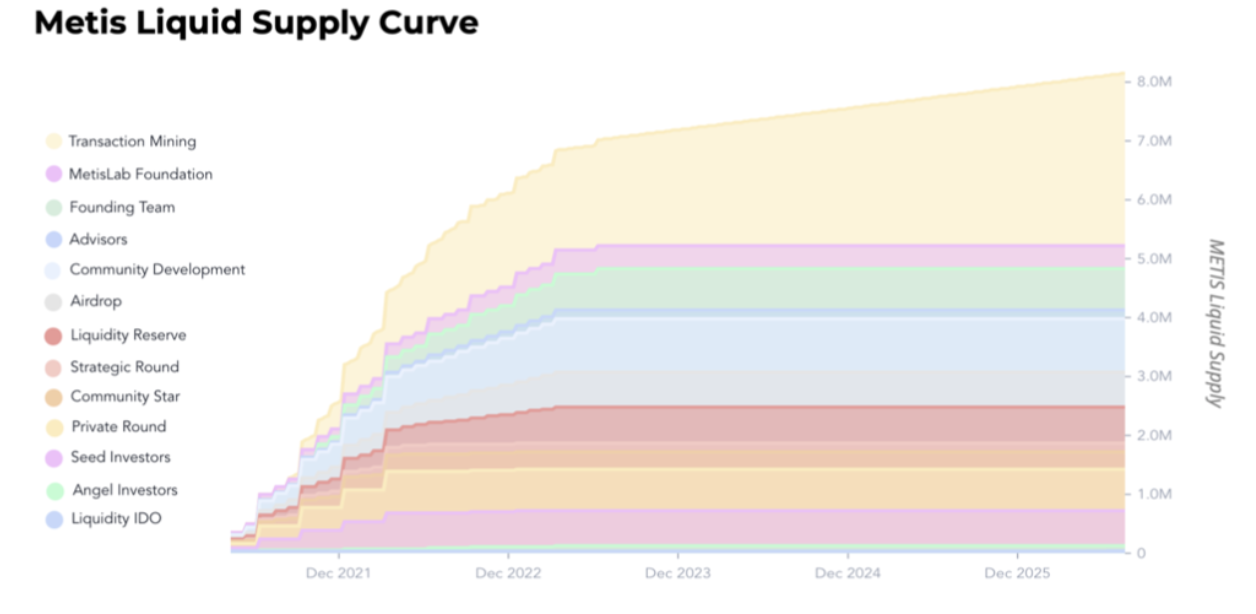
With the launch of the Ranger system comes the beginning of mining rewards for Rangers. 5 million Metis tokens have been reserved for these incentives and are designed to be distributed over nine years as follows:
- Founding Team: 7%
- MetisLab Foundation: 4%
- Advisors: 1.5%
- Investors: 18%
- Airdrop: 6%
- Liquidity Reserve: 6%
- Community Development: 9%
The remaining 47.7% of the lifetime token supply will be minted over the next 10 years.
Total supply after 10 years: 10 million
Metis Governance
Built initially to facilitate governance for DAOs, Metis appears to have failed to make a substantial impact in this regard. Instead, it has become a lackluster L2 struggling with adoption. Metis focuses on enabling enterprises to engage in Web3 using DACs, which have likely not yet reached their full potential. If/when DACs acquire more popularity in the future, this may become a more pertinent indicator of Metis' performance.
However, Metis is still continuing to work on itself, including its own governance. A new governance system is to be implemented, which includes a reputation system via soulbound tokens and new governance structures, 'Commons' and 'Eco Nodes.' The governance process starts with Commons proposing MIPs, and if it passes, it goes to Eco Nodes for final decision.
In January 2023, Metis announced KORIS. KORIS is the first DAC implementation. Developed and incubated by the MetisDAO Foundation, KORIS aims to address the unique requirements of decentralized companies, which now employ a workforce of nearly two million people. Treasuries in the crypto space have surpassed $16 billion, but there remains a dearth of efficient systems for decentralized companies to manage the daily operations of their workforce. KORIS addresses the limitations of traditional DAO platforms by providing a comprehensive infrastructure for DACs, with a suite of tools focused on streamlining business operations, such as task management, community management, and payment management, to meet the needs of customers looking to launch and grow web3 businesses.
With KORIS, web3 companies have access to a range of features, including:
- Treasury management (utilizing Gnosis Safe)
- Payroll management tools
- Enhanced governance tooling
- Gasless transactions
Metis Adoption
Metis boasts being the third largest Optimistic rollup by TVL. However, it is a distant third, lagging frontrunner Arbitrum and Optimism by orders of magnitude. The biggest dApps on Metis, as of January 2023, are Netswap, Hummus, and Hermes.

Netswap
Netswap is the leading DEX and largest protocol by TVL on Metis. It launched with similar features to Uniswap V2 and later built a launchpad. It does have an ambitious 2022-2023 roadmap, which includes a variety of functionalities such as limit orders, leveraged trading, prediction markets, lottery markets, governance functions for the NETT token, and an NFT marketplace.
Hummus
Hummus is a native Metis Stableswap AMM DEX. The platform allows users to deposit mUSDC, mUSDT, or mDAI into single-sided liquidity pools in exchange for the inflationary HUM token. Then, HUM can be staked in exchange for veHUM for yield. The platform distributes protocol fees directly back to liquidity providers. The protocol has announced a soon-to-be-implemented mechanism for fee distribution among veHUM holders, LP holders, and the protocol's treasury.

Source: Coin98
Hermes
Hermes is a modified fork of Solidly, which was developed by the team behind MaiaDAO. Solidly is a novel automated market maker (AMM) introduced by Andre Cronje. With Cronje at the helm, the protocol garnered a massive initial adoption wave that saw the protocol’s TVL rise to over $2 billion in 2021. Initially, the project had a mission of improving upon the functionalities released by Curve, including improving on the vote escrow token model and creating incentives to maintain liquidity on-chain.A key difference between Curve and Solidly is found in the rewards payout. Rather than paying users in the form of a token, users receive an NFT reward that can be traded on the market. Users also have the option of keeping their tokens locked for one to four years to alter the level of reward given.
It sought to address acknowledged difficulties with Curve's incentive structure, which supported TVL development but not trading activity, and the issue of dilution for veCRV model participants. With the introduction of Hermes V2, the Maia team intends to offer an omnichain environment to the DEX. By being omnichain, no bridge will be required, and liquidity will be centralized and unified.






