
You are reading an excerpt from our free but shortened abridged report! While still packed with incredible research and data, for just $20/month you can upgrade to our FULL library of 50+ reports (including this one) and complete industry-leading analysis on the top crypto assets.

Becoming a Premium member means enjoying all the perks of a Basic membership PLUS:
- Full-length CORE Reports: More technical, in-depth research, actionable insights, and potential market alpha for serious crypto users
- Early access to future CORE ratings: Being early is sometimes just as important as being right!
- Premium Member CORE+ Reports: Coverage on the top issues pertaining to crypto users like bridge security, layer two solutions, DeFi plays, and more
- CORE report Audio playback: Don’t want to read? No problem! Listen on the go.
RAI is an ETH over-collateralized stablecoin with a floating peg. RAI, as a decentralized stablecoin, represents a significant advancement in the world of cryptocurrencies by offering a stable and trustless medium of exchange that is not pegged to any traditional assets, thereby promoting increased autonomy, stability, and accessibility in the global financial ecosystem.
RAI Minting
To generate RAI, a user establishes a collateral debt position (CDP) that can be adversely affected under two circumstances:
- A significant drop in the collateral's value (ETH).
- A dramatic increase in the peg.
Should a user's debt become unstable, the collateral is sold at a discounted rate. This approach ensures that the stablecoin's value does not fall below the value of the locked collateral.
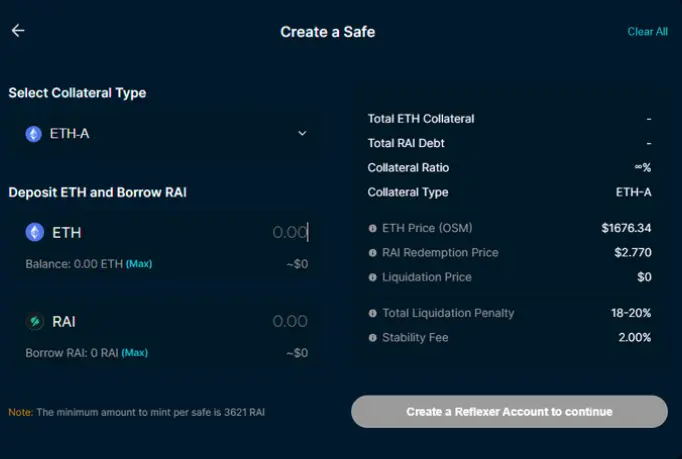
Reflexer functions in a manner analogous to the Maker protocol. Essentially, users can borrow RAI through Reflexer by depositing ETH as collateral into a "Safe." The borrowed RAI is subject to an interest rate known as the borrow rate, which determines the cost of borrowing against the deposited collateral.
The current debt/mint stats can be found here. At present, there are no unhealthy positions to liquidate.
Maintaining the Peg and the Reflexer Index
To effectively maintain equilibrium between supply and demand in a fully decentralized stablecoin ecosystem, incentives must be strategically offered to both users (those going long) and suppliers (those going short) of the stablecoin. One viable approach is the implementation of a mechanism rate that levies interest on debt (borne by the suppliers) and allocates it as credits to holders (the users). Interestingly, the interest rate can become negative when demand for holding outweighs stablecoin debt.
In March 2020, DAI depegged upward, with its market price exceeding $1, and only repegged after the addition of USDC, a centralized stablecoin pegged to $1, as a collateral form to mint DAI; otherwise, a negative interest rate would have been required. Since its inception, RAI has primarily exhibited negative interest rates, suggesting that decentralized stablecoins often necessitate negative interest rates.
Reflexer, borrowing several concepts from the original DAI paper—including negative interest rates and a floating price—developed the "reflex index." This innovative index is not pegged to any specific asset but is designed to mitigate the volatility inherent in its underlying collateral. The primary objective of a reflex index is to offer a more stable representation of collateral while preserving a high degree of trustlessness.
RAI's moving peg, known as the redemption price, commenced at an arbitrary price of $3.14, and its "peg" adjusts based on RAI's price on exchanges. Upon inception, the protocol initiates with an arbitrary redemption price. Once the Market Price (MP) deviates, the protocol establishes a per-second Redemption Rate, either increasing or reducing the Redemption Price (RP). In scenarios where interest rates are negative, RAI alters the stablecoin's actual price target instead of modifying the balance, resulting in a floating currency appearance with significantly reduced volatility compared to cryptocurrencies like Ether and Bitcoin.
RAI relies on arbitrage to stabilize its price:
- If RAI/USD < peg: it becomes profitable to purchase RAI from the market and burn it to repay debt.
- If RAI/USD > peg: it becomes profitable to mint RAI and sell it for USD, anticipating a lower price.
The peg is determined by the collateral redemption price, which constantly changes with a positive or negative rate:
- When RAI's market price > collateral redemption price: users are incentivized to mint more RAI to lower the price, resulting in a negative collateral redemption price change rate and reduced likelihood of liquidations.
- When RAI's market price < collateral redemption price: users are incentivized to burn more RAI to increase the price, leading to a positive collateral redemption price change rate and a higher likelihood of liquidations.
The redemption rate functions similarly to DAI's stability fee. However, this design proves more effective, as stability fees cannot become negative when prices need to decrease, whereas redemption rates can continue decreasing until the market price responds.
When ETH's price declines and a safe no longer possesses sufficient collateral, a liquidation event occurs, auctioning off the safe for others to purchase by providing additional collateral.
Another essential mechanism is the redemption rate adjustment. In RAI, the target is not a fixed USD quantity; it adjusts in response to market conditions:
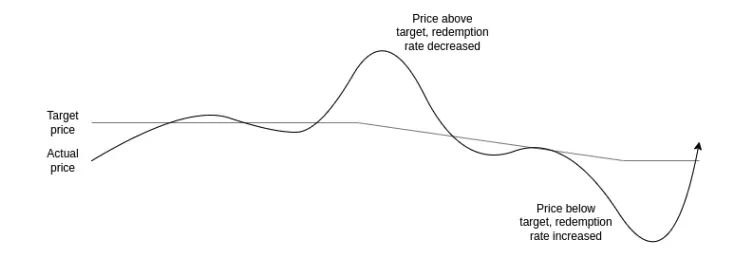
- If RAI's price is above the target, the redemption rate decreases, reducing RAI holding incentives and increasing negative RAI holding incentives by being a lender, subsequently lowering the price.
- If RAI's price is below the target, the redemption rate increases, enhancing RAI holding incentives and decreasing negative RAI holding incentives by being a lender, pushing the price upward.
RAI's security relies on an external asset, ETH, which facilitates a safer winding-down process. In cases of unbalanced demand decline, the redemption rate adjusts to equalize the two. Since lenders hold a leveraged position in ETH, not FLX, there is no risk of a positive-feedback loop causing reduced confidence in RAI and decreasing lending demand.
In an extreme case where all RAI holding demand disappears except for one holder, the redemption rate would dramatically increase, leading to the liquidation of every lender's safe. The remaining holder could buy the safe in the liquidation auction, use their RAI to clear the debt, and withdraw the ETH, ensuring a fair price for their RAI.






