
You are reading an excerpt from our free but shortened abridged report! While still packed with incredible research and data, for just $40/month you can upgrade to our FULL library of 60+ reports (including this one) and complete industry-leading analysis on the top crypto assets.

Becoming a Premium member means enjoying all the perks of a Basic membership PLUS:
- Full-length CORE Reports: More technical, in-depth research, actionable insights, and potential market alpha for serious crypto users
- Early access to future CORE ratings: Being early is sometimes just as important as being right!
- Premium Member CORE+ Reports: Coverage on the top issues pertaining to crypto users like bridge security, layer two solutions, DeFi plays, and more
- CORE report Audio playback: Don’t want to read? No problem! Listen on the go.

Overview
The future of digital transactions and interconnectivity lies in the realm of cross-chain messaging and interoperability. Pioneering this technology is deBridge, an inclusive platform that expands on the conventional concept of bridges in the blockchain world. Its fundamental proposition is to empower both users and developers by facilitating the seamless transmission of basic messages as well as intricate data sets from one chain to another. deBridge supports a broad spectrum of ecosystems including Ethereum, Polygon, Arbitrum, Solana, and Optimism. Its versatile infrastructure is utilized by notable applications such as Synapse, Perpetual Protocol, 1inch Network, Jupiter, and Neon EVM.
What sets deBridge apart is its expansive suite of developer-friendly tools. It fosters an environment of creativity and scalability, opening the doors for the development of sophisticated cross-chain applications. By leveraging its interoperability capabilities, developers have the flexibility to integrate its tools, such as SDK, API, or widget, into their platforms, enabling diverse cross-chain use cases, including token bridges, NFT bridges, cross-chain staking, lending, payments, and credentialing, among others.
DBN Token and Airdrop Announcement
deBridge originated as a project during the Spring 2021 Chainlink Virtual Hackathon. Created by Anastasia Kondaurova, Alex Smirnov, and Yaroslav Artyukh, the project won the grand prize and secured $8,000. Following this success, deBridge raised $5.5 million in a funding round led by ParaFi Capital, with participation from Animoca Brands, GSR, Crypto.com, IOSG Ventures, among others. Within ten months, deBridge launched its mainnet, marking a significant milestone.
On April 9, 2024, deBridge introduced deBridge Points to acknowledge user contributions. Early supporters will be rewarded retroactively, while new users will earn points based on their participation. This program incentivizes stakeholders, partners, integrators, and users to contribute to the ecosystem, with the initiative set to conclude upon the launch of the deBridge token.
In May 2024, deBridge announced the launch of the DBR token, which will play a crucial role in staking and governance. Token holders can stake DBR to participate in DAO governance, influencing strategic protocol decisions, such as electing active validators, setting consensus thresholds, and integrating new chains. The governance framework will manage the treasury and ecosystem reserves, enhancing the platform's security and operational efficiency.
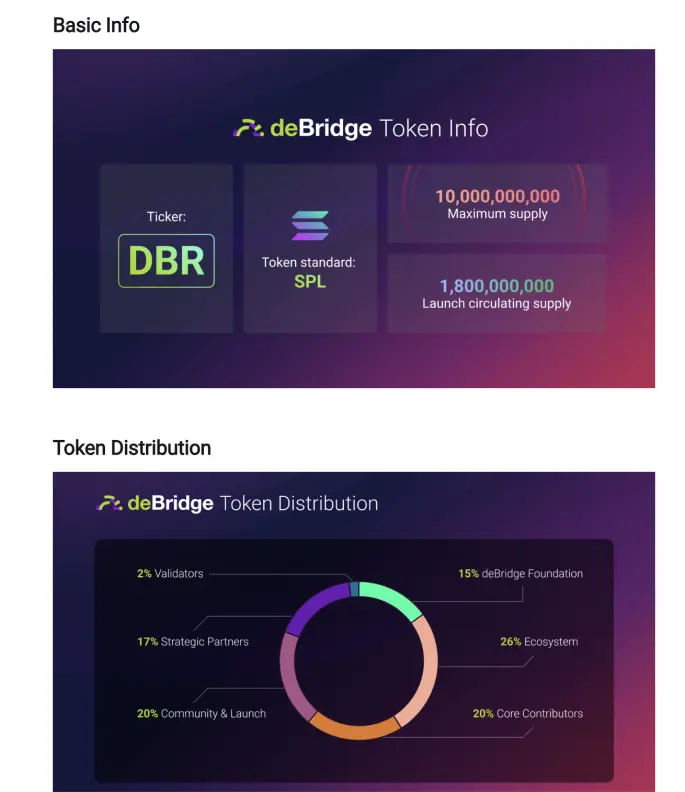
With the implementation of the delegated staking and slashing module, DBR can be staked for validators, increasing their collateral to guard against downtime, censorship, and collusion. Strategic partners and core contributors will have to wait for their tokens to vest before staking. As deBridge's governance framework evolves, the DAO will assume greater responsibilities, including the governance and upgradability of smart contracts.
Tech and DLN
Initially, deBridge relied on liquidity pools, but this approach encountered significant issues with scalability, security, and capital efficiency. High total value locked (TVL) in liquidity pools made them attractive targets for hackers, as seen in notorious exploits like Wormhole and Ronin. These security concerns, coupled with the inefficiencies of continuous interest payments for liquidity providers, highlighted the need for a more robust solution.
To overcome these challenges, deBridge introduced the deSwap Liquidity Network (DLN), shifting from liquidity pools to an intent-based approach. This model allows users to specify slippage tolerance and execution parameters, creating incentives for market makers to fulfill their intents. By decentralizing control and incentivizing market makers, DLN simplifies the process and enhances liquidity management.
DeBridge's transaction architecture consists of two primary layers: the on-chain Protocol Layer and the off-chain Infrastructure Layer. Transactions navigate through smart contracts on the source chain and, after being validated by deBridge's validators, the transactions are signed and published to the deBridge API. These signatures are saved to IPFS, where they can be accessed and passed through the smart contract on the destination chain. This process ensures a secure, validated transaction experience across chains, demonstrating deBridge's commitment to seamless, efficient, and secure cross-chain transactions
Furthermore, deBridge's hardhat plugin provides a safe environment for decentralized applications (dApps) to pilot various features before their deployment. Recognizing the possibility of downtime with some blockchains, deBridge's architecture comprises an off-chain transaction validation mechanism. This ensures that deBridge's transaction processing remains unaffected by potential interruptions in other chains. This distinctive architecture also removes the need for validators to relay transactions, thus enabling unlimited throughput and enhancing overall security by not exposing validators' IP addresses.
Every cross-chain transfer within deBridge's infrastructure is verifiable and transparent, accessible through deBridge’s Explorer. This open verification aligns with the principles of the cryptocurrency community of transparency and trust.
Security and Vulnerabilities (of the Liquidity Pool Model)
deBridge functions as a universal cross-chain messaging protocol, deriving its security from an external validator set and the cryptoeconomic guarantees arising from its delegated proof-of-stake mechanism. The validator set, as it stands today, is composed of 12 validators, with 11 currently operational. A crucial element to understand here is the functioning of the validator system. For a message to be verified as valid, it must bear the signature of at least 2/3 of the 11 validators, that is, 8 signatures. If eight validators were to be compromised or act in collusion, the protocol's integrity could be severely impacted, leading to processing of invalid messages. Likewise, failure or censoring of messages by any four validators could disrupt protocol operation. The deBridge team has expressed intentions to increase its validator set, which, if accomplished, could enhance the protocol’s security.
deBridge's security hinges on key mechanisms such as a slashing mechanism, delegated staking, transaction finality specifications, validation through nonce sequences, and balance sheet validation for synthetic assets. It ensures that validators confirm transactions in ascending order of the "Nonces," helping to prevent double-spending and enhancing the protocol’s security against chain reorganization and 51w attacks. Furthermore, deBridge's protocol has been audited 17 times by reputable firms and features a $200,000 bounty program on Immunefi to uncover potential vulnerabilities. Finally, deBridge is committed to decentralization through distributed autonomous organization (DAO) governance, empowering token holders to vote on important protocol decisions.
Despite the robust security features, there exist some trust assumptions in deBridge’s architecture. The system relies on an external set of validators for transaction validation, validators who may be incentivized more by reputation than by economic gains. In addition, validators have the power to censor messages, and it’s not mandatory for them to stake their collateral, which could potentially lower the costs of collusion for them. However, deBridge plans to scale its validator set and strengthen security further using ECDSA threshold signatures or fusion algorithms.
Ultimately, deBridge's progressive decentralization strategy signifies its commitment to enhanced security and improved functionality in the blockchain ecosystem. It's exciting to envision the future possibilities as the company continues to push the boundaries of what's possible in cross-chain transactions and interoperability.
Ecosystem
Notably, deBridge extends its influence with various applications that demonstrate its capabilities. For example, deSwap facilitates cross-chain swaps, while dePort empowers applications to mint synthetic versions of their tokens. Another exciting feature under development is deNFT, aimed at building cross-chain native NFTs.
DeBridge's vast infrastructure supports several applications, contributing to a growing network effect. Thunder Lands recently integrated dePort, leading to a scale-up of the Thunder token (TNDR) across chains. Other applications, including Frontier Wallet, Wirex Wallet, Plato, and Minimax, also rely on deBridge's tools and functionalities.
deBridge's deployment on Solana is noteworthy, as it is the only non-EVM chain supported by the platform. Solana's high performance, security, and finality make it an ideal match for deBridge's objectives. The platform's focus on speed and efficiency aligns perfectly with the demands of DeFi users, solidifying its position as a key player in the cross-chain ecosystem.
deBridge also fosters significant network effects. The team behind deBridge has developed several applications such as deSwap and dePort that showcase the protocol's capabilities, contributing to its adoption by several organizations. For instance, Thunder Lands has recently integrated dePort, indicating the increasing reliance on deBridge's infrastructure across different platforms.





