If you want more cryptocurrency analysis, including full-length research reports, trading signals, and social media sentiment analysis, use the code "Publish0x" when subscribing to CryptoEQ.io to make your first month of CryptoEQ just $10! Or simply click the button above!
Overview
Technically, Polygon is an independent blockchain with its MATIC token, but it was built to become Ethereum’s internet of blockchains. Polygon provides the architecture for developers to create custom, application-specific chains that leverage Ethereum’s security, similar to the Cosmos hub-and-spoke model. It provides an interoperable layer that can bridge many different projects and scaling solutions, such as ZK-Rollups, optimistic rollups, and sidechains (discussed below).
The use case for Polygon is a hub for scaling Ethereum network transactions. Polygon Technology, referred to as Polygon, focuses on building various platforms for blockchain infrastructure to support Ethereum as the overall crypto industry grows. Polygon consists of a flagship proof-of-stake sidechain, “Matic POS.”
Since Polygon is a separate chain, it must be secured by a separate proof-of-stake consensus mechanism where validators stake MATIC. However, MATIC is staked in smart contracts on the Ethereum mainnet. Polygon connects to Ethereum through a bridge using a lock-and-mint mechanism. You deposit funds into the bridge, locking them in an Ethereum smart contract, and mint the equivalent amount on Polygon. Polygon maintains a secure relationship with the Ethereum mainnet through periodic checkpointing, posting state changes to Ethereum, and leading the Polygon team to characterize it as a “commit chain.” To withdraw funds, you must go back through the bridge.
Access the full report here.
Technology
The Polygon bridge connects the Polygon ecosystem to the Ethereum mainnet, providing the means by which ERC-20 tokens and NFTs can be ported to Polygon. The bridge supports arbitrary state transitions, making it compatible with Ethereum’s Virtual Machine (EVM). The primary PoS bridge to Ethereum is an external verification bridge in which validators must post collateral that can get burned in the event of malicious activities. Disincentivizing malicious behavior reduces the likelihood of hacks, but it doesn’t guarantee to reimburse a user’s funds.
When tokens are bridged from Ethereum to Polygon, the token's circulating supply is not altered. Rather, tokens that leave the Ethereum network are locked, and the exact same number of pegged tokens will be created on the Polygon network. When returning the tokens to Ethereum, the pegged tokens on Polygon will be destroyed, and those on Ethereum will be liberated.
The Polygon blockchain has two key options available to note for bridge transactions:
- PoS Bridge — A proof-of-stake bridge to secure the network and enable transacting between chains. This bridge is the recommended option from Polygon and can transfer ETH and an extended list of ERC-20 tokens.
- Plasma Bridge — Plasma serves as an elevated security option for users searching for greater protection. Plasma supports MATIC, ERC-20 and ERC-721 tokens (NFTs).
Security/Trust Assumptions
The Polygon bridge and funds are secured by a 5/9 multi-sig scheme, making it incredibly more centralized than the Ethereum mainnet. Users should consider this centralization factor when weighing the cost of using the Polygon bridge.
This is because, as Celestia-founder Mustafa Al-Bassam described, “with trusted (mutli-sig) bridges, the bridge operator(s) can steal your funds. This is because the chains don't verify the state transitions of each other, and instead rely on a committee of validators to sign off on transactions.”
Usage
As of Q3 2022, Polygon boasts over 7,000 decentralized applications (dapps), over 130 million unique users, over 3 million daily transactions, and recorded over 3.4 billion transactions since inception. The Polygon blockchain currently hosts some of the largest decentralized applications on Ethereum, including OpenSea, Aave, SushiSwap, and others.
Your first entry point with the Polygon ecosystem would be via bridging their tokens and liquidity into Polygon. There are currently three bridges on Polygon: the ERC-20 bridge, ETH bridge, and Plasma bridge.
The ERC-20 bridge is in charge of all non-MATIC ERC-20 token bridging activities. The ETH bridge is in charge of ETH token bridging activities. The Plasma bridge is in charge of all MATIC token bridging activities. These three bridges act as gateways between the Polygon PoS Chain and the Ethereum mainnet.
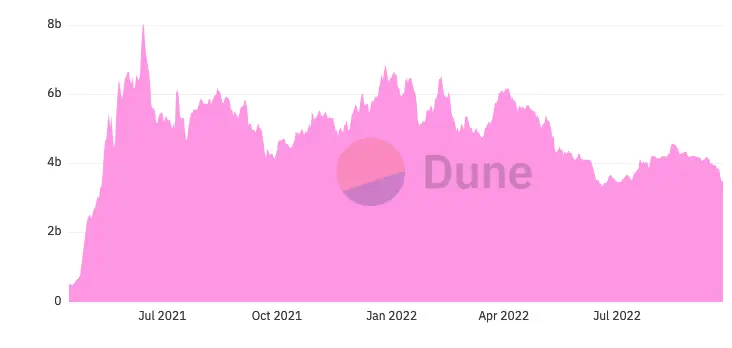
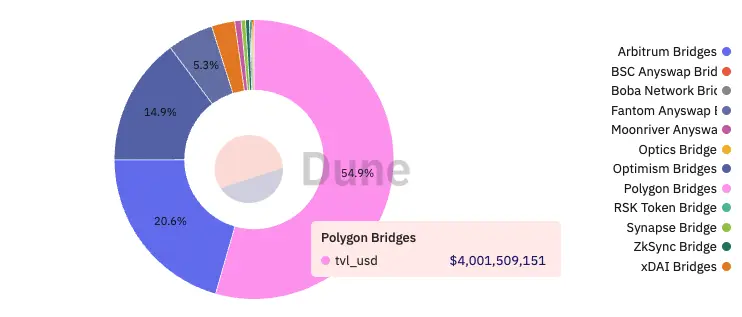
Polygon is the top bridge by TVL with ~$3.5B in assets bridged to Polygon in Q3 2022. However, while TVL has remained strong throughout the 2022 bear market downturn, unique depositors (third image) have declined to near negligible levels.