

If you want more cryptocurrency analysis, including full-length research reports, trading signals, and social media sentiment analysis, use the code "Publish0x" when subscribing to CryptoEQ.io to make your first month of CryptoEQ just $10! Or simply click the button above!
Overview
Polkadot is an open-source blockchain network designed to enable various separate, siloed blockchains to become interconnected, application-specific sub-chains called “parachains.” Each chain built within Polkadot uses Parity Technologies' Substrate modular framework, which allows developers to select specific components that best suit their application-specific chain.
The Polkadot network is the entirety of all parachains that plug into a single base platform known as the “Relay Chain.” The Relay Chain doesn’t support application functionality but provides security to the network's parachains and contains Polkadot's consensus, finality, and voting logic. The network aims to offer better scalability, upgradeability, transparent governance, and cross-chain composability. The native token (DOT) is used to incentivize and coordinate behavior across the different actors of its ecosystem that promotes the well-being and proliferation of the entire project.
Technology
Polkadot developed a generalized format for communication between parachains, separate smart contracts, bridges, and Substrate pallets called “Cross-Consensus Message Format” (XCM). XCM works with Vertical Message Passing (VMP) to enable message exchanges between the relay chain and parachains. Cross-Chain Message Passing (XCMP) allows parachains to exchange messages with other parachains on the same relay chain. A message in XCM is a program that runs on Cross-Consensus Virtual Machine (XCVM). Other heterogeneous blockchain networks can use this network programming to build composable inter-chain applications.
The Cross-Consensus Messaging format (XCM) allows secure and native interoperability between the parachains. The same validators sign the XCMP messages that secure the chains exchanging messages, i.e., natively verified, full nodes of the Ethereum mainnet and their specific parachain that convey the state transition. Under this model, parachains can safely pass arbitrary data among each other and unified finality is guaranteed.
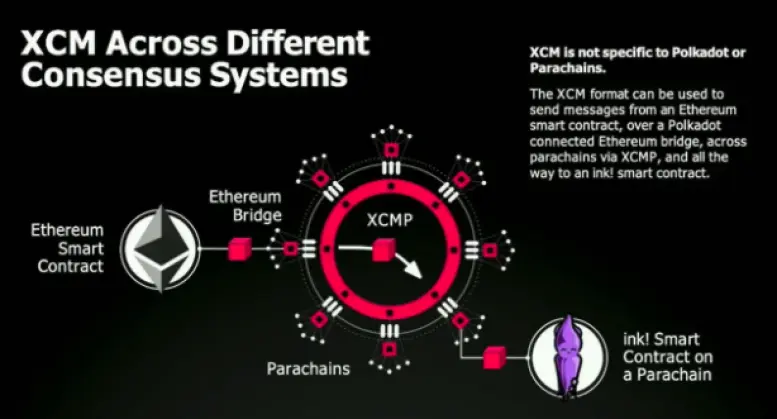
The inherited security dynamic from the Relay Chain makes arbitrary data passing possible. Fourteen parachains are live, each with different specializations such as DeFi, EVM smart contracts, social media, privacy, and games. In development are bridges to Ethereum, Bitcoin, and other projects.
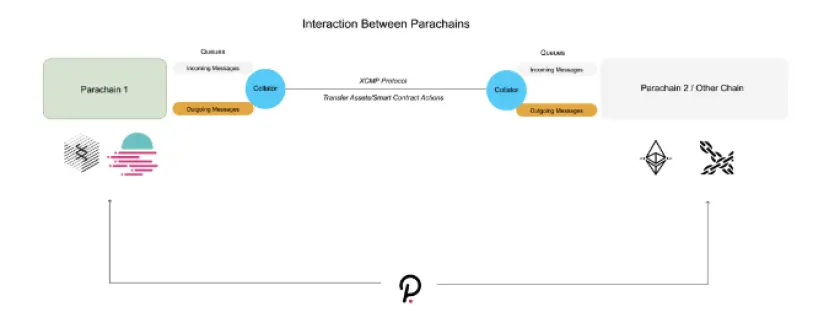
The XCM process:
- A smart contract on Parachain A is executed, i.e., sending a message)
- Collators on Parachain A put the messages into the outbound queue
- Collators on Parachain B, who constantly scan for inbound messages, find the message and place it in the inbound queue for processing
- A new block is proposed by a Collator on Parachain B
- Validators confirm they can read the inbound and outbound message on both Parachains and reach consensus
Security and Trust Assumptions
Polkadot has hierarchical inherited security in which the central relay chain is connected to the parachains. The relay chain has validators, and the parachains have collator nodes that collect transactions and produce state transition proofs for the relay chain to validate.
An added layer of security within the Polkadot system is its ability to proactively select which parachains with which to interact. One parachain can designate which specific parachains with which it wishes to open a communication channel. It can also determine the conditions under which it will receive and process inbound messages.
Access the full report here.





