If you want more cryptocurrency analysis, including full-length research reports, trading signals, and social media sentiment analysis, use the code "Publish0x" when subscribing to CryptoEQ.io to make your first month of CryptoEQ just $10! Or simply click the button above!
Hop Protocol
Launched in July 2021, Hop Protocol serves as a general token bridge for facilitating fast, low-fee transfers between Ethereum rollups and side chains As of Q3 2022, Hop connects Ethereum mainnet to Arbitrum, Optimism, Polygon and Gnosis (formerly xDai) and supports ETH, WBTC, WMATIC, DAI, USDC and USDT as transferrable tokens.
Access the full report here.
Technology
Hop leverages a system of h-tokens, an asset created as a bridging token, and Automated Market Makers (AMMs) to facilitate transfers between Ethereum and its various rollups and sidechains. The use of AMMs allows for the reliable generation of liquid markets for h-tokens with their native assets.
The h-tokens are essentially an efficient means of exchange between the underlying assets. h-tokens are created by locking the original asset in the Hop bridge smart contract on Ethereum and then minting h-tokens on the destination chain. These h-Tokens can be traded for the canonical asset on each supported L2s across Ethereum. End users do not interact with h-tokens, only LPs and Bonders.
LPs need to deposit ETH (or another asset) on both the Hop bridge contract and the native L2 bridge contract in order to pool their assets. LPs are compensated four basis points for providing liquidity. The liquidity pools create a market on either side of the bridge for the original token and its h-token equivalent (ETH and h-ETH). LPs earn four bps on trading/transfer fees.
Bonders lock up capital and run a Bonder node, acting as market makers to provide liquidity on the destination chain. Bonders operate full verification nodes on each chain, meaning they execute and confirm the validity of all rollup transactions. Because of this, Bonders aren't reliant on the challenge period (remember, they did the work themselves instead of optimistically assuming validity). This enables them to lend a user the liquidity needed to circumvent the ~7-day challenge period for a fee (4-25 bps) and then confidently collect the assets after the challenge window closes and the transaction finalizes. As of Q3 2022, Hop Protocol requires Bonders to be whitelisted by the Hop Bridge smart contract.
Say Alice has ETH on the sending chain. She can leverage Hop to swap this for a corresponding h-token, hETH, and send it to the destination chain. A Bonder provides liquidity to support the transfer to the destination chain by minting hETH which can then be exchanged for ETH via an AMM.
A Bonder must stake collateral as credit for transfers to guarantee liquidity on the destination rollup. They provide liquidity on the destination chain to make the user’s transfer instant instead of waiting a couple of days if they were to use the native rollup bridges. In exchange, they take a small fee (0.02%).
Token
Hop decentralizes its protocol’s governance via a DAO and HOP token. Hop has a 1 billion HOP token supply and distributes them as follows:
- 8% airdropped to early network participants
- 60.5% to the Hop DAO treasury
- 22.45% to the initial development team (3-year vesting, 1-year cliff)
- 2.8% saved for future team members
- 6.25% to investors (3-year vesting, 1-year cliff)
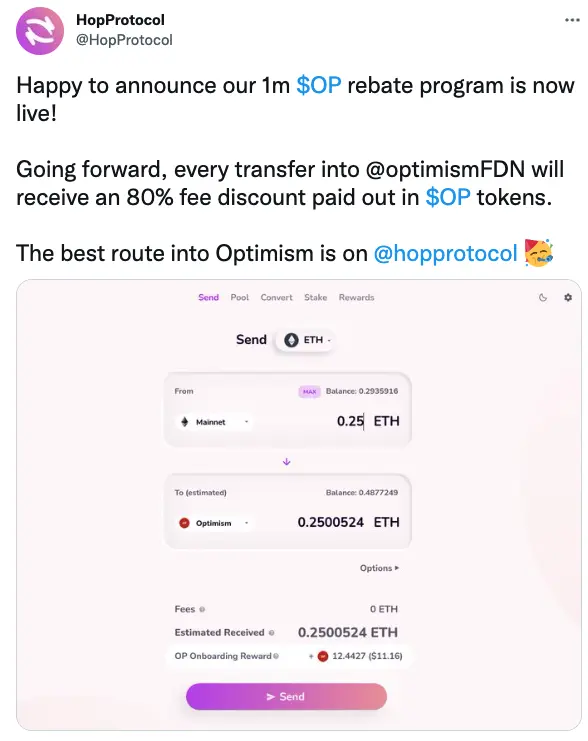
As the vast majority of HOP tokens are designated for the protocol’s treasury, it’s likely Hop will run an aggressive incentive program in the future to incentivize users and protocols. Beginning just last week, Hop began subsidizing bridging costs to Optimism!
Hop DAO
With HOP’s introduction, we also received the HOP DAO. Protocol responsibilities will move away from Hop Labs and toward the token holder community. Governance for the Hop DAO will operate under a delegate model similar to ENS, in which responsibilities include onboarding decisions, determining supported tokens, managing incentives and more.
Security and Trust Assumptions
Hop focuses exclusively on rollups, which may take a risk-averse approach compared to cross-chain solutions that bridge L1-to-L1. While there's a broader market for pursuing multiple settings, extra-trusted parties (multi-sig holders/network validators) pose new risks and costs. Hop intends to be the rollup-to-rollup transfer market leader and is directly betting on the Ethereum ecosystem.
The Hop bridge is "locally validated." Remember, this means only the parties personally involved in the bridge transaction verify it as opposed to third-party validators. Hop is approximately as secure as the underlying L2 solutions. Additionally, users of Hop bridge are only at risk during the actual bridging process. Once assets have been successfully moved to the L2, a user is no longer susceptible to any Hop issues.
Hop is also able to confine risk to individual networks, eliminating the concern of contagion that is present in many general-purpose cross-chain bridges. In essence, they employ a hub-and-spoke design in which the Ethereum mainnet serves as the central hub. All Hop transactions settle to a single Ethereum contract. This contract can monitor the balances of each Hop network and prevent a vulnerability on one network from affecting users on another.
In the event that Bonders are offline, users will then have to wait for the exit time of the rollup. Usually, since the Bonders are providing liquidity, Hop can provide near-instant funds transfer.
In the early stages of the network, Bonders must be whitelisted to participate. This measure decreases the risk that they might arbitrarily fail to fulfill transactions. The worst-case scenario using Hop is that all Bonders are simultaneously offline, and even in this case, the result is that users wait for the typical exit time of the utilized L2s.
Lastly, Hop provides economic incentives for challenging fraudulent transactions if a Bonder has malicious intent. In Hop, a Bonder must stake 110% of the total transfer value as collateral for 24 hours. If caught acting maliciously, the Bonder’s stake covers the fraudulent transaction, and the remaining 10% goes to the challenger. However, a 1-day challenge period, as opposed to a 7-day like with Optimism and Arbitrum, means Hop users must be OK with such a short fraud detection window. Such a short window means it is less costly for an attacker to try and censor fraud proofs at the base layer and simply allots less time to counter fraud should it be detected.
Metrics
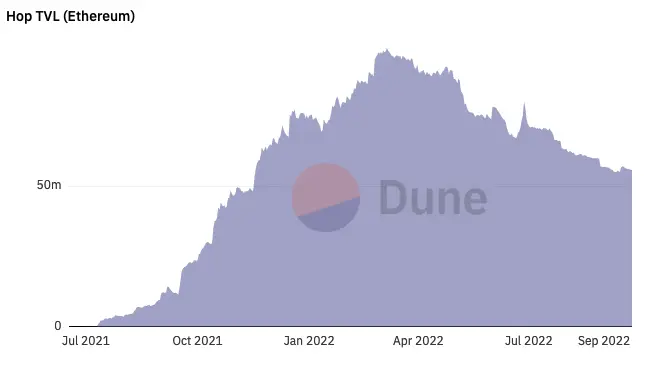
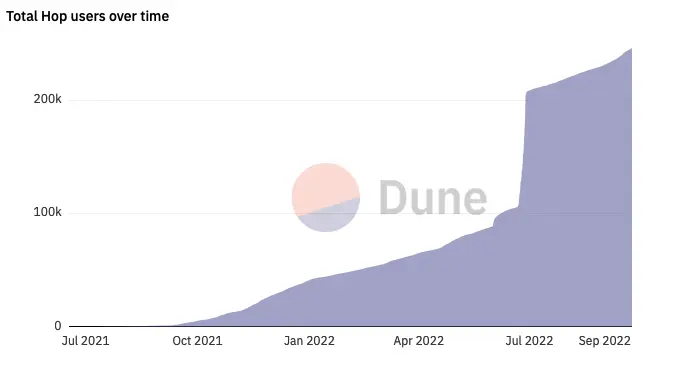
To date, Hop has transferred ~$1.1 billion in volume between its supported chains and is among the most adopted Ethereum bridges. Because Hop has chosen to focus solely on Ethereum rollup scaling solutions, it does not boast the same level of TVL (currently, ~$60 million) but has over ~230,000 users to date, which is similar to the number of Optimism and Arbitrum depositors.