
If you want more cryptocurrency analysis including full-length research reports, trading signals, and social media sentiment analysis, use the code "Publish0x" when subscribing to CryptoEQ.io to make your first month of CryptoEQ just $10! Or simply click the button above!
The Collapse Felt 'Round the World
As nearly everyone on Earth is now aware, the Terra protocol, with its LUNA token and UST algorithmic stablecoin, blew up in May 2022, erasing nearly $40B wealth in under a week. To understand what and how it happened, a quick refresher on the mechanics behind LUNA and UST.
Algorithmic stablecoins (UST, MIM, and others) solve for decentralization and capital efficiency, but price stability suffers, especially in market downturns as seen by the recent UST collapse. Algorithmic stablecoins have the most complex (and fragile) stability mechanism. Rather than being backed by collateral, algo stablecoins rely on economic market incentives and efficient arbitrage to maintain the peg. Generally speaking, algorithmic stablecoins are run by pre-programmed smart contracts that execute specific actions to maintain the peg. They usually exhibit some or all of the following properties:
- No outside collateral backing the token
- Partially/fully collateralized by a native token
- Floating peg (e.g. RAI)
Terra is a decentralized, Proof-of-Stake (PoS) protocol that creates algorithmically-governed, seigniorage share-style stablecoins that target their underlying fiat peg. Seigniorage refers to when profit is made by issuing currency in regards to the difference between its face value vs its cost of production.
LUNA, the native token within the Terra ecosystem, is critical in keeping UST (the “stablecoin”) pegged to $1. LUNA is one half of a two-token seigniorage model in which the UST price is held stable by controlling the supply of LUNA in circulation. LUNA, therefore, acts as a volatility dampener of sorts because it can always be minted at a fixed exchange rate, irrespective of market conditions.
By way of example, if one UST rose in value to $1.05, demand for UST would increase as arbitrageurs can burn LUNA, mint more UST, and pocket a 5% profit. The supply of UST would increase as arbitrageurs take advantage of this trade, driving down the UST price back to equilibrium.
As the circulating supply of UST grows, it puts upward pressure on the price of LUNA (reflexive to the upside). This works extremely well in bullish markets, as it allows users holding LUNA to see direct value creation for their tokens as the underlying stablecoin use-cases grow and evolve. However, in a risk-off market, the same mechanisms can create problematic cycles for trying to reclaim a lost peg i.e. reflexivity to the downside.
At the risk of getting overly technical, the mint/burn mechanism in the Terra protocol is expressed through a virtual automated market maker (vAMM) that simulates $50M worth of stablecoin liquidity and $50M worth of LUNA liquidity in a standard x*y=k pool. During normal market conditions and when the pool is balanced 50/50, users should be able to execute their LUNA/UST minting and burning without problems or slippage. But during a depegging event, there is a significant amount of flow in one direction, redeeming UST (worth less than $1) for $1 worth of LUNA. This flow drains LUNA from the vAMM and arbitragers need to wait for liquidity to refill in order to continue. Over time the vAMM replenishes its reserves at a fixed rate known as the recovery period, currently 36 blocks (3.6 minutes). The base amount of liquidity in the vAMM and recovery period acts as a natural limit to the amount of burning/minting that can happen in a short period of time. However, this cap can inhibit rebalancing when huge amounts of capital are all trading in one direction.
So, prices across all of crypto began to decline last month causing LUNA selling, leading to a small de-pegging of UST, which caused more concern. And then the whole thing spiraled to $0. But how?
- Anchor Protocol offered an unsustainable ~20% APY on UST deposits. As the macro environment worsened, many investors looked to “de-risk” and moved to cash. Many bought UST to deposit in Anchor for the high yields, peaking at ~15B in TVL.
- As the market conditions worsened, concerns about UST redemptions and sustainability that were overlooked in a bull market, began to rear their ugly head.
- Then, as part of the 4-pool plan laid out by Terraform Labs, the team moves $150M of UST liquidity out of the 3CRV + UST pool. At this very moment, an anonymous address dumped $85mn of UST, causing the Curve pool to become imbalanced and put downward pressure on UST price. To help correct for this imbalance, TFL removed another $100mn of UST liquidity from Curve.
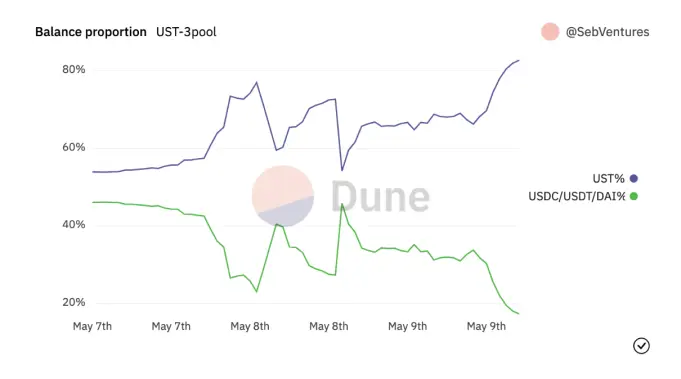
USTw-3pool Balance Proportion - Source: Dune Analytics
- Because of the poor market conditions and a perceived “attack” on UST, the LUNA price began dropping rapidly. This means that subsequent UST redemptions have to be exchanged for increasingly large quantities of LUNA. The more LUNA drops, the more LUNA is needed for redemptions of the same USD value, creating a hyperinflationary loop called the “Death Spiral.”
- The spiral also causes network congestion and this caused Terra’s chain activities to be suspended across a handful of platforms, adding further panic to the users.
- In an attempt to mitigate the spiral, Terraform Labs and partners added $280M+ of non-UST liquidity to the 3CRV + UST Curve Pool but to no avail as the selling pressure quickly absorbed this new addition.
- Anchor UST deposits fell from ~14B UST on May 6th to less than 10B UST on May 9th. The velocity of unwinding Anchor positions was likely exacerbated by leveraged deposits in the Degenbox. Discussed further in our future LUNA/UST CORE report, Degenbox preyed on the idea that if Anchor is paying a 20% “risk-free” rate, then you can lever it up multiple times to earn 100%+.
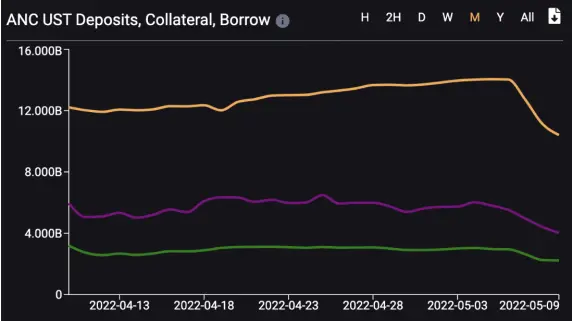
Anchor UST Deposits (In Yellow) - Source: Smart Stake
- Finally, the LFG decided to use their BTC reserve to try and defend the UST peg. The Luna Foundation Guard (LFG) had accumulated 42,530 bitcoin ($1.275 billion at a $30,000 price) as reserves to defend the UST peg when it sustains below the $1.
- They first loaned $750M worth of BTC to OTC trading firms to help protect the UST peg and then loaned 750M UST to accumulate BTC as market conditions normalize. The problem is that UST is trading extremely cheaply that TFL’s ability to pay back market makers for their peg support is evaporating with every passing hour.
- Then, all 42,530 BTC from the LFG address was initially transferred out. The Luna Foundation Guard issued a statement that the withdrawn BTC had been loaned to market makers and used to help support the UST peg.
- Amidst all the chaos, the price of LUNA dropped more than 30%, meaning its circulating market cap of $18.24 billion is less than that of all outstanding UST. This is critical because at this point, the LUNA-UST redemption mechanism cannot be honored. Terra is essentially insolvent. Not everyone would be able to exit the system, i.e. redeem $1 of UST for $1 of LUNA, should they choose to.
- UST finally dropped as low as $0.63. This threshold is important because below $0.70 UST trading was halted on Binance, the largest exchange in the world and a huge source of liquidity for UST.
- LUNA dropped another ~50% in the following 24 hours to ~$30.
- Finally, at this point, with LUNA down 60%+, the UST peg at ~$0.60, the protocol insolvent, the BTC reserves spent, and the three largest pools of liquidity (Anchor, Binance, and Curve pool) all breaking down, all confidence was lost and the LUNA circulating supply went into hyperinflationary mode as everyone tried to redeem any UST they could at any price.
In the end, the LUNA supply went parabolic into the trillions, UST value went to $0.00, the blockchain was halted (AKA died), LUNA was delisted from exchanges, and ~$40B in LUNA and UST evaporated while dragging down the broader crypto markets with it. It was the largest, fastest, and most violent crypto collapse in history!
And if that wasn’t enough, there is now a LUNA 2.0! The Terra community voted to accept Do Kwon’s plan to relaunch the Terra blockchain. Around 65% of voters accepted the proposal which includes the creation of a new chain and token which will be airdropped to existing LUNA and UST token holders. Prior LUNA and UST holders will receive 70% or (700 million) of the total LUNA 2.0 token supply. The amount of LUNA 2.0 airdrop each person gets varies depending on whether those tokens were held before or after UST’s depeg.
Terra’s community pool, an on-chain treasury fund, is set to receive 30% (300 million) of LUNA of which 30 million are assigned for developers who have decided to remain and rebuild on the new Terra chain.. The community pool is controlled by Terra governance to fund development activities.
A few key differences in Luna 2.0:
- No algorithmic stablecoin (UST)
- The old chain will be called Terra Classic ($LUNC) with the new chain Terra ($LUNA)
- The new LUNA will be airdropped across different stakeholders including LUNA Classic stakers/holders, residual UST holders, and developers on the old Terra chain (see details)
- No token allocation to Terra’s parent organizations Luna Foundation Guard or Terraform Labs and no central position of power for Do Kwon
A few major crypto exchanges like Binance, FTX, Crypto.com, Huobi, Bitfinex, Bybit, Gate io, Bitrue and Kucoin have announced that they will support the relaunch and list the new token.





