

If you want more cryptocurrency analysis including full-length research reports, trading signals, and social media sentiment analysis, use the code "Publish0x" when subscribing to CryptoEQ.io to make your first month of CryptoEQ just $10! Or simply click the button above!
Solana User Experience
As an L1 blockchain network, using Solana can vary in difficulty depending on what you need. For instance, those wishing to become validators will need to acquire the knowledge base of advanced computing. This includes setting up an advanced CPU or GPU and installing the necessary software to run the Solana blockchain.
For the majority of interested parties and investors, simply acquiring SOL is the overarching goal. This is extremely easy now as any user would only have to set up an account on one of the supported crypto exchanges and purchase SOL. Below are key links for anyone looking to enter the Solana ecosystem.
Wallets - Phantom, Ledger, and TREZOR
DeFi Charts and metrics
Staking
For anyone wishing to stake their SOL, but not become a validator, this process only requires a few extra steps that anyone can do. Anyone purchasing SOL on either Binance or FTX can actually stake their SOL directly on those exchanges. The downside to that is the staker can’t choose their own validator; it’s assigned.
Otherwise, SOL can be purchased and sent to a supported staking wallet. Listed wallets that support SOL staking are:

Staking rewards are based on the amount of SOL staked during an epoch (~2.5 days). You can’t withdraw in the middle of an epoch. This means, as an example:
- When you first delegate, you have to wait for that epoch to finish in order for your funds to become active and begin earning rewards.
- To withdraw, you must first undelegate it and wait for the epoch to end. Again, this could take up to ~2.5 days.
- Once undelegated and the epoch has ended, you can withdraw the SOL back to your wallet.
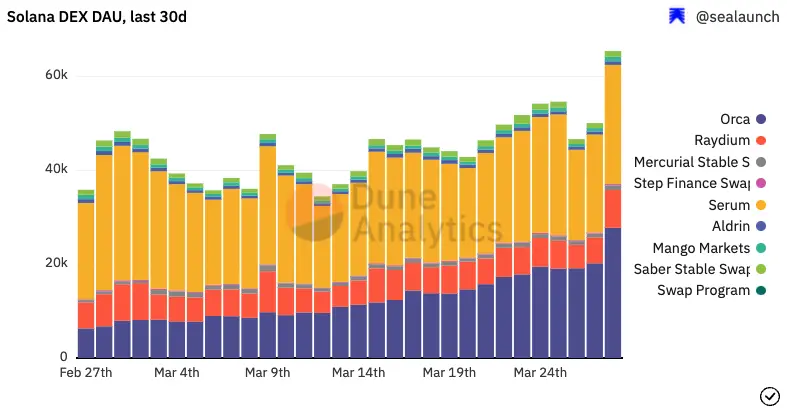
Solana has managed to build a large and fast-growing community of users, including over 60,000 daily active DeFi users.
The most popular Solana wallet, Phantom, has seen Monthly Active Users (MAUs) grow from 200,000 in August 2021 to 2+ million in March 2022. Phantom has doubled its users in ~6 months due in large part to the growth of the NFT space. Comparing Phantom to the most popular Ethereum wallet, Metamask, Solana user growth is roughly where Ethereum was in October 2020.
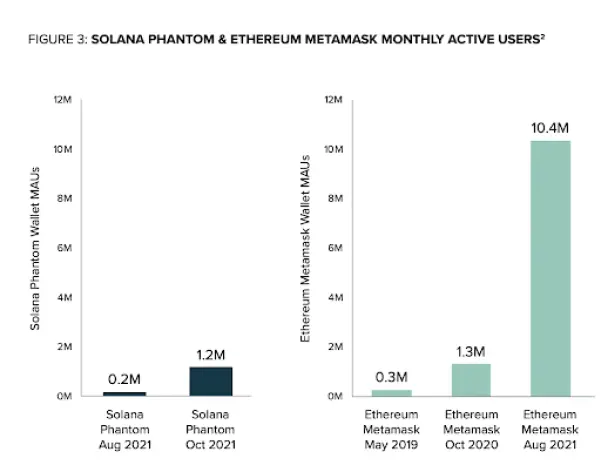
Solana’s Phantom wallet growth versus Ethereum Metamask wallet growth. Source: Grayscale.
While any SOL stored on exchanges could be subject to theft, moving SOL into a wallet in which the private keys are held by the user increases security substantially. For beginners, managing the keys for the wallet will be the biggest learning curve. In March 2022, Coinbase Wallet announced its browser extension wallet will support sending, receiving, and storing Solana and SPL tokens. This will give Phantom wallet a rival while also introducing Coinbase’s millions of users to an easy Solana onboarding experience.
Before the Coinbase Wallet integration, most SOL users came into the ecosystem from an exchange or a bridge from Ethereum. Bridges are blockchain infrastructure that allow you to send funds between previously disparate and siloed L1 chains like Ethereum to Solana. One of the most popular is Certus One’s Wormhole (discussed earlier), a bi-directional ERC-20 and SPL Token bridge between Ethereum and Solana. The process for sending ETH to the Solana blockchain is as follows:
- “Guardians” certify token lockups and burn the asset on one chain to mint them on the other (burn ETH and mint SOL). Wormhole is a Proof-of-Authority (PoA) network in which the guardians are selected by Solana.
- All guardians have equal weight since it’s a PoA network.
- The project uses a multi-sig scheme to secure funds, making it susceptible to loss of funds if a majority of Guardians decide to collude and/or are compromised.
- Consensus is established through a gossip network in which, once two-thirds of Guardians observed a transaction, it’s automaticallyconsidered valid.





