
MATIC Launch, Initial Token Allocation & Funding
The launch of the MATIC token was via a private sale and initial exchange offering (IEO).
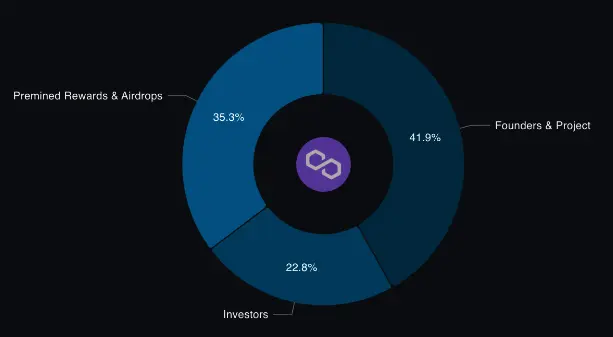
MATIC Initial Supply Breakdown (Source: Messari.io)
Polygon Labs, the founding company, raised $48M on a $125M Reg D offering. Investors took the $48M in the form of a Simple Agreement for Future Tokens (SAFT). The $48M was raised in three separate rounds of $4.5M, $36M, and $7.1M USD.
The initial distribution of the total of 10B MATIC tokens was as follows:
- Private sale accounted for 3.80%
- Binance Launchpad sale (IEO) accounted for 19% of the total supply
- Team accounted for 16% of the total supply
- Advisors were attributed 4% of the total supply
- Network operations: 12%
- Foundation: 21.86%
- Ecosystem funds: 23.33%
The supply curve of emissions hitting the open market over time can be seen below.
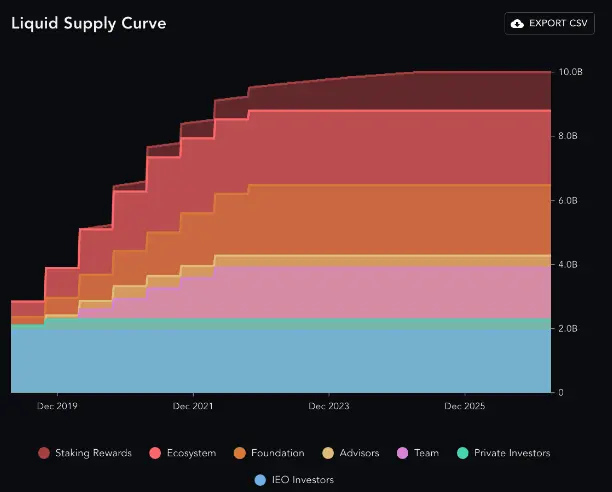
Liquid Supply Curve for MATIC (Source: Messari.io)
With its suite of scaling technologies to support the Ethereum network to scale to over a billion users, Polygon’s total addressable market is similar to that of Ethereum’s. As user adoption of the main public Ethereum blockchain grows, the need for Polygon’s scaling solutions increases both for public and enterprise use.
Token Burns
MATIC tokens are burned via the same EIP-1559 model in Ethereum. EIP-1559 replaces the first-price auction, in which the highest bidder would win, with a base fee for transactions. Users can also pay a priority fee to miners to speed up the processing of their transactions. This base fee is now burned instead of paid to miners. This means that over time, there will be less supply of MATIC in circulation, making the MATIC token more deflationary than otherwise.
In terms of how the tokens are burned, the MATIC tokens are first burnt on Polygon and then completed on Ethereum. Users can follow the instructions here to initiate the burn of tokens.
As of Q4 2022, the amount of total burned MATIC is 616,000 MATIC at a rate of 0.27% of the total MATIC supply per year. The EIP-1559 upgrade for Polygon was released in January 2022 and adds deflationary forces to the MATIC economics.
The purpose of the upgrade was to replace the gas fee calculation mechanism to make it easier for users to estimate transaction fees, while also burning MATIC tokens. The upgrade also offers better fee visibility.
Staking Economics
Any party can become a validator on the Polygon PoS mainnet and share the non-inflationary network rewards. Users can set up their own node or lease to a community node. Rewards for staking depend on the amount of MATIC tokens staked and the transactions in the network.
Validators must also be adequately compensated to ensure network security. They are now rewarded with MATIC incentives, but these are largely depleted (circulating supply is 97% totally diluted), which is part of the impetus for the foundation to issue revised tokenomics later this year, and we anticipate incentive dilution.
Polygon allocates 12% of the total supply of 10 billion MATIC tokens to fund these staking rewards. Validators can set their own commission for accepting delegations. Staked funds can be slashed and penalized if a validator acts maliciously or is unavailable. Staking on the PoS mainnet currently offers 14.3% APR or ~4% APR when accounting for network inflation. 27.31% (2.73 billion MATIC tokens) of the total MATIC supply is currently staked.
The PoS mainnet has an unbonding period of 9 days for unstaking tokens. Users who wish to unstake and opt-out would need to send an unbonding request first and delegated tokens will start to unbond immediately. During this unbonding period, the tokens can still be slashed for misbehavior committed by the valiator.
It should also be noted that staked tokens are locked into a contract deployed on the Ethereum blockchain and validators do not hold custody of their delegate token.
*****************************************************************************************************************************************************
You are reading an excerpt from our free but shortened abridged report! While still packed with incredible research and data, for just $20/month you can upgrade to our FULL library of 50+ reports (including this one) and complete industry-leading analysis on the top crypto assets.

Becoming a Premium member means enjoying all the perks of a Basic membership PLUS:
- Full-length CORE Reports: More technical, in-depth research, actionable insights, and potential market alpha for serious crypto users
- Early access to future CORE ratings: Being early is sometimes just as important as being right!
- Premium Member CORE+ Reports: Coverage on the top issues pertaining to crypto users like bridge security, layer two solutions, DeFi plays, and more
- CORE report Audio playback: Don’t want to read? No problem! Listen on the go.





