
You are reading an excerpt from our free but shortened abridged report! While still packed with incredible research and data, for just $40/month you can upgrade to our FULL library of 60+ reports (including this one) and complete industry-leading analysis on the top crypto assets.

Becoming a Premium member means enjoying all the perks of a Basic membership PLUS:
- Full-length CORE Reports: More technical, in-depth research, actionable insights, and potential market alpha for serious crypto users
- Early access to future CORE ratings: Being early is sometimes just as important as being right!
- Premium Member CORE+ Reports: Coverage on the top issues pertaining to crypto users like bridge security, layer two solutions, DeFi plays, and more
- CORE report Audio playback: Don’t want to read? No problem! Listen on the go.

Polygon 2.0 Design
Web3 has been grappling with a persistent scaling problem since its inception. The continuous addition of new chains to meet the demand for blockspace invariably leads to fragmented liquidity and a subpar user experience. Polygon 2.0 emerges as a solution to this problem, offering an elastically scalable, unified environment for accessing value, akin to how the Internet provides a scalable, unified environment for accessing information.
Polygon 2.0 is envisioned as an ecosystem of ZK Layer 2 chains based on Ethereum, referred to as "Polygon Chains". This structure is designed to improve both vertical and horizontal scalability, much like the layered structure of the Internet protocol suite. Polygon 2.0 comprises layers that perform different roles.

Overview of POL Token
The introduction of the Polygon Ecosystem Token (POL) marks a significant shift in the architecture of the Polygon network's cryptocurrency infrastructure. As the newly minted native token, POL is poised to supplant MATIC, encompassing not only its current functions pertaining to governance and gas fees but also integrating additional utilities as the ecosystem broadens.
POL represents both a technical and economic refinement over its predecessor, MATIC. Designed to be scalable, POL is engineered to adapt and expand concurrently with the Polygon ecosystem, thereby ensuring future readiness. This adaptability extends to improved security and scalability functions, where validators are enabled to secure multiple chains within the network, thus enhancing overall ecosystem support as the blockchain industry evolves.
Initial Supply and Emission Strategy
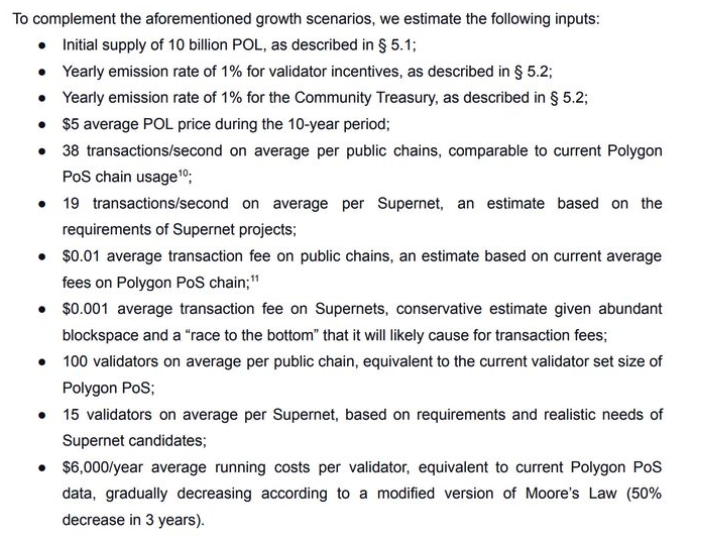
According to the POL whitepaper, the initial token supply is set at 10 billion units. This reserve primarily facilitates the transition from MATIC to POL. Over time, POL will be distributed to validators as rewards at a predetermined rate, capped at a 1% annual increase, with potential for reduction post a decade, contingent on ecosystem maturity—a strategic move to incentivize ongoing validation activities while managing token inflation effectively.
Utility and Functionality
POL is designated as the primary transactional currency within the Polygon network, meaning network fees across integrated platforms will be transacted in POL. This utility not only simplifies operations but also anchors the token’s integral role across the network's financial activities.
Restaking and Security Enhancement
Restaking, a concept brought into prominence by EigenLayer, involves validators reinvesting their tokens to secure additional protocols. For Polygon, this means POL holders can stake their tokens to run validator nodes, thereby strengthening network integrity. Validators not only secure the Polygon network but can extend their protective reach to other chains within the ecosystem, earning additional rewards from these networks.
Expanded Validator Roles
Beyond traditional transaction validation, POL validators can assume roles in Data Availability Committees (DACs) and contribute to zero-knowledge validation proofs, illustrating the expanding scope of responsibilities in line with the evolving technology.
Governance and Community Involvement
Holders of the POL token are vested with governance rights, allowing them to influence the development trajectory of the Polygon ecosystem through a decentralized voting mechanism. This system aligns with the governance models of many decentralized autonomous organizations (DAOs), where token holders vote on proposals encompassing technological, administrative, or financial aspects of the network.
To ensure the future-proofing of the ecosystem, a continuous POL emission to fund the Community Treasury is proposed. A yearly emission rate of 2% is proposed for validator incentives and to fund the community treasury. This self-sustainable ecosystem fund can support protocol development, research, ecosystem grants, and adoption incentives. The Community Treasury will be governed by the Polygon community, via an agreed-upon governance process.
 Source: Polygon 2.0 white paper





