You are reading an excerpt from our free but shortened abridged report! While still packed with incredible research and data, for just $40/month you can upgrade to our FULL library of 60+ reports (including this one) and complete industry-leading analysis on the top crypto assets.

Becoming a Premium member means enjoying all the perks of a Basic membership PLUS:
- Full-length CORE Reports: More technical, in-depth research, actionable insights, and potential market alpha for serious crypto users
- Early access to future CORE ratings: Being early is sometimes just as important as being right!
- Premium Member CORE+ Reports: Coverage on the top issues pertaining to crypto users like bridge security, layer two solutions, DeFi plays, and more
- CORE report Audio playback: Don’t want to read? No problem! Listen on the go.
Evolution of Parachains
Parachains were designed to enable customized environments for developing specific applications while maintaining interoperability. Initially, the structure demanded slot auctions for independent chain operations, leading to a chain-focused ecosystem. However, an ecosystem must cater to diverse needs, including both small startups and large enterprises. To address this, the Polkadot parachain auction has undergone significant upgrades under the Polkadot 2.0 roadmap.
Improved Auction Mechanism
The first upgrade in the Polkadot 2.0 roadmap involves the parachain auction mechanism, integrating the candle mechanism and Verifiable Random Function (VRF). In this new system, bids remain hidden to participants, fostering a more competitive and fair environment.
Benefits of the Vickrey Auction Mechanism
The introduction of the Vickrey Auction Mechanism ensures transparency and non-bias in the auction process. In a scenario where two participants, Alice and Bob, compete for a parachain slot, the hidden bids prevent wealthier participants from outbidding others unfairly. This mechanism promotes ethical bidding by revealing bids only at the end, allowing all bidders to participate without the burden of locking their tokens for extended periods. Instead, a pay-as-you-go method is employed.
Addressing High Demand: CoreTime Upgrade and Asynchronous Backing
High demand for parachain threads poses challenges, particularly when resources are underutilized in the ecosystem. The solution lies in the CoreTime Upgrade and Asynchronous Backing.
The CoreTime upgrade transitions the Polkadot ecosystem from a chain-specific to an application-specific framework. It abstracts processing functions, dynamically allocating resources to meet pay-as-you-go demands. Previously, the protocol produced blocks regardless of network demand, often resulting in blocks with minimal or no transactions. In the new model, cores can be dedicated to pay-as-you-go clients based on bidding status, reducing the need to lock tokens.
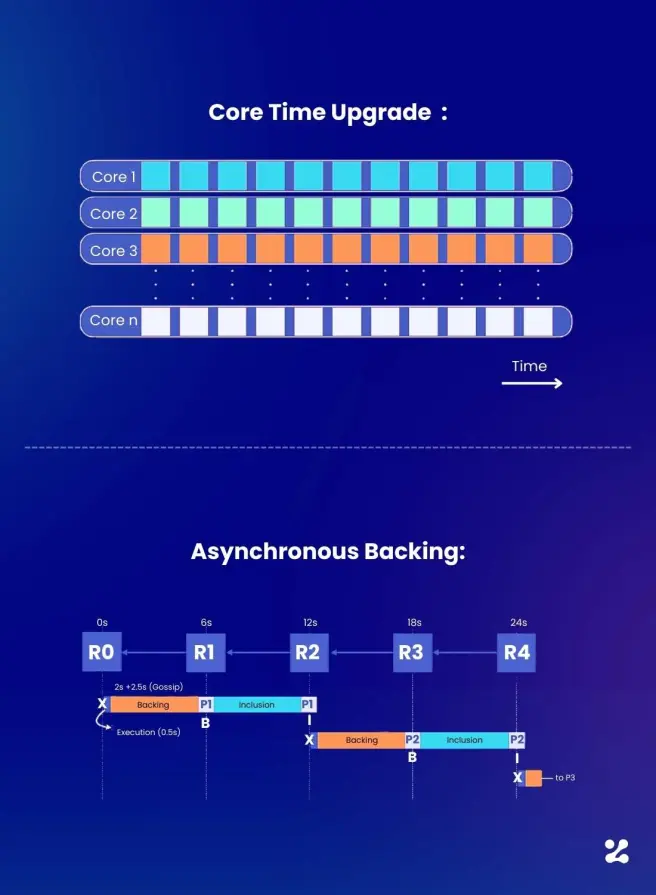
Asynchronous Backing
Asynchronous backing enhances the system by abstracting the dependency on the Relay chains for validation. It utilizes erasure-coded chunks, distinguishing from other unincluded elements, chains, or candidate parablocks. This approach reduces the reliance on the relay chain for block validation, allowing multiple parachain blocks to be added to the Relay chain simultaneously, thereby increasing throughput and finality rate.
Enhancements in Processing and Finality
With these improvements, the time for processing and finality is significantly reduced from 12 seconds to 5 seconds. Additionally, the new system can accommodate up to four times more data on parachain blocks, facilitating elastic scaling.
Customization and Interoperability
Polkadot parachains stand out due to their ability to allow developers to tailor their blockchains while maintaining high interoperability through the State Transition Function (STF). This standardizes communication across the WebAssembly (WASM)-compliant Polkadot ecosystem and beyond via bridges. Unlike Alt L1s, which require building consensus and connectivity from scratch, Polkadot provides a robust framework for seamless integration. In contrast, Ethereum's L2 solutions, such as rollups, face challenges with heterogeneous shared chain execution, which can affect network performance and speed.
Ethereum L2 solutions store data on Ethereum's L1 blocks, which raises operational costs when different blockchain ecosystems need to communicate with the base layer. Dapps on L2s incur high fees to use Ethereum as a data availability (DA) layer. Polkadot, however, employs an in-house DA mechanism using erasure coding, reducing reliance on Relay chain validators and protocol-level sharding. This approach enhances throughput, facilitates interchain communication, and significantly reduces fees, passing benefits to users.
Polkadot's parachains also offer cost advantages over ZK-rollups and Alt L1s. For instance, running a ZK-Rollup provider is exponentially more expensive than operating a Polkadot parachain. Additionally, optimistic rollups, despite using fewer provers, are more susceptible to hacks due to the public nature of verifier identities. This highlights Polkadot’s efficient and secure operations.
Ecosystem Challenges
Despite its strengths, the Polkadot ecosystem faces several challenges. The high inflation rate of the token and limited use-cases hinder user retention. Development costs are significant, requiring investments in infrastructure and tooling such as blockchain explorers, indexers, hardware wallets, and RPC providers. The lack of standardized tools and documentation further impedes rapid development. Additionally, the Polkadot treasury has seen a significant decline, raising concerns about sustainable ecosystem development.
Roadmap for Growth
Polkadot's roadmap includes significant upgrades like the Agile CoreTime for elastic scaling and asynchronous backing. These enhancements aim to transform Polkadot from a network of interconnected blockchains to a global supercomputer, as articulated by CEO and founder Dr. Gavin Wood at the Polkadot Decoded 2023 event.
Cross-Consensus Messaging (XCM)
A crucial upcoming feature is XCM (Cross-Consensus Messaging), which will enable blockchains developed on different stacks to communicate in a common language. This development is expected to provide a stable and reliable interchain messaging channel, surpassing the current fragmented bridge solutions. As Hoon Kim, CTO of Astar, stated, the introduction of XCM opens up endless possibilities for creating innovative projects that were previously unimaginable.