

If you want more cryptocurrency analysis, including full-length research reports, trading signals, and social media sentiment analysis, use the code "Publish0x" when subscribing to CryptoEQ.io to make your first month of CryptoEQ just $10! Or simply click the button above!
Economics
The economics behind NEAR Protocol are entirely designed around the protocol’s dynamic sharding scalability. NEAR directly incorporates the qualities of DoomSlug block production and Nightshade dynamic sharding to essentially “shard” the incentives and ensure adequate participation in all shards of the network.
The NEAR economy’s designed to suit the following roles:
- Validators - Provide computational power, storage, and security to the protocol
- Developers - Build and port applications to create the infrastructure on top of the protocol
- Users - Ground-level users of the applications on the protocol
- Token Holders - Those who hold the actual NEAR token
A single entity on NEAR Protocol may hold one or multiple roles on the platform. This is in addition to the NEAR Governing Body, the entity in control of the development and governance of the protocol.
The NEAR token inflates at a rate of 5% per year. This 5% supply increase is split between validator rewards (4.5%) and protocol development (0.5%). Additionally, NEAR’s economic model includes a burn mechanism, discarding 70% of every transaction with the remaining 30% paid back to the contract creator. This is a unique design versus other blockchains, such as Ethereum, as it incentives applications to build on NEAR as they receive that 30% cut from transaction fees. On Ethereum, applications themselves don’t benefit from gas fees as it all goes to validators.
Initial Launch of NEAR Protocol
NEAR premined 1 billion tokens at genesis which were distributed during the mainnet rollout on April 22, 2022. Despite the April 2022 launch, NEAR began selling tokens as early as 2017 in four separate private funding rounds and a Series A funding round.
The following is an overview of each NEAR token funding round that occurred:
- Private Round 1: NEAR sold 21.6 million tokens in 2017 for $0.0375 each, raising just under $1 million
- Private Round 2: Over the summer of 2018, NEAR sold 57.6 million tokens for an average price of $0.05 each, helping to raise nearly $3 million
- Private Round 3: At the beginning of 2019, NEAR raised $8.5 million after selling 71 million tokens for $0.12 each
- Private Round 4: The final private funding round was in 2019 for a relatively small 2.5 million tokens at an average price of $0.15
- Series A Funding Round: Directly preceding the official mainnet launch, NEAR Protocol held its Series A round in which it raised over $21 million through different sales options
- Community Sale: The first time the NEAR token was placed on public markets was in August 2020 which saw 120 million NEAR tokens allocated. Purchase options varied from $0.29 to $0.40 per token depending on the vesting schedule
Investors in the first private funding round saw an ROI of around 700% with the closing of the community sale in 2020 after the mainnet launch.
In total, the initial allocation of the 1 billion tokens at genesis is presented in detail in the following graphic from NEAR:
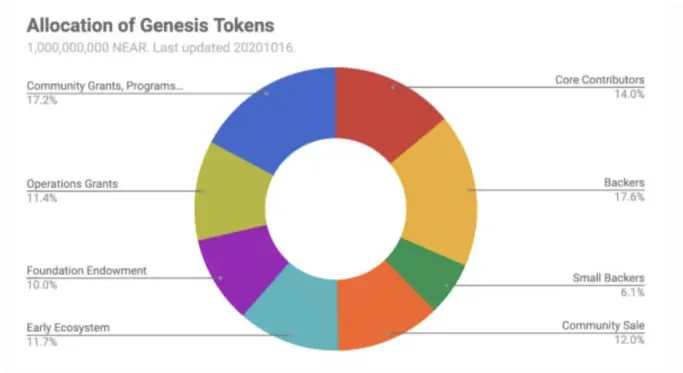
It's highly important to note the above graphic is misleading. While it appears tokens were distributed nearly consistently in many different categories, the actual breakdown can be summarized like this:
- 52.6% to the developers and NEAR Foundation
- 35.4% to private investors
- 12% to the community through public sale
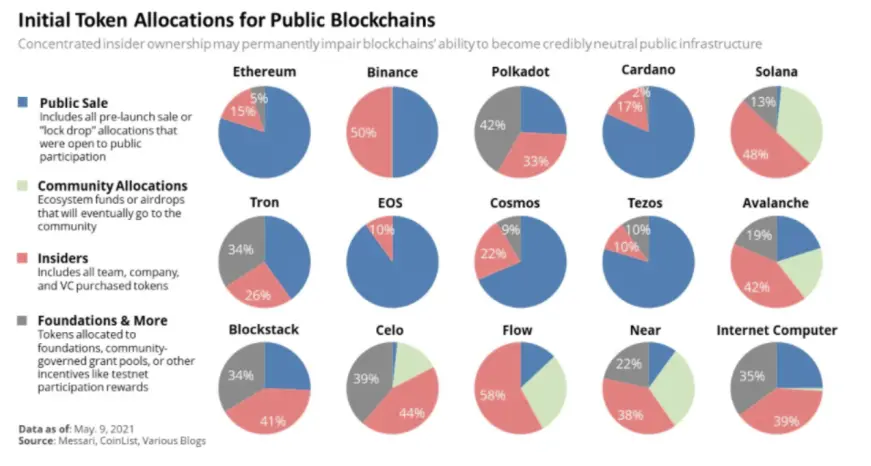
In reality, this was one of the most centralized token launches in the ecosystem from 2020-on (image below for comparison to other popular L1s). The community was directly in charge of only 12% of the initial NEAR token supply while the remaining 88% of tokens were either controlled by investors or the protocol itself. This is a huge problem in terms of real decentralization and a potentially major roadblock when regulations begin to get more defined by government organizations such as the SEC.
Source: Messari





