
If you want more cryptocurrency analysis including full-length research reports, trading signals, and social media sentiment analysis, use the code "Publish0x" when subscribing to CryptoEQ.io to make your first month of CryptoEQ just $10! Or simply click the button above!
Metis is an L2 scaling solution on Ethereum that's best described as an EVM-equivalent, sharded Optimistic Validium (discussed further in ZK-rollup sections) featuring a Dynamic Bond Threshold staking design. Metis began as a “regular” Optimistic rollup but later transitioned to the validium model in April 2022 in which it no longer posts calldata to the Ethereum L1 but rather to a different DA layer. Remember, posting calldata is essential so that independent validators on the L1 can verify the validity of the data (state root) coming from the L2.
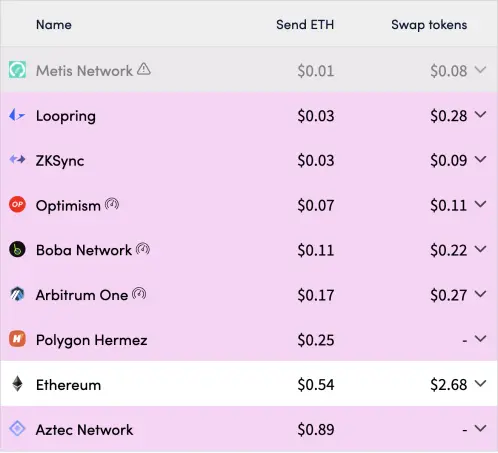
Metis’ transition to an optimistic validium has made it one of the cheapest L2 options currently live but at the expense of security. Data availability is necessary for generating fraud proofs and effectively resolving disputes in an OR. If a dispute is filed and data for the contested state transition is missing, the fraud proof cannot substantiate fraud. Therefore, if theMetis' off-chain DA supplier fails to provide the data, funds can be stolen from an optimistic validium.
The METIS token is used to pay transaction fees on the rollup, stake to become a sequencer, and for fraud challenge incentives.
Off-chain DA layer
Like all rollups, Metis still features a sequencer that will receive the most recent transactions, batch them together (“roll them up”), and construct the necessary transaction data to facilitate fraud detection. The sequencer will then build a Merkle tree root from the transaction data compilation. However, then, the sequencer will then generate an identifier or “identity tag” on the Merkle tree root, which will be used to send the data to an off-chain decentralized storage environment called Memolabs. As part of the rollup, once the data is accessible in Memolabs, the Merkle tree node is uploaded to the Ethereum mainnet. Thus, the rollup of transaction data for the batch is complete.
Metis features
Metis was originally a hard fork of the Optimism chain but has since undergone numerous changes, which have given rise to its own computation engine, the Metis Virtual Machine (MVM). The MVM used to be EMV-compatible but has since been re-engineered to be EVM-equivalent after its Andromeda update in November 2021.
Through its Polis middleware layer, Metis enables dApps to easily migrate their product from L1 to L2. The combination of low fees and a low learning curve for software development can foster an atmosphere conducive to experimentation and creativity, which are essential for establishing a new application ecosystem.
The Dynamic Bond Threshold staking design dictates Sequencers can't sequence blocks if their stake is worth less than the amount they’re sequencing. Transactions are blocked until an eligible sequencer is found, limiting the size of the transaction value.
The Metis Virtual Machine (MVM) contains various decentralized autonomous companies (DACs) with their own separate, application-specific computational and storage layers. A DAC can be compared to a DAO, or decentralized autonomous organization, in which no single entity or person is in charge of the decision-making process.
However, DAOs only deal within the realm of voting and governance, so they’re limited in that they lack the crucial corporate capabilities to support businesses. On the other hand, DACs function like DAOs, but with the additional ability to scale horizontally with integrated features such as HR, payroll, CRM, marketing campaigns, corporate management systems, and more.
These DACs in the MVM allow for richer interactions and a higher level of being able to onboard fully functional companies onto the blockchain, which offers infrastructure support comparable to that of Web2.0 companies, while still remaining decentralized. Nodes of DACs act as trusted parties that keep copies of data off-chain, but if rollup operators act maliciously, they can port it back on-chain. These nodes make an on-chain attestation that the data of the L2 is available by posting signatures on-chain.
The costs to operate DACs are low and their committees are typically made up of 7-10 members. The costs remain especially low since no transaction data is actively posted on-chain outside of DA attestations, so regardless of the transaction volume, the cost remains low and fixed.
However, there are some security tradeoffs for DACs. This is because a small, permissionless committee that may not be credibly neutral still requires end-users to trust the group of actors to store transaction data. If a threshold of committee members act maliciously, they could freeze (in the case of a ZK-rollup) or steal (in the case of an OR) all funds on the chain and kill the chain’s liveness, posing a large risk.
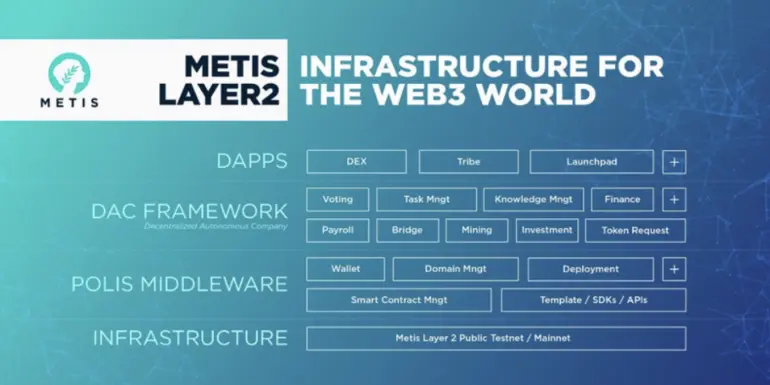
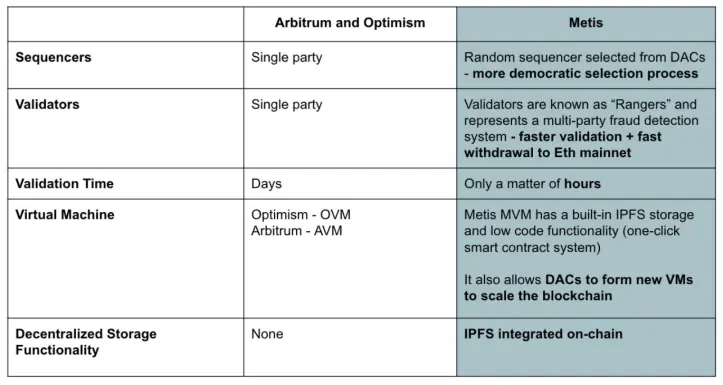
Additionally, a network of sequencers is randomly selected from the DACs to rollup and submit transactions back to the L1. These parallel sequencers enable higher scalability compared to the single-party approach by other ORs.
Token
The METIS token is used for transaction fees while returning 30% of the gas paid to protocols that build on the network. METIS is also used to encourage decentralization and security among its sequencers. Instead of relying on a single sequencer run by the team, Metis intends to allow third parties to also run sequencers by staking METIS to financially prove their honesty.
The Metis Team is led by Co-Founders Elena Sinelnikova, Kevin Liu, and Yuan Su. Elena is a software developer and entrepreneur known for leading the CryptoChicks organization, and Kevin is a serial entrepreneur who's a researcher and practitioner of DAOs, governance protocols, and the token economy. Yuan Su is a veteran Ethereum developer and Optimistic rollup expert.
Metis uses a sequencer whose role is to bundle transactions and send them back to the Ethereum chain. Multiple transactions are picked from a pool randomly for work, and the process is democratized or done to prevent a single point of failure.
Sequencers, and eventually Rangers, are required to stake METIS to verify transactions. In this way, Metis effectively replicates the Proof-of-Stake model whereby a random sequencer is selected from the entire pool of sequences to submit a recorded transaction to the Ethereum chain. A sequencer is rewarded in METIS tokens for carrying out duties, similar to how validators on Ethereum earn ETH.
The minimum number of $METIS required to participate in an amount greater than the Dynamic Bond Threshold (DBT). The DBT is the value of the total transactions in the sequence blocks, meaning if a block has $100 worth of transactions, a Sequencer would need a minimum of $100 worth of $METIS staked. If they don’t have enough, another Sequencer with enough staked $METIS will be selected.
Despite the separate execution layers, liquidity in Metis between the shards can flow frictionlessly due to the MVM cross-layer communication protocol. The goal is to scale horizontally with distinct, application-specific execution layers that are while also preserving the security of Ethereum via fraud proof submission to the mainnet.
Finally, Metis will also implement a fraud detection system called the ‘Ranger system.’ In essence, the Ranger system is a network of nodes that monitor sequencers for bad behavior. The Rangers constantly check the fraud proofs for validity. This active “watchdog” system results in a shorter challenge period since some simultaneous effort to detect fraud has already occurred and is not just assumed to be valid. The Ranger system is planned to be integrated into the Andromeda network in Q2-Q3 2022.
Rangers are there to police dishonest sequencers as a system of active checks and balances. Rangers compete for bounties in the form of Metis rewards to detect fraudulent transactions. Due to this ranger system, the withdrawal process on Metis has been shortened from a week to only hours or even just minutes using Celer as a third-party liquidity provider who will take on the challenge risk for a user for a small fee.
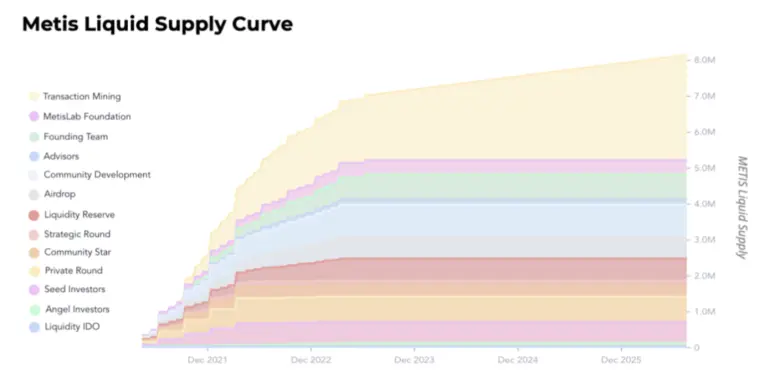
With the launch of the Ranger system comes the beginning of mining rewards for Rangers. 5 million Metis tokens have been reserved for these incentives and are designed to be distributed over nine years as follows:
- Founding Team: 7%
- MetisLab Foundation: 4%
- Advisors: 1.5%
- Investors: 18%
- Airdrop: 6%
- Liquidity Reserve: 6%
- Community Development: 9%
The remaining 47.7% of the lifetime token supply will be minted over the next 10 years.
Total supply after 10 years: 10 million
Pros
- EVM-equivalence
- Parallel sequencers
- No-code integration via a middleware Polis layer powered by smart contract templates
- DAC (Decentralized autonomous company) infrastructure enables both blockchain and Web2.0 companies to build decentralized businesses on-chain while enjoying the decentralization and security of Ethereum
- The withdrawal period could (theoretically) take minutes (rather than days)
Cons
- Less secure than other ORs because it does not post calldata to L1
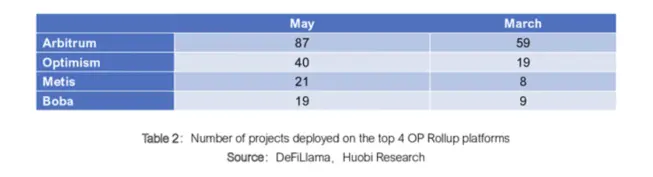
- Fewer dApps, integrations, and TVL than Arbitrum and Optimism
Resources
CEX bridges- @MEXC_Global and @gate_io
Fees paid to L1






