
You are reading an excerpt from our free but shortened abridged report! While still packed with incredible research and data, for just $40/month you can upgrade to our FULL library of 60+ reports (including this one) and complete industry-leading analysis on the top crypto assets.

Becoming a Premium member means enjoying all the perks of a Basic membership PLUS:
- Full-length CORE Reports: More technical, in-depth research, actionable insights, and potential market alpha for serious crypto users
- Early access to future CORE ratings: Being early is sometimes just as important as being right!
- Premium Member CORE+ Reports: Coverage on the top issues pertaining to crypto users like bridge security, layer two solutions, DeFi plays, and more
- CORE report Audio playback: Don’t want to read? No problem! Listen on the go.
Introduction
Polygon is preparing to migrate its native token from MATIC to POL-on September 4, 2024. This significant upgrade, following months of deliberation, marks Polygon's evolution from a simple Ethereum scaling sidechain into a sophisticated, interoperable network of scaling solutions. Central to this upgrade is the creation of an ecosystem of interconnected networks leveraging Zero-Knowledge technology, with Polygon serving as the foundational layer. This new architecture introduces an Aggregation Layer (AggLayer), which provides a unified liquidity layer across all networks developed using Polygon's Chain Development Kit (CDK).
Polygon 2.0: A Detailed Overview
The migration from MATIC to POL is a cornerstone of the Polygon 2.0 upgrade. Announced last October, this transition will see POL become the primary gas currency for ecosystem interactions, mirroring the role of ETH within the Ethereum network. Additionally, POL will serve as the staking token for validating transactions across Polygon and its associated CDK-based chains. This upgrade involves converting MATIC tokens on the Polygon POS network and staked MATIC on the Ethereum mainnet into POL. The conversion rate is expected to soar from the current estimate of around 0.5% to approximately 50% following the September 4 migration.
Polygon 2.0 is envisioned as an ecosystem of ZK Layer 2 chains based on Ethereum, referred to as "Polygon Chains." This structure is designed to improve both vertical and horizontal scalability, much like the layered structure of the Internet protocol suite. Polygon 2.0 comprises layers that perform different roles.

Staking Layer
The Staking Layer is a Proof-of-Stake (PoS) based protocol that leverages Polygon's native token to provide decentralization to participating Polygon chains. It achieves this through a common, highly decentralized validator pool and an in-built restaking model.
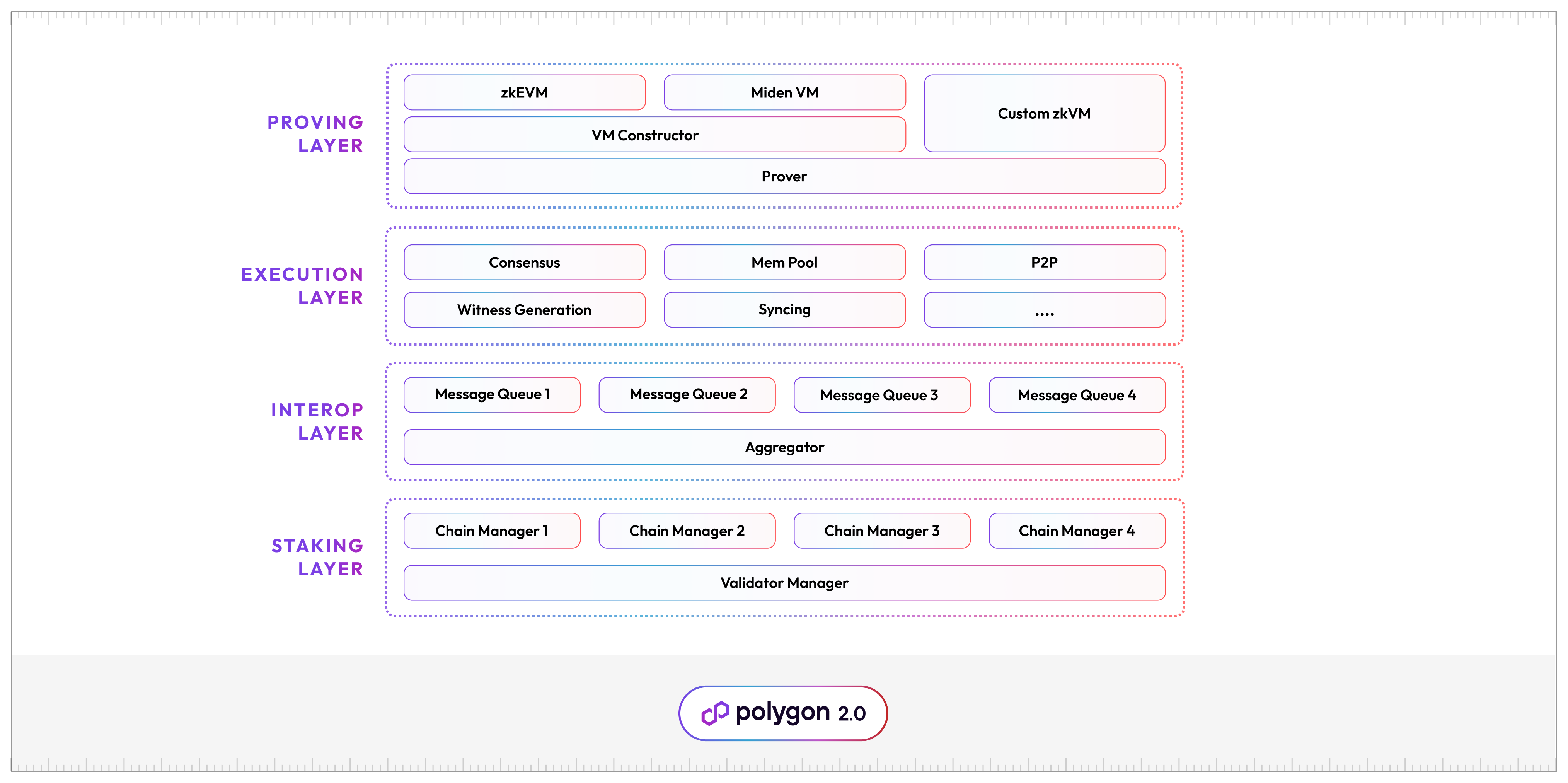
The Staking Layer is responsible for all matters related to Polygon 2.0 validators. It exists on the Ethereum network as a smart contract. There are two types of smart contracts in this layer: the Validator Manager and the Chain Manager. The Validator Manager manages the pool of validators in the Polygon 2.0 ecosystem, including a list of all validators, which validators are participating in which Polygon Chains, their staking size, staking/unstaking requests, slashing, and more. The Chain Manager exists for each Polygon Chain and manages the list of validators, configurations for validating that chain, and more.
Validators can join the common validator pool in Polygon 2.0 by staking tokens and participate as validators on multiple Polygon Chains if they wish. They are responsible for ordering and validating users’ transactions to create blocks, as well as the proving process of generating Zero-Knowledge Proofs (ZKPs) and ensuring the availability of transaction data. Validators are compensated for their various roles with protocol rewards, transaction fees from participating Polygon Chains, and additional rewards from Polygon Chains (e.g., native tokens).
Interoperability/Aggregation Layer
The Interop Layer facilitates secure and seamless cross-chain messaging within the Polygon ecosystem. It abstracts the complexity of cross-chain communication and makes the whole Polygon network feel like a single chain to users. Every Polygon Chain manages Message Queues, which are messages sent to other Polygon Chains containing the content, the destination chain, the destination address, and metadata. Message Queues have a corresponding ZKP, and if the ZKP of a particular message is verified on Ethereum, the destination chain can safely perform this cross-chain transaction.
The Interoperability Layer also adds an Aggregator component that brings together multiple ZKPs generated by Message Queues in Polygon Chains and allows them to be validated cheaply on the Ethereum network. The Aggregator is managed by Polygon 2.0’s common validator pool to ensure decentralization for liveness guarantee and censorship resistance. This cross-chain interaction is designed to give users a "Unified Liquidity" experience, as transactions can be processed almost instantly and atomically despite using multiple networks.
The introduction of Polygon 2.0 and its central feature, the Aggregation Layer (AggLayer), marks a significant advancement in the quest for scalability, interoperability, and user experience. The AggLayer, through the use of Zero-Knowledge (ZK) proofs, aims to create a cohesive, integrated environment while maintaining the autonomy of individual chains within the ecosystem. For L2 blockchains that integrate with the AggLayer, the primary benefit lies in the ability to retain full sovereignty while accessing a vast pool of unified liquidity. This aspect is particularly crucial for bootstrapping liquidity, a common challenge for emerging blockchains. Application developers, on the other hand, gain the ability to reach a broader audience seamlessly. Their decentralized applications (dApps), regardless of the native chain, can interact with users from across the ecosystem without the need for complex and user-unfriendly bridging processes. This fosters a more interconnected and accessible blockchain environment, akin to the fluidity and openness of the internet, thereby facilitating true growth and user acquisition for developers.

From the perspective of the end-user, the AggLayer enables users to execute cross-chain transactions in less than a second, creating a user experience that mirrors the simplicity and interconnectedness of the internet. This streamlined interaction model eliminates the need for frequent and cumbersome bridging between chains, thereby reducing friction and enhancing the appeal of blockchain technologies for a broader audience.
The AggLayer facilitates asset transfers and participation in activities across different chains with ease. For example, a user engaged on a gaming chain developed with the Polygon Chain Development Kit (CDK) and connected to the AggLayer can effortlessly move assets like ETH and DAI to participate in decentralized exchanges (DEXs) on another chain. This is achieved through a transaction that bridges assets and executes function calls for liquidity pooling, all within a unified and efficient fee structure.
The AggLayer operates by aggregating proofs and state updates from L2 chains and submitting them to Ethereum. This process is structured around three key components: proof aggregation, optimistic batch confirmation, and atomic cross-chain interaction. The AggLayer employs an innovative approach to reduce latency and ensure the reliability of cross-chain messaging, thereby overcoming one of the significant hurdles to seamless interoperability.
The optimistic confirmation mechanism is designed to address the latency challenges inherent in the aggregation layer. It enables the pre-confirmation of batches based on trust in the message's validity and the assurance that the batch will be finalized on Ethereum, thus facilitating faster cross-chain messaging. The concept of finality within the AggLayer framework ensures that once a batch is pre-confirmed, it is only under exceptional circumstances, such as collusion between the chain and the aggregation layer, that the batch could be reverted.
Validity in this context is ensured through a sophisticated process where chains can submit batches and message queues without immediate proof, relying on the AggLayer to confirm the pre-confirmed state. This approach safeguards against inconsistencies and ensures the integrity of cross-chain transactions.
The culmination of AggLayer's design is the enablement of atomic cross-chain interactions, which are designed to provide a truly seamless experience for users. By allowing for the submission of transaction bundles to multiple chains within the Polygon ecosystem, the AggLayer guarantees that all transactions will either be executed successfully or not at all. This atomic mode of operation, devoid of the need for a shared sequencer, represents a significant step forward in achieving a multi-chain ecosystem that operates with the simplicity and user-friendliness of a single chain.
Execution Layer
The Execution Layer is where the actual computation takes place in Polygon Chains.It enables any Polygon chain to produce sequenced batches of transactions, also known as blocks. This protocol layer is relatively commoditized and is used in a similar format by most blockchain networks. It has components similar to a typical blockchain network (e.g., P2P communication, Consensus, Mempool, Database, etc.). Polygon Chains are highly customizable at the client level, including the native tokens, transaction fee flow, additional validator rewards, block time and size, checkpoint time (how often ZKPs are submitted), and rollup/validium selection.
Proving Layer
The Proving Layer is a highly performant, flexible ZK proving protocol. The Proving Layer is responsible for generating ZKPs for every transaction on Polygon Chains. The prover utilizes Plonky2, a technology developed by the Polygon team.
The novel design of the Proving Layer offers several major benefits, including efficient proof generation and verification, straightforward and efficient proof aggregation, implementation of different ZK state machines, and safe cross-chain communication between those state machines.

Enhanced Functionality of POL
The redefined role of POL extends beyond securing a single network. POL will act as a hyperproductive token, validating the security of multiple networks. This expanded utility allows token holders to participate in various capacities within the ecosystem, earning diverse rewards tied to different services. For instance, POL will play a pivotal role within the AggLayer, although the specifics of its involvement remain subject to a community governance vote. This integration will enable rewards linked to the security validation of all networks within the Polygon ecosystem, alongside the operations of the AggLayer.
POL enables its holders to become validators and receive rewards, but with two significant improvements: Validators can validate multiple chains, and every chain can offer multiple roles (and corresponding rewards) to validators. This design aligns the Polygon ecosystem and fuels its growth while offering practically unlimited opportunities to POL holders.
POL introduces several benefits for the Polygon ecosystem. It provides ecosystem security through a highly decentralized pool of Proof-of-Stake (PoS) validators. It supports scalability, enabling the validator pool to scale to support thousands of Polygon chains without sacrificing security. POL also offers ecosystem support through a sustainable, in-protocol mechanism. Importantly, POL is designed in a way that does not introduce friction for users and developers.
The utility of POL revolves around validators, aligning and incentivizing them to perform useful work. Validators are required to stake POL to join the validator set. Once they stake POL, validators enter the validator pool and become eligible to subscribe to validate any Polygon chain. In return, validators can establish at least three incentive streams: Protocol rewards, transaction fees, and additional rewards.
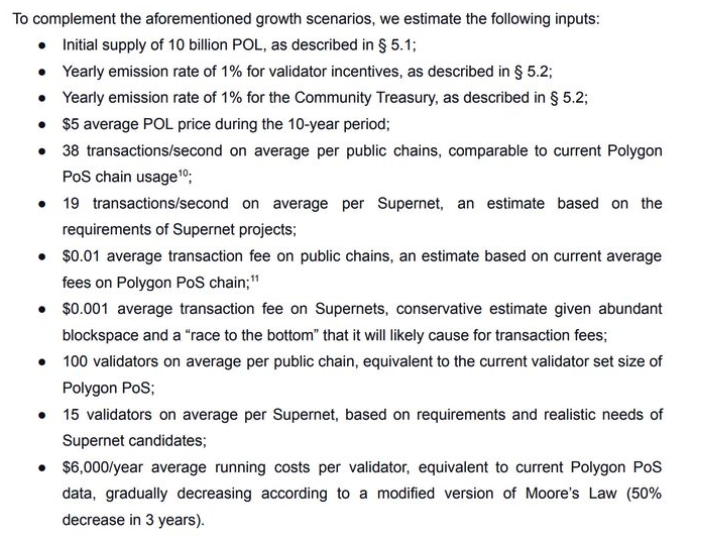
To ensure the future-proofing of the ecosystem, a continuous POL emission to fund the Community Treasury is proposed. A yearly emission rate of 2% is proposed for validator incentives and to fund the community treasury. This self-sustainable ecosystem fund can support protocol development, research, ecosystem grants, and adoption incentives. The Community Treasury will be governed by the Polygon community, via an agreed-upon governance process.
 Source: Polygon 2.0 white paper
Long-Term Strategy and Broader Implications
Polygon's long-term strategy for POL emphasizes its potential to facilitate block and Zero-Knowledge proof generation and participation in Data Availability Committees (DAC). This innovative approach could serve as a valuable blueprint for other scaling solutions, showcasing how to unlock greater utility. Comparatively, tokens from networks like Arbitrum and Optim
ism have sparked controversy due to their high valuations, primarily limited to governance roles. By adopting Polygon’s proposed model, these networks could enable their tokens to be staked, fostering increased community participation in decentralized sequencer operations. This model decentralizes critical aspects of the network's infrastructure, reducing the risk of a single point of failure.
Implications for the Cryptocurrency Ecosystem
The transition to POL is not just a technical upgrade; it represents a paradigm shift in how blockchain ecosystems can operate. By enhancing token utility and expanding the role of validators, Polygon sets a new standard for network security and community involvement. This upgrade could potentially influence other blockchain networks to rethink their tokenomics and governance structures, driving the entire cryptocurrency industry towards more decentralized and resilient models.
Conclusion
Polygon 2.0 signifies a monumental step in realizing the vision of an "Internet of Blockchains." The migration from MATIC to POL, coupled with the introduction of the AggLayer and enhanced token functionality, positions Polygon at the forefront of blockchain innovation. As the network evolves, it will likely serve as a model for other projects, illustrating the benefits of increased token utility and decentralized governance. This transformation promises to bolster the security, interoperability, and overall robustness of the cryptocurrency ecosystem, paving the way for a more integrated and user-centric future.





