
If you want more cryptocurrency analysis including full-length research reports, trading signals, and social media sentiment analysis, use the code "Publish0x" when subscribing to CryptoEQ.io to make your first month of CryptoEQ just $10! Or simply click the image below!

Defending the UST peg
As mentioned before, validators earn revenue for their services, however, their rewards are dependent on variables like network transactions (mining fees) and the fluctuating supply of LUNA. The Terra protocol looks to smooth out this volatility by:
- When mining rewards are increasing (bull market), the transaction fees are decreased and less LUNA is burned
- When mining rewards are decreasing (bear market), transaction fees are increased and more LUNA is burned
These adjustments, known as ‘stability levers,’ are made weekly and help entice new validators with more predictable returns, thereby strengthening the network.
As a solution, Terra Protocol relies on a decentralized oracle voting mechanism, whereby a set of trustless participants vote on the price data — more specifically, on the correct exchange rate between Luna and different Terra pegs. Similar to the consensus process, participants lock a significant amount of assets to participate in voting and receive a reward for correctly voting on the median price. Basically, this process allows Terra Protocol to bring external (exogenous) price data into the blockchain in a decentralized fashion and the Terra algorithm uses this data to set a target price.
Validators are also subjected to a minimum 21-day lockup period where they cannot earn rewards or withdraw their LUNA tokens. This three week lockup makes it less likely that validators will cut and run should the LUNA price experience short-term volatility. This gives time for arbitrageurs to try and restore the network equilibrium and avoid a “death spiral” situation.
In January 2022, the Terra Protocol announced the formation of Luna Foundation Guard. LFG is meant to be a center of excellence for the Terra Protocol with two mandates: 1- preserving the stability of Terra stablecoins, 2- fostering the Terra economy to maintain Terra’s mainstream adoption. Specifically for the first mandate, LFG raised $1 billion in bitcoin via the sale of Luna.
Finally, the community dApp White Whale Protocol allows anyone to deposit UST into a vault to earn yield via UST arbitrage, helping to stabilize the UST peg.
Anchor sustainability
Currently, a lot of UST is created for the ~18% interest rate paid by Anchor for deposits. Anchor represents approximately 70% of the TVL locked in the Terra ecosystem. As of Q2 2022, Anchor has ~$180 million in its yield reserves, thanks to the $450 million cash injection from the LFG organization, to guarantee the 18% interest on deposits. As previously stated, the reserves have been declining for months and the trend is not likely to reverse. Therefore, reserves will be drawn down again and a new solution will be needed.
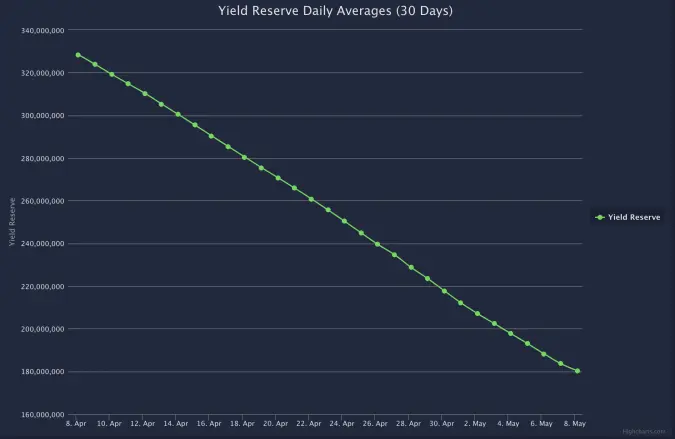
The difficult part of lowering the anchor rate is that when the 20% interest rate is lowered to a rate that is more sustainable, there is a risk that the large amount of UST on Anchor deposits may leave the Terra ecosystem as mercenary capital to find other opportunities. When the UST market cap is reduced, more LUNA is released into circulation and the LUNA price goes down. Those who borrowed UST with LUNA can get liquidated in this case. In the past, Terraform Labs has injected fresh capital into the Anchor yield reserve in July 2021.
Currently, the comparatively high 20% yield Anchor offers has led to other protocols, termed “vampires,” to farm the yield and suck the capital out of Anchor’s yield reserve. This is done by creating more UST and compounding it several times with leverage. In effect, the Terra ecosystem currently is subsidized by incentives for further adoption. Anchor’s 20% yield comes from staking rewards from Proof-of-Stake tokens that are deposited as collateral. Time will tell what happens when those incentives are stopped or reduced and this yield is reduced.
Thus far, Terra and Anchor have seen tremendous growth and adoption, but even during the bull market of 2020 and 2021, the system needed two “bailouts” ($70 million in May 2021 and $450 million in February 2022) to keep the system from imploding. Additionally, it has been observed just how hard and expensive it is to exit the UST/Anchor system when moving millions of dollars. Whales may be de facto “locked” into the UST positions because exiting would erode most of their gains. This is obviously not sustainable and the long-term sustainability of Terra and Anchor is a point of uncertainty.
However, steps have been taken in an attempt to avoid further issues like the ones experienced in the past. Proposal 90 was passed that increases the minting/redemption limits of UST/LUNA to over 100 million (compared to $20 million in the past). Terra also introduced insurance for UST on Anchor where a payout is given if UST deviates from its peg for too long for certain reasons.





