

If you want more cryptocurrency analysis, including full-length research reports, trading signals, and social media sentiment analysis, use the code "Publish0x" when subscribing to CryptoEQ.io to make your first month of CryptoEQ just $10! Or simply click the button above!
NEAR Protocol is a decentralized layer-1 smart contract platform that uses a Proof of Stake (PoS) consensus model and aims to provide advancements in usability, efficiency, and scalability through its unique sharding infrastructure.
Cohesively, NEAR Protocol can be broken down into four distinct layers:
- A permissionless base layer
- An independent native currency layer
- A predetermined monetary policy layer
- A marketplace layer for computing resources
Through NEAR Protocol’s novel technologies, it aims to minimize network congestion and provide developer-friendly technology stacks to encourage on-chain protocol construction. NEAR Protocol also operates through its own native token, NEAR.
Strengths
- Strong developer-focused incentives: part of every transaction fee goes back to the contract creator and a portion of the token inflation goes to protocol development
- Bleeding-edge sharding technology enabling lower fees and increased TPS when compared to legacy blockchains like Ethereum or Bitcoin
- EVM-compatible Aurora helps attract Ethereum community and developers
Weaknesses
- Concentrated token distribution at launch: 52.6% of supply went to the developers and NEAR Foundation
- Centralization around the “Reference Maintainer” and governance of the technical aspects of NEAR
- Limited validator set (125) and high cost (hundreds of thousands of dollars in NEAR) to become one
- Lagging in adoption compared to other comparable smart contract protocols
Nightshade Sharding
NEAR Protocol achieves scalability through sharding, a process that distributes computational stress by partitioning data on the network into smaller pieces called “shards.” In traditional sharded blockchain models, each shard is its own parallel blockchain with its own validator set. NEAR has implemented a slightly modified version referred to as “Nightshade.”
To further grok a sharded blockchain architecture, it is critical to understand the role nodes play in a blockchain as well as the resource burden over time. Nodes (typically) perform three tasks in a decentralized blockchain:
- Compute: Process new transactions
- Consensus: Relay valid blocks to the other nodes in the network
- Storage: Store state/history of the entire network
However, each of these activities places an increasing demand on nodes. As the volume of transactions increases, more computing power is required to process them. Relaying transactions and blocks increases network bandwidth requirements. As the amount of data to store increases, more storage is required.
In sharded blockchains, each shard stores only its own local state and only relays transactions associated with its state. While this does reduce the resource load on nodes and improves scalability, it introduces increased complexity in the form of cross-shard interoperability. All the shards must know where all/specific states resides at all times and coordinate in validator selection/slashing. Designs like Ethereum and Polkadot have a Beacon/Relay chain at the center to help coordinate these things.
Differentiation from Beacon Chain
Nightshade takes a step away from the Beacon Chain model of sharding. In Beacon chains, multiple blockchains are secured by different validators with each chain being its own shard. This creates separation within the overall security of the total system as validators are separated per chain (shard). So, if there are 10 shards in a system with each shard having its own validator, to achieve the same level of security of a non-sharded chain, each shard requires 10x the validators.
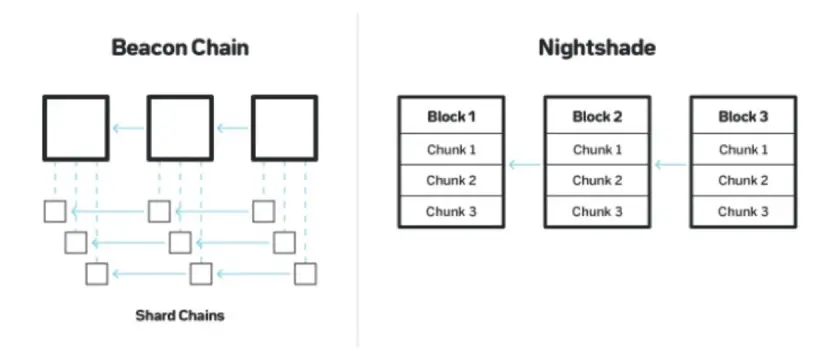
Rather, Nightshade operates as a single blockchain as each individual block contains all transactions from all shards while also simultaneously adjusting the whole states of all shards. No one node downloads the full state of the network. This is how NEAR protocol performs dynamic sharding.
This has three advantages that benefit NEAR:
- There’s less opportunity for the network to fork, granting higher security
- The network operates faster as participants are only responsible for their shards
- Increased cross-shard composability
Nightshade lists the transactions within a block and splits them into chunks (one chunk:one shard). Generally, NEAR ideally has one chunk per block, though it's possible that chunks are missing due to network delays. This functionality corresponds with DoomSlug in ensuring that even when data is missing, blocks can still be validated and added to the chain.
In Ethereum's case, every transaction must be confirmed by the beacon chain, which limits scalability based on the throughput of the beacon chain. The interblock sharding method of Near does not rely on a single chain for transaction validation and, therefore, does not suffer this limitation.
Stages of Nightshade
The Nightshade sharding implementation is being rolled out in stages. Nightshade was initially released as Simple-Nightshade, a phase 0 launch in November 2021 that enabled the basics of Nightshade to begin providing transactions four times as fast for validators. Phase 1 was recently completed in Q3 2022 and introduced a new form of validator on NEAR, the chunk-only producers. Hypothetically, this will add decentralization to the network by countering the network’s previous 100 validator limit.
Phase 2 is the full release of Nightshade for validators in which both the state and processing of the state will be 100% sharded. This eliminates the need for validators to track all shards, reducing the hardware requirements overall to make the network far more accessible to those who wish to participate directly. This rollout is projected for sometime in 2023, though developers are notably behind schedule.
Lastly, Phase 3 is projected for some time in 2023 and will include the ability for the network to dynamically split and merge shards entirely based on resource use. This means that less used shards can be combined with other under-utilized shards to help the network increase overall efficiency.





