

If you want more cryptocurrency analysis including full-length research reports, trading signals, and social media sentiment analysis, use the code "Publish0x" when subscribing to CryptoEQ.io to make your first month of CryptoEQ just $10! Or simply click the button above!
Due to Avalanche’s Proof-of-Stake consensus, validators only need modest hardware requirements and it doesn’t use enormous amounts of energy. Avalanche’s consensus mechanism is theoretically able to scale to millions of validators participating in consensus at once, offering unparalleled decentralization compared to that of Bitcoin, for which just five mining operations control the majority of Bitcoin’s hashing power.
There are several unique advantages Avalanche has in terms of security due to its unique consensus protocol. In comparison to Classical consensus protocols that can achieve higher throughput and lower latency than Nakamoto Consensus protocols, Classical consensus protocols can withstand up to ⅓ + 1 of the validators being malicious. Nakamoto Consensus protocols are able to withstand up to 50% of the network being malicious, meanwhile Avalanche is secure with up to 60% of the network being malicious. Additionally, if the network is parameterized for a 33% attacker (like in Classical consensus), and an attacker is able to obtain 34% of the stake, they’re not guaranteed to succeed in their attack, but only slightly more likely to succeed. This is different than in Classical consensus when, once an attacker obtains 34% of the network stake, they’re guaranteed to be successful in a double-spend attack.
Avalanche consensus combines the benefits of Nakamoto Consensus with its robustness, scale, and decentralization, with all of the benefits of Classical consensus with its speed, fast time-to-finality, and energy efficiency without the disadvantages.
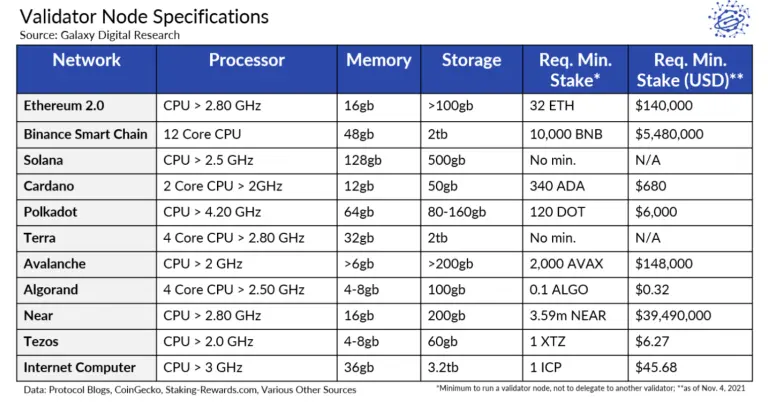
All of the chains in the primary Avalanche network are secured by the full stake value of the network, and since Avalanche’s consensus is inclusive and not restricted to a small number of validators like other blockchains, it can scale to millions of validators securing the network. There are currently over 1,000 block-producing validators and all participate in consensus on a decision.
Governance Parameters
Avalanche provides on-chain governance for critical parameters of the network where participants are able to vote on changes to the network and settle network upgrade decisions democratically. This includes factors such as the minimum staking amount and time, minting rate, transaction fees, and others, and enables the platform to perform dynamic parameter optimization through a crowd oracle.
However, there has been at least one instance in which Ava Labs pushed through an upgrade without a community vote. An increase to the minimum uptime threshold for validators was implemented, catching some validators off guard and leading them to voice their displeasure in the project’s discord. This is one example of how early projects are typically centralized around their founding team.
Staking rewards, fees, and airdrops are all influenced by governance and are all levers to change monetary policy. Staking rewards are set by on-chain governance and are set by a function to never surpass the capped supply.
To induce staking, the fees can be increased or the staking rewards can be increased. To increase engagement with the platform services, fees can be lowered and the staking reward can be lowered.
One key difference between other governance platforms and Avalanche is that unlimited changes to arbitrary aspects of the system are not allowed. Only a predetermined number of parameters, noted below, can be modified via governance, rendering the system more predictable and increasing safety.
All governance parameters are also subject to limits within specific time bounds, introducing hysteresis, meaning that changes to parameters are highly dependent on their recent changes. Once a parameter is changed using a governance transaction, it becomes difficult to change the same parameter immediately and by a large amount, but this difficulty in both time and degree of change decreases over time since the governance transaction.
This prevents the system from changing drastically over a short period of time and allows users to safely predict system parameters in the short-term while having control and flexibility in the longer term





