

If you want more cryptocurrency analysis including full-length research reports, trading signals, and social media sentiment analysis, use the code "Publish0x" when subscribing to CryptoEQ.io to make your first month of CryptoEQ just $10! Or simply click the button above!
Rollups
Rollups are a relatively new L2 solution being implemented on Ethereum that enable exponential scalability gains while providing (nearly) identical security guarantees as mainnet Ethereum. The primary innovation of rollups is that they move computation off-chain, while storing only the bare minimum of transaction data on-chain with no added trust assumptions. The rollup chain handles all of the expensive and computationally-dense data processing, enabling exponential growth in Ethereum’s ability to execute transactions. Again, in its simplest form, the rollup chain executes the Ethereum transactions on its own chain, “rolls'' them up into one batch, and Ethereum receives and stores the results. Rollups can be thought of as branches off of the main trunk of Ethereum that increase the computation surface area of Ethereum.
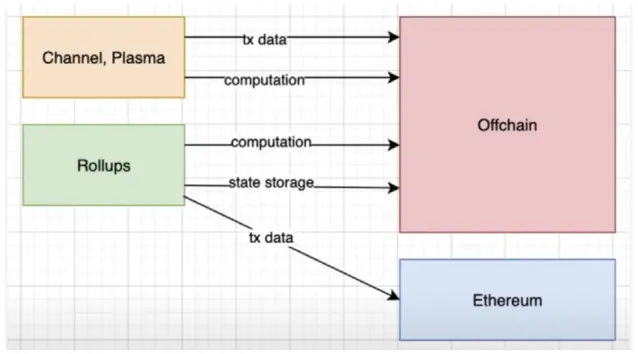
However, in order to do so, the Ethereum mainnet needs some way to verify that the transactions that happen off-chain are valid. So, how does Ethereum determine that submitted data from a rollup is valid and not submitted by a bad actor?
The answer is cryptographic proofs, like validity proofs for ZK-rollups (ZKR) and fraud proofs for Optimistic rollups (OR). Each rollup deploys a set of smart contracts on L1 Ethereum that are responsible for processing deposits/withdrawals and verifying the submitted proofs. The main value proposition of rollups is that they minimize the data footprint on L1 while still preserving the ability to check for fraud.
In the case of Optimistic rollups, no computation is actually done. ORs “optimistically” assume all state changes are valid and post the off-chain transactions to Ethereum’s layer 1 as calldata. To counter any potential fraudulent transactions, a challenge/dispute period is put in place for ~one week after posting to L1. During this time any third party can publish a fraud proof to verify the validity of the transactions across L1 and L2. If the transactions are found to be invalid, the invalid transactions and all affected transactions will be reverted. Arbitrum, Optimism, Metis, Boba, and Fuel are examples of Optimistic rollups.
Zero-knowledge rollups (ZKRs) batch together thousands of off-chain transactions, actually do the computation, and then post the batch to mainnet as a “validity proof.” The validity proof is a cryptographic proof (called a “SNARK” or STARK) that has already computed the state of the L2 and is sent to mainnet for storage, containing much less data than the calldata used in Optimistic rollups. The “batch” that’s rolled up is periodically posted to mainnet Ethereum and contains the net outcomes of many different transactions as they occurred on the rollup layer. This data is verified and updated by the rollup operator every time the L2 advances its state. Therefore, L2 execution and L1 data update in lockstep. Starkware, zkSync, and Polygon Hermez are a few examples of ZKRs.
This removes the burden of data on Layer 1 while also allowing Layer 2 transaction data to be available on Layer 1 for validation. Rollups remove everything from being done on-chain (monolithic) to the Ethereum mainnet now serving as the settlement layer for off-chain L2 interactions (modular design).
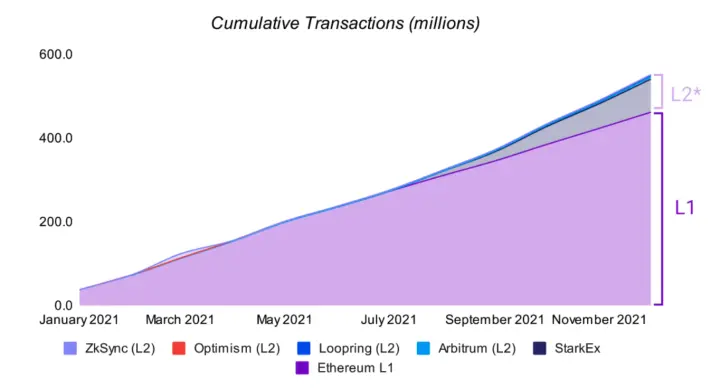
A rollup needs orders of magnitude less validators than L1 to maintain its security. As long as a single honest validator does its job, the network will remain secure. ORs allow any user to run a sequencer (Arbitrum full node) that processes the transactions and enables users to withdraw funds to mainnet. Sequencers require a “fidelity bond” to be locked on the L1 and is at risk if the Sequencer is caught (during the challenge period) propagating invalid transactions. This creates a financial incentive to be honest and act in the best interest of the rollup chain. Strong crypto-economic incentives and a network of decentralized sequencers will allow L2s to have high network uptime, fast and cheap transactions, and leverage Ethereum’s security.
With rollups, Ethereum can go from ~25 to 3,000+ TPS without sacrificing security. What makes rollups such an attractive scalability technology is the fact that users' funds cannot be stolen or censored (as is the case on some sidechains) and that no one can prevent users from exiting the rollup whenever they wish. Users can always access data on L1 to safely exit the rollup chain with their funds.
From a solely scalability perspective, ZKRs are more performant than ORs because they compress data more efficiently meaning they have a smaller “batch size” when submitting to L1. This also helps in costs. As of Q2 2022, the primary cost associated with a rollup is the cost to post calldata (discussed further below) to L1 Ethereum. Optimism, an OR implementation, posts data to the Ethereum L1 for every transaction, however, some ZKR implementations, like dYdX, only post to mainnet to reflect every account balance. Because of this approach, dYdX interacts with L1 only ~20% as much as Optimism, equating in roughly 90% reduction in fees.
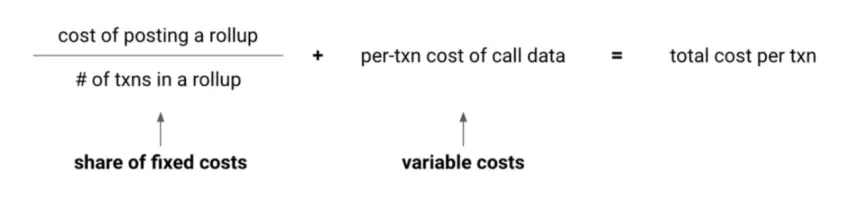
Reducing the frequency of L1 interactions is one cost-saving method but so, too, is batching more transactions into one block (the denominator in the image above) in order to “socialize” the L1 calldata cost. By socializing gas cost across bundled users and only posting calldata to mainnet, rollups are able to reduce transaction fees by 70-95%. Fees will continue to get cheaper as data storage is optimized on mainnet for rollups.
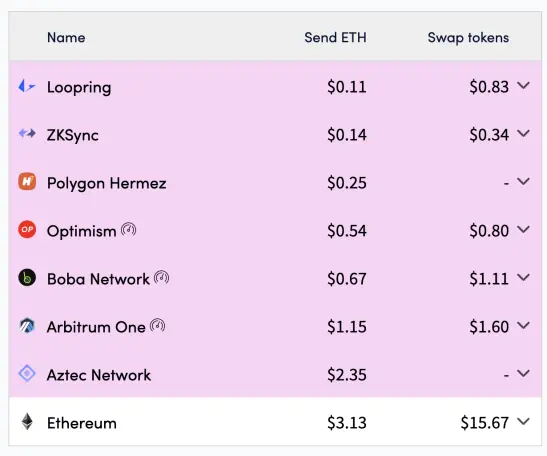
Despite being extremely nascent, rollups are already significantly reducing fees for many Ethereum users. l2fees.info frequently shows Optimism and Arbitrum providing fees that are ~10x lower than the Ethereum base layer itself, and ZK-rollups, which have better data compression and can avoid including signatures, have fees ~40-100 times lower than the base layer.
While rollup’s efficiency gains and cost reductions are impressive, it is important to note that rollup’s potential scalability is constrained by the limitations of the L1. The primary factor on the scalability of a rollup is how much data the main chain can hold. This comes at a cost and means rollups can only offer linear scalability gains.
For the next exponential jump in sustainable scaling, Ethereum will need to scale its data capacity via sharding. Shards will complement rollups nicely as they increase the data availability of Ethereum (think 64 data centers vs just one). Once sharding is live (2023 or later), there will be an almost 20x increase in capacity, allowing rollups to operate cheaper and faster.





