If you want more cryptocurrency analysis, including full-length research reports, trading signals, and social media sentiment analysis, use the code "Publish0x" when subscribing to CryptoEQ.io to make your first month of CryptoEQ just $10! Or simply click the button above!
1. What is GMX, who founded it, was it audited, who audited it, metrics?
GMX is a decentralized spot and perpetual futures exchange on both the Arbitrum One Layer 2 (L2) network and Avalanche blockchain network. The exchange lets users trade BTC, ETH, LINK, and a handful of other tokens with up to 30x leverage. Users can also provide liquidity for the protocol and earn rewards in ETH or AVAX for staking GMX tokens.
GMX started as Gambit Financial, which was originally on Binance Smart Chain, but rebranded to GMX in early 2022 with the expansion to Arbitrum. The founders/team are mostly anonymous/pseudonymous, with xdev10 and gkrasulya serving as the primary Github contributors. The GMX contracts have been audited by ABDK Consulting, whose review can be found here.
Trading in GMX is supported by its unique multi-asset pool. Because GMX is a decentralized platform, users must supply liquidity to trade instead of using a typical order book model. Users who supply liquidity receive a portion of the protocol’s fees.
This shared liquidity mechanism functions via GMX’s $GLP token, a token that acts as a blue-chip cryptoassets index. GLP accrues 70% of the platform’s generated fees.
GMX is the protocol’s governance and utility token and can be staked to earn escrowed tokens (esGMX) as well as ETH or AVAX rewards. It also accrues 30% of the protocol's fees.
On its website, GMX boasts over $67 billion in total trading volume and ~107,000 users. It's the largest Arbitrum dApp (~$370 million) and 7th-largest Avalanche dApp (~$65 million) by TVL. It's regularly among the top-five crypto projects, L1s or otherwise, in revenue with ~$400,000+ in daily fees generated.
2. What is Arbitrum, potential for airdrops, why switch to Arbitrum Nitro?
Arbitrum is an optimistic rollup L2 built by Offchain Labs. The currently-live implementation is called Arbitrum One and uses fraud proofs, on-chain calldata availability, a ~seven-day withdrawal period, and a particular type of node called a ‘sequencer.’ Offchain Labs currently operates Arbitrum's sequencer, which can control transaction ordering.
While both are Optimistic rollups, Arbitrum has some key differences from its counterpart, Optimism. One critical difference: Optimism OVM 2.0 is EVM-equivalent, running directly inside the EVM, while Arbitrum One is only EMV-compatible. This reduces code complexity and audit surface for Optimism. Arbitrum's AVM lacks EVM-equivalence because it’s consciously optimized for more compact fraud proofs but at the expense of implementation complexity.
In an effort to improve, Arbitrum will soon undergo its Nitro upgrade. Nitro helps Arbitrum adopt popular languages and tools such as WASM, Geth, and Golang, allows Aributrum to increase transaction speed 20-50x, and lowers fees by an entire order of magnitude. The upgrade will replace the current AVM with a WASM-Geth combo in which interactive fraud proofs execute over WASM, and the node software runs a Geth-equivalent codebase, making it easier for more Ethereum developers to onboard onto Arbitrum.
While nothing’s official, an eventual Arbitrum token (ARBI) is suspected. Many believe one of the factors for qualifying to the airdrop will be to participate in the upcoming Arbitrum Odyssey campaign, a month+ initiative in which users earn exclusive NFTs as rewards for interacting with the Arbitrum ecosystem in specific ways, such as:
- Bridging assets to Arbitrum
- Providing liquidity on bridges and DEXes
- Participating in governance
- Minting NFTs
- Running nodes and/or validating transactions
3. How is MEV being executed post-Merge, who profits, is it worse than before?
MEV is the value extracted by miners or validators using their ability to organize transactions within a block. Arbitrage, liquidations, and sandwiching are the three major MEV types on Ethereum.
In 2021, miners made $730 million via MEV on Ethereum. However, now that Ethereum has moved to PoS, MEV involves new entities and opportunities compared to its previous PoW scenario.
In PoS, Ethereum validators are randomly selected to propose blocks for each “epoch,” which consists of 32 “slots.” This means the next/future 32 block producers are known in advance. This is distinct from PoW and enables new MEV strategies.
Rather than take on the highly-sophisticated and technical work required to maximize MEV in a block themselves, validators can now outsource that work and select a pre-built block from a specialized “block builder.” Validators can run mev-boost, a (now) open-sourced software that creates the marketplace connecting the block builders and block proposers (validators) via a “relay.”
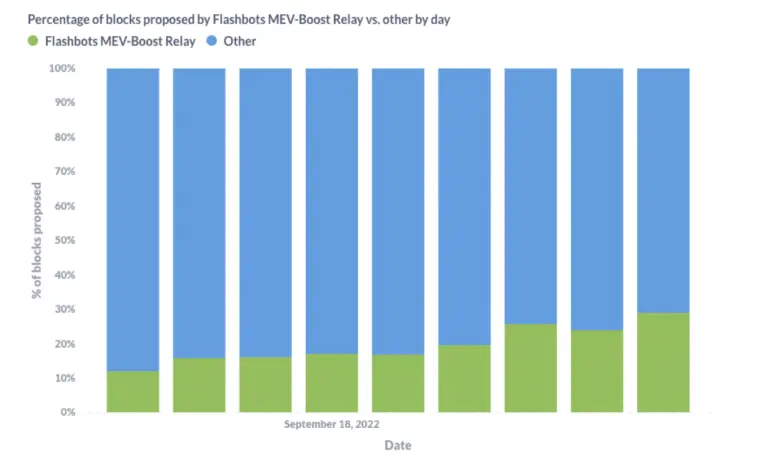
Builders monitor the mempool, build the most highly optimized block possible, and submit the block, along with a "bid," to the relay. Relays collect offers from multiple builders on the next block. The validator can see the builders' bids, which include the total value of priority fees plus any MEV value they stand to earn if they opt to propose the block. Post-Merge, the proportion of mev-boost blocks in the total block mass has increased steadily from approximately 15% of blocks per epoch to 30%.
Mev-boost adoption in the first week post-Merge was ~25% and growing. Of that 25%, the Flashbots relay executed ~80% of those blocks, showing signs of being the early PoS MEV winner.