

If you want more cryptocurrency analysis, including full-length research reports, trading signals, and social media sentiment analysis, use the code "Publish0x" when subscribing to CryptoEQ.io to make your first month of CryptoEQ just $10! Or simply click the button above!
*See the full article here.*
GameFi Rankings
Overall:
-
The Sandbox - SAND already has some immense partnerships created with giants such as Atari, Universal Music Group, and others. The metaverse is being actively developed by the world’s largest builders and has a much more favorable player count.
-
Axie Infinity - AXS saw one of the highest daily player counts out of the games on this list but suffered immensely from the massive Ronin Bridge hack. Outside of the hack, AXS has a high barrier to entry compared to other metaverses/gaming titles but has had one of the highest rates of success in terms of player conversion.
- Enjin Coin - ENJ is providing what could be a multi-billion dollar solution for gaming titles in the near future. As more gaming developers wish to enter the blockchain / P2E space, ENJ will already have a solution to fast-track that process.
- Gala Games - Despite some tokenomics issues, Gala Games has one of the most sophisticated platforms that caters to pure gamers. Many gamers don't want to deal with blockchain mechanics openly or have it interfere with the gameplay, and Gala is doing a good job of offering that.
- Merit Circle - Has a sophisticated ecosystem model and already launched some well-renowned scholarship programs to bring in new gamers to GameFi. MC is ahead of YGG in terms of utility for its native token as it offers more of a platform where MC can be considered a medium of exchange.
- Flow - FLOW offers a highly sustainable blockchain network and has some of the most impressive NFT partnerships in the space. The gaming side of the blockchain is obviously lacking, however, so for users to bet on FLOW, they need to be betting on the value of art-style NFTs from major brands holding value long term—at least until true gaming titles emerge.
- Decentraland - MANA lags behind The Sandbox slightly but still offers a large metaverse with valuable LAND. Decentraland also benefits from a more favorable graphics package than The Sandbox.
- My Neighbor Alice - Out of all the blockchain games on this list, ALICE does the best job of appealing to non-blockchain gamers. The game model is simple yet refined, and it actually offers a level of gameplay that other titles don’t have.
- Gods Unchained - Unlike other titles on this list, Gods Unchained does have playability. The game is being developed, but it’s amassed a large player community of over 450,000 and fills a niche gaming category as a trading card title. Beyond this, however, growth may appear limited as the game itself hasn’t necessarily improved upon the style of game it is and could fall victim to copycat games.
- Otherside - BAYC is undoubtedly the king of NFTs, and with the successful testing of its metaverse concept, it could end up being a leader among metaverse protocols. Of course, graphics will be an issue while on the Ethereum blockchain, and the high degree of exclusivity will always limit its overall growth.
- Efinity - Efinity by itself offers lower fees and quicker transaction processing than that of its mainnet Enjin. For that reason, Efinity maintains a smaller market share and serves as a secondary solution for users to engage with outside of Polkadot.
- Illuvium - ILV has attracted a lot of attention and hype as players patiently wait for a full game launch. The reason it's low on this list is similar to other gaming titles this low: it has no playability. Those purchasing ILV and ILV-native NFTs are betting on the future of this title.
- Aavegotchi - While initially highly popular, Aavegotchi has no players and little playability. The main appeal of obtaining a ghost is for yield-generating as it gives users passive income over time.
- DeFi Kingdoms - DFK has been at the center of many controversies, but it still lives on as a protocol. The development team have been working diligently to add true playability to the game beyond just being a gamified DEX. Until this happens officially, DFK remains speculative along with Illuvium and Star Atlas
- Star Atlas - ATLAS is another gaming title that has hype building behind it with no true proven product. With the game set to release sometime in 2022, long-time backers and eager players may finally get to interact with the game.
- Yield Guild Games - YGG is very similar to Merit Circle in a lot of ways, just with less overall utility. The DAO is more centered on the gamers joining and generating revenue for the DAO, acting more like a business than a GameFi protocol. This could lead it getting into trouble with regulators should they ever investigate the space.
Gaming Protocols / P2E
Gala (GALA)
Gala Games is a gaming studio that focuses specifically on non-intrusive blockchain gaming. The ‘non-intrusive’ part means Gala makes an intentional effort to “hide” the blockchain element of the gaming titles, ensuring players’ first focus is simply on how fun it is to play.
Gala Games was started in 2019 to build a full gaming ecosystem, giving players full control over the games and in-game assets themselves in a Play-to-Earn (P2E) style economic model. Gala has also been developing its own blockchain called “GalaChain” to improve upon its titles’ scalability and affordability over the Ethereum chain.
Key Features
Gala Games is an Ethereum-based protocol that operates through its own native token, GALA. The GALA token powers the ecosystem, giving users the following:
-
Governance over Gala Games
-
Rewards to Founder Nodes
-
Serves as the in-game currency standard
-
Used as a medium of exchange on Gala marketplaces
Gala Games has compatibility with two of the largest chains in the ecosystem: Binance Smart Chain and Ethereum. Gala itself is the fourth-largest gaming protocol in the space, holding a market cap of ~$400 million with a max total supply of 50 billion tokens.
The ecosystem itself is operated by a dual-node configuration:
-
Founder Nodes - With a maximum of 50,000 available, these nodes can't be run unless an individual purchases a license (costs 287,000 GALA). These node licenses give owners the ability to earn compensation for securing the Gala Games network and will be tradable as NFTs.
-
Game Nodes - Work very similar to Founder Nodes, except they're game-specific. People can purchase specific game nodes they enjoy, but pricing is based on the free market trading of the license.
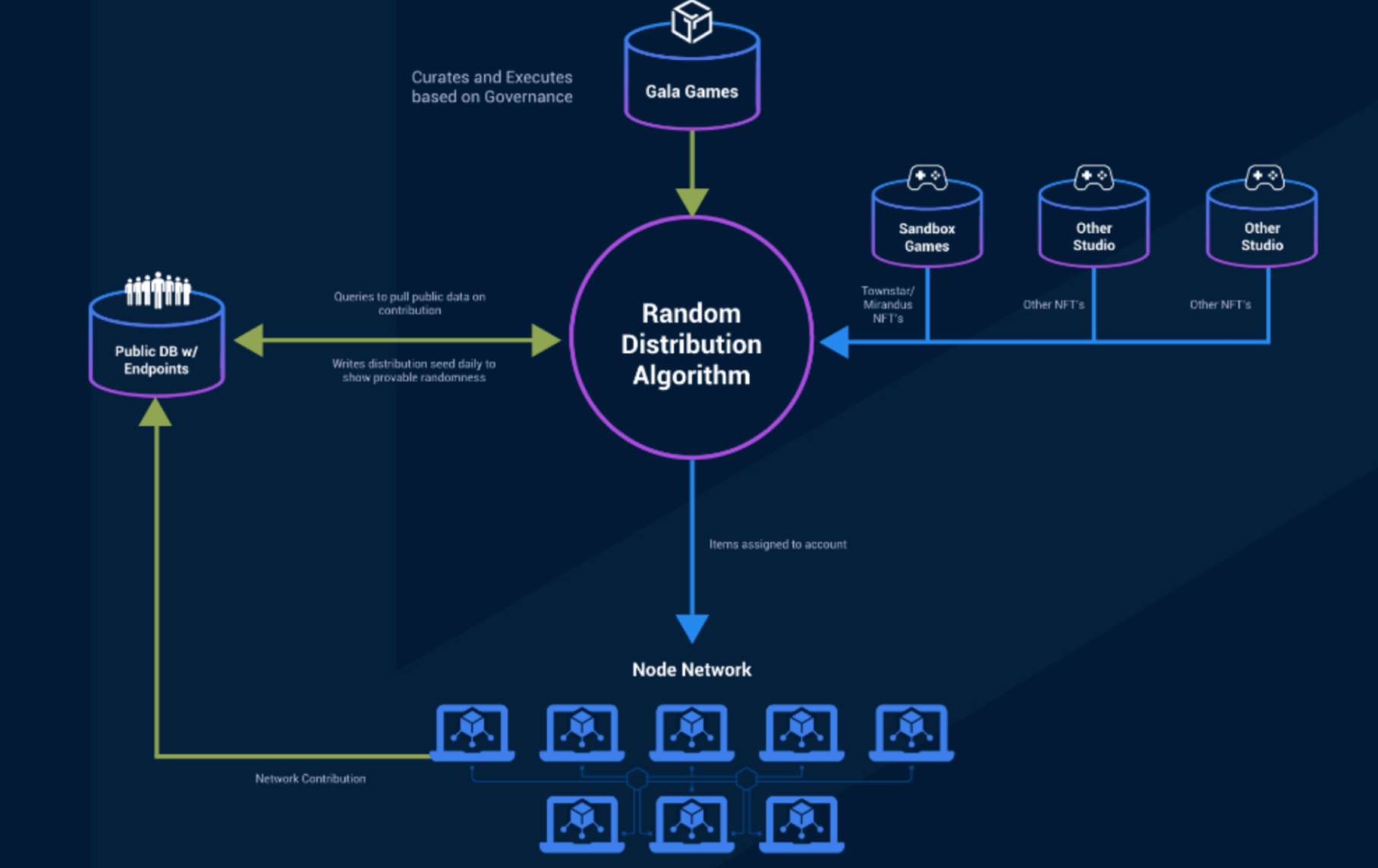
Gala games random distribution algorithm.
Gala Games boasts partnerships with some major brands, including Under Armour and the TV series The Walking Dead. Other gaming titles available on the platform include:
-
Townstar (playable)
-
Spider Tanks (playable)
Titles in development include:
-
Fortitude
-
Grit
-
Battlestar Galactica
-
Eternal Paradox
-
Superior
-
Legends Reborn
-
Mirandus
-
Legacy
-
Last Expedition
-
Echoes of Empire
Pros & Cons
Gala Games has built a relatively robust ecosystem of gaming titles for players to enjoy. Outside of Axie Infinity, Gala is one of the more widely popular platforms for P2E opportunities and blockchain gaming. Unfortunately, Gala Games is much more centralized in terms of tokenomics than it may seem on the surface.
From a node perspective, the network is actually highly distributed. There are over 26,000 nodes living and securing the network day-to-day. This is a significant number; higher than almost any blockchain network to date. The problem is the high barrier to entry for normal users to run nodes. It's also reasonable to assume one individual could purchase multiple node licenses and remove them from circulation.
The bigger confusion for GALA token holders is the actual economics behind the coin. Nearly 90% of GALA tokens are held by top-100 wallets, showing that, from a distribution standpoint, the GALA token is highly concentrated. Additionally, holding GALA gives no equity incentives over the Gala Games ecosystem directly. This is accomplished by purchasing a Founder Node license.
For most gamers, this is more than likely not an issue. The barrier to entry for seasoned crypto and blockchain experts is much lower than for chains like NEAR, and it removes the need for players themselves to have to worry about network governance and other factors.
My Neighbor Alice (ALICE)
My Neighbor Alice is a blockchain-based multiplayer builder game where users can interact, buy, and own virtual islands and build in-game items. Alice is directly inspired by titles like Animal Crossing and aims to provide a gaming platform that can introduce millions of gamers to blockchain.
The game itself is designed to be player-owned and -governed, giving them decision-making power over the Alice DAO. It was originally launched by a game studio called Antler Interactive.
Key Features
My Neighbor Alice was intentionally designed to cater to non-blockchain natives, meaning zero prior knowledge of cryptocurrencies, NFTs, or other blockchain concepts is needed. The game itself is free to play, allowing anybody to begin participating. LAND purchases aren’t necessary to play. Plus, the game has reserved 50% of the available plots for rentals or public uses.

Six different types of virtual islands in My Neighbor Alice. Source: Cointelegraph/My Neighbor Alice
Users can engage in a number of different activities, such as:
-
Gathering collectibles
-
Fishing and farming
-
Purchasing upgrades through missions, competitions, or activities
The game itself has four core features:
-
Avatars - Playable characters within the game that can be customized
-
Virtual Islands - Islands within the game can be visited, hold in-game activities, and be purchased by the user as LAND
-
In-Game Assets - Collectibles, upgrades, and other items of value. These assets can then be traded between players on the Alice marketplace
-
ALICE Token - The game’s native token can be used to purchase in-game items, earned through various in-game activities, and staked for awards. The token gives holders power over the DAO through governance.
Overall, My Neighbor Alice is the 10th-largest gaming asset in the space. ALICE holds a market cap of around ~$40 million with a max total supply of 100 million tokens.
Pros & Cons
My Neighbor Alice is currently in development, but it’s already executed public token sales and multiple LAND sales. Being a free-to-play title, this will help My Neighbor Alice attract a larger portion of the non-crypto crowd.
The land sales that have been conducted has shown that LAND, at least through this initial launch, is highly obtainable for interested players. LAND costs 50 ALICE tokens (just over $100), so a player that's interested in the title long-term could very easily acquire ownership of the game. This is much harder in major titles like Axie Infinity, The Sandbox, and others.
The downside for Alice is the game is only available through Binance Smart Chain. This creates some limitations, but with the cross-chain infrastructure that already exists in 2022, this is ultimately less of an issue than it used to be. The other negative to consider is the game itself is still mostly experimental as it's in development. The release of Alpha v1 access has just recently commenced.
Aavegotchi (GHST)
Aavegotchi is an open-source NFT gaming protocol. The NFTs themselves are on-chain collectible ghosts staked with aTokens, the interest-bearing token of the DeFi protocol, Aave. Aavegotchis can be purchased on a secondary market for the protocol’s native token, GHST. Aavegotchis can also be acquired by purchasing an asset called a ‘portal’ and summoning one.
Key Features
Aavegotchis are verifiably rare, interest-bearing ERC-721 tokens (NFTs) native to the Ethereum / Polygon blockchains. Aavegotchis all have some form of rarity balance that determine their underlying value based on these three attributes:
-
Collateral stake associated with the ghost
-
Traits of the ghost (brain size, energy, spookiness, etc.)
-
Ghost wearables (armor, badges, etc.)

Aavegatchi example Socrates
The GHST token itself has a handful of different utilities for Aavegotchi, most notably for the buying and selling of assets within Aavegotchi. This includes for ghosts themselves, portals, upgrades, and other items of value.
The token doubles as a governance token, allowing players to stake it for awards in addition to having decision-making power over the Aavegotchi DAO. GHST has a $60 million market cap of ~$60 million with a low maximum total supply of 48,903,762 tokens.
Besides staking, players can also earn GHST through a process called “rarity farming.” This is a game mechanism in which players compete to raise the rarest ghosts, upgrading their ghosts with wearables and engaging in minigames to win prizes.
Aavegotchi also just launched the Alpha version of its own metaverse called the “Gotchiverse.” Within the metaverse, Aavegotchi owners will be able to engage with other owners, purchase LAND, and participate in activities.
Pros & Cons
The Aavegotchi ghosts themselves are interest-bearing assets, so simply owning one will generate a passive yield over time. Outside of passive income, the only true playability right now is through rarity farming which is nothing more than yield-farming. With the Alpha launch of the Gotchiverse on March 31, 2022, this could change in time.
Aavegotchis are relatively expensive to acquire on secondary markets, with some going for upwards of $1,500. Portals aren’t cheap either, as most costs hundreds in GHST. The biggest downside to Aavegotchi is the complete lack of any real players. The minigames exist, and the platform has some usability, but the players just aren’t there.
On any given day, the daily player count has been tallied ~2500 or so people. The GHST token itself also comes off as a bit unnecessary without the immersion of a real metaverse. Being on the Polygon sidechain, it would be much easier for users to simply use MATIC rather than convert into GHST.
DeFi Kingdoms (JEWEL)
DeFi Kingdoms is a Play-to-Earn (P2E) game located on both the Harmony and Avalanche blockchains. The game itself is powered through a dual token system: JEWEL on Harmony and CRYSTAL on Avalanche. Players can engage in various yield-generating activities within the game, completing quests, purchasing in-game assets, and more.
DeFi Kingdoms aims to move away from its current gamified DEX model and push into a fully operable MMORPG title later in its roadmap. This would bring real playability to the game itself, allowing users to purchase LAND, engage with a full storyline, and create actual utility for in-game assets outside of yield generation.

DeFi Kingdoms castle and grounds. Source: DeFi Kingdoms
Key Features
DeFi Kingdoms operates as a cross-chain platform between the Harmony ONE network and the Avalanche AVAX network. The developers have created two different “realms” within the game to represent this:
-
Serendale realm on Harmony
-
Crystalvale realm on Avalanche
Players can bridge their assets between the two realms now, including characters and other in-game assets, to participate in quests and other activities throughout DeFi Kingdoms. The game has four core assets to its functionality:
-
JEWEL Token - JEWEL is the main token of DeFi Kingdoms and can be used in a few different varieties to generate yield on Serendale. This includes storing it with the DFK Bank or delegating it to liquidity pools within Gardens.
-
CRYSTAL Token - CRYSTAL powers the DEX and farms on Crystalvale, allowing players to mint new heroes and engage in activities on Avalanche.
-
Mintable Heroes (NFTs) - Heroes are NFTs that'll eventually represent fully playable characters within the game. They can be used for quests and contain different traits, stats, and skills.
-
Kingdom Plots (LAND) - A major objective of the roadmap was completed with the creation and release of Kingdom Plots, a form of LAND NFT that lets players own parts of the DeFi Kingdom virtual realms. These plots will allow players to eventually construct buildings, foster upgrades, and create equipment.
Pros & Cons
The long-running criticism by DeFi Kingdoms users has always been the lack of any real gameplay. Most users are just simply not interested in a gamified DEX as it just adds unnecessary complexity to basic DEX functionalities. The DeFi Kingdom developers have worked hard to address this problem.
A major positive about the project has stemmed from two key decisions by the developers:
-
Branching to the Avalanche blockchain to foster new partnerships and opportunities away from just Harmony
-
Creating and implementing features on the new roadmap to reinforce user confidence
DeFi Kingdoms has successfully implemented three out of six phases of its roadmap. The last of these phases is to include actual gameplay functions, including a battle system, player-versus-player combat, and more.
The negative part of DeFi Kingdoms, outside of the lack of gameplay, has been seen in tokenomics. The DFK community were outraged during a major collapse in the value of JEWEL as it appeared they were being rug-pulled by developers. This turned out not to be the case, but with a market cap of only $14 million, the project can't afford any more controversies.
Gods Unchained (GODS)
Gods Unchained is a free-to-play trading card game that offers similar mechanics to Magic The Gathering. Players collect and trade cards, build decks, and compete in battles against other players to earn awards. These awards are paid out in the game’s native token, GODS. Gods Unchained is being built by game developer Immutable.
Key Features
Gods Unchained focuses on transferring the ownership of in-game assets to players in the form of collectibles. Players can either purchase card packs themselves or buy and sell collectibles from other players on the marketplace.

Gods Unchained deck sample.
The game has three distinct features:
-
GODS token
-
Collectible trading cards (NFTs)
-
Marketplace
Gods Unchained was developed on the Ethereum blockchain, so all in-game assets take the form of ERC-721 tokens. The native token of Gods Unchained is an ERC-20 token. GODS has a market cap of ~$20 million with a maximum supply of 500 million tokens. The game recently began moving assets to ImmutableX starting in July 2021.
Pros & Cons
The most impressive facet of Gods Unchained is its strong community. The game has built up a community of over 450,000 gamers. Packs themselves are inexpensive, at least for lower-tier packs. The more valuable packs come with higher price tags on the marketplace, but this is to be expected.
Another plus for Gods Unchained is the strength of its developer Immutable, and the project’s supervisor, Chris Clay. Clay was a Former Director for Magic The Gathering, hence the comparable gameplay models. For ImmutableX, it's a layer-2 network with lower gas fees and has formed some powerful partnerships.
ImmutableX has partnered with all of the following:
-
Iluvium
-
Marvel Entertainment
-
Disney
-
Guild of Guardians
The main concerns with Gods Unchained are the potential barrier to entry for new players and the game technically still being in development. The barrier to entry stems from new players simply not having the assets to compete with long-standing players.
While this is obviously a common theme in virtually any multiplayer title, in P2E games this can pose a potentially insurmountable monetary gap for new. This problem is precisely what is being addressed by protocols such as Yield Guild.
Star Atlas (ATLAS)
Star Atlas is a virtual gaming MMORPG built on top of the Solana blockchain. The game itself is a strategy-style RPG (role-playing gaming) with a space-faring setting where you can explore a galactic universe. The game itself is rumored to have a metaverse build where players can interact in an open virtual world. The project is still in the very early stages of development.
Key Features
Star Atlas has three main blockchain-based components to its game:
-
ATLAS Token
-
POLIS Token
-
In-game assets (Solana-based NFTs)
The ATLAS token powers the game itself. It can be used in a variety of ways within the game, such as purchasing equipment, LAND, spaceships, and so on. The token also powers the Star Atlas NFT marketplace, where users can buy and sell digital goods. The POLIS token serves as the governance token for the Star Atlas platform.
ATLAS holds a market cap of ~$15 million and a maximum supply of 36 billion tokens. POLIS adds an additional $9 million. The game itself hasn’t launched at all, meaning interested parties can only engage with the protocol by betting on the value of available NFTs within the marketplace.

Star Atlas portable living vessel.
Pros & Cons
The concept behind the game is highly ambitious. The trailer release attracted a lot of interest and surpassed over a million views. Outside of a very basic minigame available off the main website, the game currently has no other playability.
Anyone purchasing NFTs, LAND, and other goods for the game are betting on the playability before it ever launches, similar to anyone who has ever preordered a game prior to release. Until there's true playability following an official launch, the project should be considered nothing more than highly speculative. The project is rumored to launch sometime in 2022.





