
You are reading an excerpt from our free but shortened abridged report! While still packed with incredible research and data, for just $20/month you can upgrade to our FULL library of 50+ reports (including this one) and complete industry-leading analysis on the top crypto assets.

Becoming a Premium member means enjoying all the perks of a Basic membership PLUS:
- Full-length CORE Reports: More technical, in-depth research, actionable insights, and potential market alpha for serious crypto users
- Early access to future CORE ratings: Being early is sometimes just as important as being right!
- Premium Member CORE+ Reports: Coverage on the top issues pertaining to crypto users like bridge security, layer two solutions, DeFi plays, and more
- CORE report Audio playback: Don’t want to read? No problem! Listen on the go.
Privacy and Security
The launch has also sparked concerns about security and privacy. Less savvy users may not realize that by funding their Friend.Tech account, they are linking their primary wallets to their Twitter/X account, thereby exposing themselves to potential social hacks and exploits. Moreover, the application has not yet released a privacy policy. The speculative nature of Friend.Tech, coupled with past incidents of memecoin rug pulls and smart contract hacks on Base, raises ongoing questions about Coinbase's role in moderating a chain that is, at present, only "decentralized" in name.
In early October, the founder of SlowMist claimed that some users reported their accounts on the Friend.Tech had been hacked and their assets were stolen. FT provides centralized services and can be registered with a phone number, email or Apple account, and no 2FA, which hackers can exploit for their own gain.
To avert the same outcomes as its predecessors, Friend.Tech must devise a strategy to convert short-term speculative interest into long-term demand for user keys. This necessitates continuous experimentation with new features that bolster interaction between shareholders and accounts and create a pathway for users to perceive value from engaging with the application.
Technical Risks
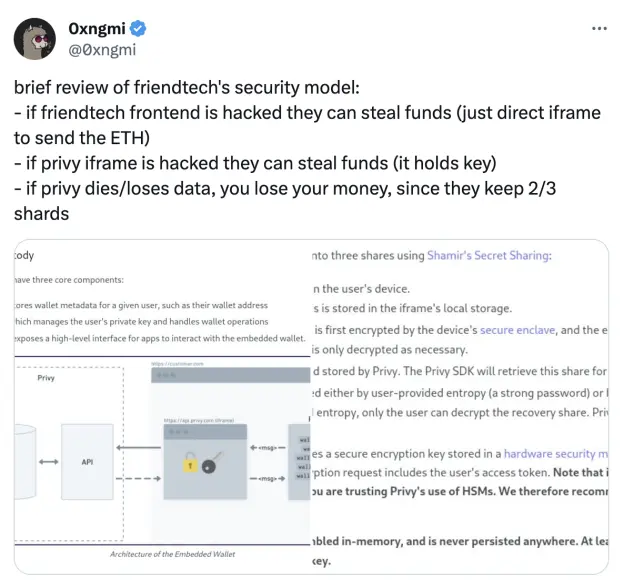
One of the major concerns surrounding friend.tech is the potential vulnerability of its smart contracts. Currently, friend.tech’s Shares V1 contract on Base holds approximately 18k ETH, valued at around $28.4 million. As with all smart contracts, there’s a perpetual risk of cyber-attacks or exploits. Amplifying this concern is the storage strategy for user private keys. Unlike traditional custodial storage methods, these keys are solely stored on friend.tech's servers, making them susceptible to potential breaches.
Infrastructure challenges have already manifested for friend.tech. Twice on August 11th, its server maxed out its capacity, rendering users unable to access the platform. Despite subsequent upgrades, the user experience has occasionally been hindered by these infrastructural constraints, leading to some dissatisfaction among its user base.
Sustainable Model?
The primary stakeholders on Friend.Tech (FT) can be categorized into three groups:
- Creators: Active channel managers who encourage users to purchase their keys, motivated mainly by the trading fees earned.
- Consumers: Those who buy keys to access a creator's channel, driven by the desire to consume the creator's content or gain exclusivity.
- Speculators: Individuals who buy and flip keys, motivated by capital gains on keys.
Of these three groups, speculators are likely the first to leave as the platform matures and the initial excitement wanes, making active trading less profitable. This is especially true for FT due to its aggressive bonding curve, which makes keys progressively more expensive and thus, challenges attracting new investors.
The increasing cost of content on FT contrasts sharply with other content-driven social platforms, which usually offer free content or exclusive content for a consistent monthly fee. This pricing strategy means that on FT, high-quality content is accessible only to those who can afford it, potentially leading to reduced engagement and making consumers the next group to leave.
As speculators and consumers exit the platform and sell their keys, share prices will likely spiral downward. While this might generate short-term fees for creators, the lack of buying demand may not provide a sustainable incentive in the long run. As engagement decreases and content creation declines, the departure of both speculators and consumers could accelerate, further discouraging creators. This chain reaction could signal the beginning of FT's decline as its value proposition diminishes for all stakeholders.
Potential Death Spiral of FT The conflicting monetization scheme and business model of FT further complicate its long-term sustainability. Traditional content platforms rely on sustained engagement and user retention to drive revenue for creators. However, FT's unconventional model allows creators to earn from trading activities, specifically from the buying and selling of keys that grant access to their content. This model seems to encourage user turnover rather than stable, enduring relationships.
Such a model could create a misalignment of incentives between creators and their audiences. Instead of fostering deep and lasting connections, creators might be incentivized to capitalize on short-term trading spikes. Although creators benefit when consumers purchase keys, the exponential growth in share prices inherently limits the buyer pool, effectively capping the group size. Additionally, the one-off payment received by creators, instead of continuous revenue, raises questions about the model's sustainability.
Regulatory Risks
Digital platforms always run the risk of becoming a conduit for inappropriate content. Friend.tech, being a social interaction platform, is not immune to this. The presence of illicit or illegal content could attract negative attention from regulatory bodies or law enforcement. To combat this, the platform would need robust moderation, which subsequently drives up operational costs.
Conclusion
Navigating the digital landscape, especially in the realm of decentralized applications, often involves traversing a minefield of risks. While friend.tech exhibits promising potential, it's crucial for stakeholders, from investors to users, to be cognizant of these challenges. Ensuring continuous evaluation, robust security measures, and transparency can be the guiding principles as the platform moves forward.





