
Something New or Something Old?
Friend.Tech represents the most recent iteration of on-chain applications that aim to monetize social media. It sets itself apart from previous versions like BitClout and Rally by concentrating on providing a user-friendly interface for speculating on "clout" instead of offering a comprehensive social media platform. Despite encountering initial hiccups, such as the application continually crashing, it still succeeded in drawing significant attention from the crypto community on Twitter. Prominent accounts like Cobie established profiles within a day of the launch, and several third-party applications have already been developed to provide additional analytics and insights.
However, converting this initial enthusiasm into a sustainable model that can retain user attention presents a formidable challenge. The daily transactions and volume have witnessed a significant decline, and the share prices of the most coveted accounts have plummeted by 50% or more from their initial values. The ability to access private chats with high-profile crypto influencers has limitations in terms of scalability, and the overall value proposition remains uncertain. For instance, smaller accounts have started purchasing keys in higher-valued ones and then sharing screenshots to entice new shareholders.
Friend.Tech Points and a Potential Token
Friend.Tech is presently piquing the interest of many in the cryptocurrency space. A chief driver behind this intrigue revolves around the platform's imminent token issuance. Many fervent participants have come to believe that each point they earn could be converted into a token, potentially valued anywhere between $1 and $5. Such a proposition also suggests that, based on their level of participation, they might be looking at a return rate of 200-500% APR, or even higher.
But how does one earn these coveted points? Friend.Tech has delineated a structure where the platform will distribute a substantial 100 million points over a span of 25 weeks. Most believe these points are precursors to a token airdrop. The amount of these points is directly influenced by the total number of Keys an individual invests, the length of time they are held, and various in-app behaviors, such as how often the app is opened, the duration of use, and commenting activity.
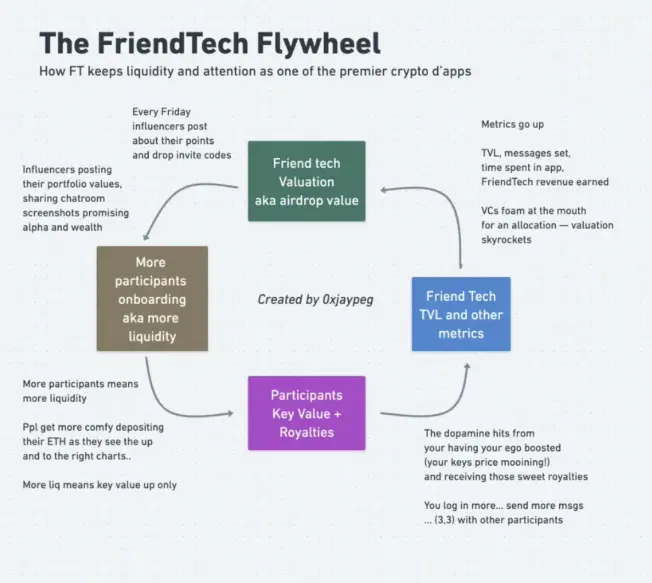
However, these benefits are not just handed out freely. To gain this potential advantage, one must purchase the KEY, remain active on the platform, and navigate through inherent product frictions. These requirements serve as barriers, filtering out large funds from flooding the platform. This could change, though. With growing awareness of Friend.Tech in the industry, accompanied by product improvements, enhanced financial structures, and attention from major players in Silicon Valley and the Asia-Pacific region, there is a strong potential for an uptick in the Total Value Locked (TVL) and the value of KEY.
One can better grasp this potential through the illustrative scenario: If Friend.Tech’s token issuance concludes with a Fully Diluted Valuation (FDV) of 1.5 billion, 10% of which is earmarked for airdrops, and the average TVL across 25 weeks stands at 80 million, then the airdrop ratio for participants would be in sync with the TVL. This translates to an impressive annual airdrop rate of roughly 360%.
From a strategic standpoint, Friend.Tech has made a notable decision. As of now, they have chosen not to engage with venture capitalists, except for Paradigm. This move can be interpreted in various ways, but it unmistakably casts a spotlight on retail investors and secondary funds. These entities, often overlooked in favor of larger institutional investors, now find themselves in a unique position to potentially benefit from Friend.Tech's ascent. For many, mining might become the predominant, if not the only, method to connect with the company and its offerings.
In the evolving digital landscape of Friend.Tech, the allocation of KEYs represents a pivotal component for users to maximize their engagement and potential returns. If the end goal is to accrue the maximum number of Points, then certain strategies become evident.
Understanding the Value Proposition of KEYs
At a foundational level, KEYs in Friend.Tech extend beyond merely serving as tokens of knowledge consultation and identity recognition. The anticipation of token airdrops infuses these KEYs with an enhanced value proposition. Should we make the educated assumption that the ultimate token airdrop is intimately tied to the accumulation of Points, then the primary objective becomes clear: maximize Point acquisition on a weekly basis.
Although the Friend.Tech team retains the discretion to fine-tune the allocation formula periodically, our analysis leads us to project the likely conversion methodology as:
In-app activity (own + others) * KEY total asset price (own + others) * KEY holding durationIn-app activity (own + others) * KEY total asset price (own + others) * KEY holding duration
Drawing from this projection, several strategies emerge for users to optimize their Point acquisition:
For users to accrue maximum Points, it's essential to engage frequently with the product, making their voices heard both in their own groups and others. Moreover, the KEY room owner a user associates with should exhibit high activity levels.
Room owners with substantial financial resources offer an added advantage, as their Ethereum (ETH) is poised to convert to KEY, thereby bolstering the weightage. A preference should be given to users boasting high total asset prices.
Acquiring KEYs of active KOLs at the outset, when prices are comparatively low, poses a challenge. Thus, for financially endowed users with substantial traffic, an early, hefty investment in their own KEYs could amplify the associated parameters.
Considering that the duration of KEY holding likely influences the weightage, coupled with the substantial fees associated with entry and exit (around 20%), a long-term holding strategy becomes more appealing. Users should seek room owners deeply entrenched in the platform's ecosystem, rather than trend followers. This approach underscores the importance of aligning with individuals dedicated to genuinely nurturing the product.
From an allocation standpoint, the quintessential room owner embodies a blend of high traffic, user engagement (stickiness), considerable net worth, and a long-term commitment to enhancing their brand on Friend.Tech. A noteworthy observation is that such users would have already amassed a commendable number of Points in recent weeks, thus providing an effective criterion for screening.
Mechanisms for Points Accumulation:
-
Referrals: Encouraging users to bring new members to the platform. Referral programs have historically been successful in driving user growth and engagement for various online platforms.
-
Your Own Key Value Rising: This mechanism directly ties users' actions and the market's perception of their value to points accumulation. It rewards individuals who are deemed valuable or influential by the community.
-
Holding Volume: Encouraging users to accumulate and retain keys over time, thus fostering long-term user commitment.
-
Trading Volume: Although it seems to be of lesser importance, active trading, buying, and selling keys can also fetch points.
The design, which rewards both accumulation and daily activity, aligns well with Friend.Tech's goals. By requiring both holding and active participation, the system cleverly promotes long-term loyalty combined with daily engagement.
Friend.Tech's approach seems to leverage behavioral economics. By tying rewards to both long-term (holding keys) and short-term (daily activity) actions, the platform instills a habit-forming behavior among its users. It's akin to checking one's social media feeds daily, ensuring that users keep coming back. The revelation of points every Friday creates a sense of anticipation and eventfulness. This periodic unveiling becomes a social event, fostering community discussions, speculations, and comparisons.
Monetary Value of Points:
Currently, the exact value of these points remains a subject of speculation. Several factors play into this uncertainty:
-
Conversion Ratio: It's unclear how these points will be converted to tokens. Will it be a static ratio or something that changes based on certain criteria?
-
Airdrop Dynamics: The total supply intended for airdrops and the distribution method remain undisclosed.
-
Market Conditions: When Friend.Tech finally introduces its token, the broader market conditions will significantly influence its value. This encompasses the general sentiment around cryptocurrencies, the Ethereum ecosystem's health, and Friend.Tech's standing within the community.
In conclusion, while the precise monetary implications of the points remain speculative, the strategy adopted by Friend.Tech is evident. They aim to solidify user engagement, stimulate daily activity, and foster a sense of community. Whether this will lead to sustained success or whether adjustments will be needed remains to be seen. But for now, users seem to be engaging, trading, referring, and eagerly awaiting their Friday points reveal.





