

If you want more cryptocurrency analysis, including full-length research reports, trading signals, and social media sentiment analysis, use the code "Publish0x" when subscribing to CryptoEQ.io to make your first month of CryptoEQ just $10! Or simply click the button above!
In Q1 2022, NEAR Protocol released its own native stablecoin soft-pegged to USD called “USN.” USN operates similarly to TerraUSD (UST) or Frax Finance (FRAX). The USN token can be minted by users depositing NEAR tokens as collateral, making it an on-chain stablecoin.
The USN token is operated by an external independent organization called “Decentral Bank” (in collaboration with Proximity Labs). So far, USN as been adopted by multiple NEAR-native applications, including:
- Ref Finance
- Burrow
- Aurigami
- Bastion
USN’s soft peg to the USD is secured through an arbitrage process along with a self-balancing reserve fund. It works through a smart contract that oversees a NEAR-USN exchange. When USN loses its peg to the USD (<1), profit-seekers can take advantage of the arbitrage opportunity and buy USN at a discount. The reserve fund is collateralized at a 2:1 ratio of NEAR:USN to maintain a level of over-collateralization.
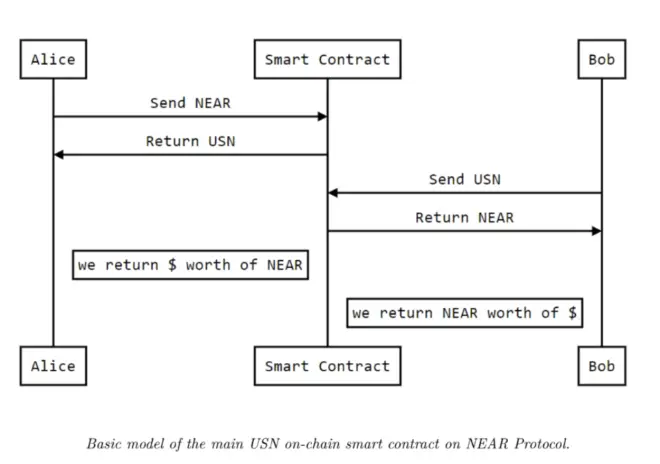
USN’s largest existing pool is on Ref Finance, the main application where USN tokens can be swapped. Ref Finance and other applications are able to offer yields on USN through the Decentral Bank DAO’s ability to stake the NEAR reserve tokens. By staking the reserves, the NEAR automatically earns the equivalent of staking rewards on the blockchain or greater (~11%).
Staking NEAR tokens comes with a lock-up period which could prevent immediate withdrawals in case of a large redemption event. That said, because of the NEAR staking rewards, the NEAR blockchain could be one of the leaders for stablecoin yields in the market.
USN v2.0
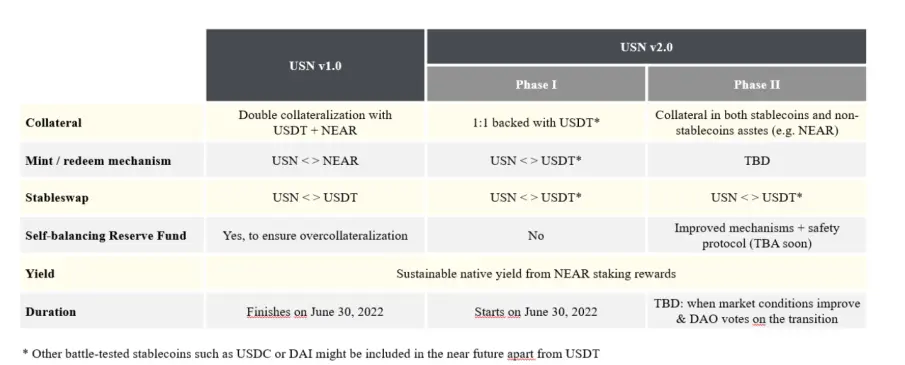
It only took ~three months (and the collapse of Terra’s UST stablecoin) before the Decentral Bank DAO released a new version of USN dubbed “v2.0.” The changes to the nascent stablecoin were made with hopes of making it more resilient in a bear market/volatile conditions and avoiding any “death spiral” as seen in UST. These changes included:
- What the DAO calls “Phase I,” $USN will be 1:1 backed with USDT. Users can mint and redeem USN only with USDT. A native yield will be sustainably generated from $NEAR staking rewards. While USDT remains the top stablecoin in Q3 2022, it’s lost considerable market share to USDC throughout 2022. To bootstrap the Phase I period, 1 million USN will be distributed per month via Ref Finance in July and August 2022.
- Phase II will begin in which USN will be collateralized by non-stable assets, starting with NEAR. Interestingly, the DAO (via its Twitter) claims this period will only begin during a “bull market.” To quote, “As market conditions recover, the Decentral Bank DAO may vote to transition to Phase II, where non-stablecoin assets will be reintroduced to mint and redeem $USN - starting with $NEAR.” This means the stability of the coin and its collateral will be altered based on one DAO’s decision of what constitutes a bear/bull market. This is obviously incredibly subjective and risky. Users of USN should be aware that humans behind the scenes are essentially making trading decisions around the coin’s collateral.
To make matters worse, it took less than one week into v2.0 (July 6th, 2022) before a bug was exploited and 10 trillion USN were minted. To the team’s credit, they noticed the bug immediately and rectified the situation by upgrading the smart contract and burning the 10 trillion minted USN. However, to do so, they paused the USN smart contract, illustrating complete control over the stablecoin.
To recap:
- The DAO plans to make changes and collateral decisions based on bull/bear markets
- The Phase I implementation is just a one-to-one representation of USDT (why not just use USDT then?)
- It took less than one week for a catastrophic bug to be found
- The DAO can freeze the entire USN smart contract and funds
It's safe to say that an extreme degree of caution is warranted if interacting with USN.





