You are reading an excerpt from our free but shortened abridged report! While still packed with incredible research and data, for just $20/month you can upgrade to our FULL library of 50+ reports (including this one) and complete industry-leading analysis on the top crypto assets.

Becoming a Premium member means enjoying all the perks of a Basic membership PLUS:
- Full-length CORE Reports: More technical, in-depth research, actionable insights, and potential market alpha for serious crypto users
- Early access to future CORE ratings: Being early is sometimes just as important as being right!
- Premium Member CORE+ Reports: Coverage on the top issues pertaining to crypto users like bridge security, layer two solutions, DeFi plays, and more
- CORE report Audio playback: Don’t want to read? No problem! Listen on the go.
Scaling Tradeoffs
First, there was Bitcoin. A few years later, Ethereum was launched. Ethereum has been massively successful as an open network and computing platform where software and application developers can collaborate and innovate quickly, easily, and without having to request permission. The Ethereum network has become especially popular for DeFi (decentralized finance), NFTs, DAOs (digital autonomous organizations), and trading. But all of this use of the Ethereum network has led to congestion, high user fees, and surging electricity consumption.
Ethereum is a Layer-1 (L1) blockchain currently in the midst of a 5+ year upgrade to satisfy future global demand while also improving security and decentralization. This is the much anticipated Ethereum 2.0/Eth2 upgrade. However, that terminology is being phased out. Now (at least for the time being), it’s best to think of Ethereum in two parts: the Ethereum consensus layer and the Ethereum execution layer.
- Eth1 → execution layer
- Eth2 → consensus layer
- Execution layer + consensus layer = Ethereum
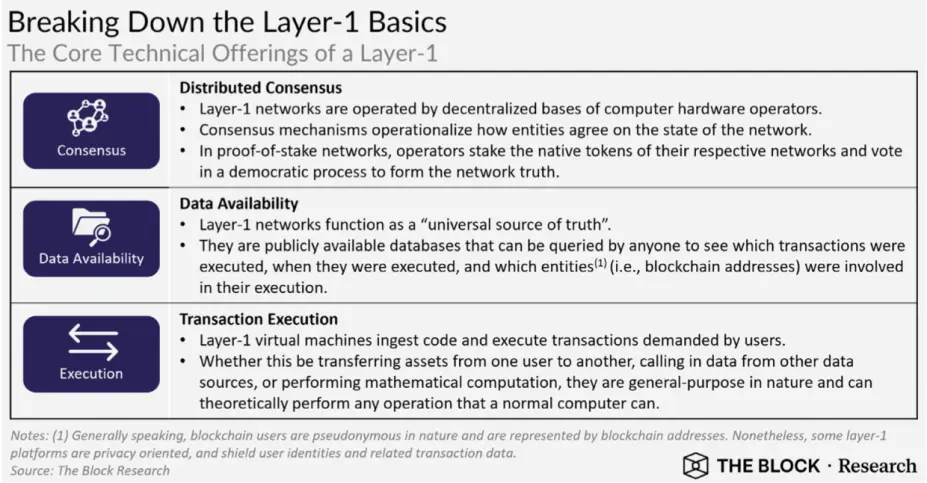
There are currently close to ~220 million unique Ethereum addresses, but if Ethereum is ever to realize its goal of becoming a truly global, decentralized settlement layer, it must find a way to store 10,000x the data efficiently. Storing the data more efficiently enables lower compute requirements for nodes. Thus, the more people that can afford to run nodes, the more people that can audit the system, thereby reducing the need to trust others and protect the integrity of the chain. Individuals who run their own nodes enjoy full self-sovereignty by verifying all transactions for themselves while also getting increased privacy benefits by not relying on third parties.
The Ethereum network wants more users! It just can’t keep storing their data in the same old way. Instead of allowing the state of the EVM to grow into infinity, new technical ideas have been proposed to remove inactive parts of the state.
As of Q4 2023, Ethereum can only process ~25 transactions per second (TPS) due to its design, which is optimized for decentralization and security. Without the ability to process more transactions, congestion on the network forces users to pay more to have their transactions executed. This has led to extremely high (>$40) transaction fees for users and is due to the high demand for limited block space on the Ethereum blockchain. Block space is the commodity that users, creators, and builders consume, making it the pulse of all cryptocurrency networks.
High network fees are a product of how blockchains process transactions. There is a cost associated with a global, decentralized, censorship-resistant financial settlement layer! For a transaction to be executed, all of the nodes across the decentralized network must agree. All nodes on the network keep a full copy of the transactions to validate the transactions on the network.
Ethereum’s ability to process transactions is (partially) constrained by the network's computing power, bandwidth, and storage. The scalability trilemma is a well-known issue among all blockchains.
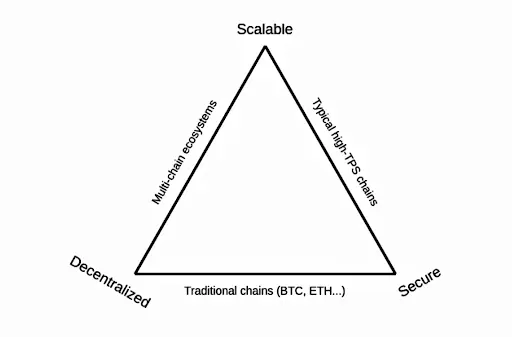
The scalability trilemma, illustrated. Credits: Vitalik Buterin
A blockchain can achieve two of these traits but at the expense of the third. Many alternative layer 1 (L1) chains have chosen to sacrifice decentralization for scalability and security. However, it’s important to remember why decentralization is important. It provides the chain anti-fragility, robustness, reliability, and censorship resistance.
In cryptocurrency, something is trustless if users do not have to rely on third parties or intermediaries (like banks) to control their funds. Instead of trusting third parties, users rely on blockchains and smart contracts that run code to execute transactions and protect the funds. Thus, a trustless system is one that does not depend on external actors to facilitate transactions from point A to B.
The goal is to increase the number of transactions while retaining sufficient decentralization. What are the decentralization sacrifices (tradeoffs) other smart contract L1s have made?
Generally speaking, other blockchain efforts (outside of Ethereum) to increase TPS have focused on one/all of the following:
- Speeding up consensus (allowing nodes to agree on the order of transactions faster),
- Increasing block sizes (more data per block) and
- decreasing block times (more blocks per minute)
Blockchains that scale by simply increasing the block space and throughput per unit of time (Binance Smart Chain and EOS) also greatly increase their state growth. Those chains are short-term solutions that lead to long-term unsustainable networks.
Implementing one/all of these parameter tweaks has generally been the approach for most next-generation “Ethereum Killers”: Binance Smart Chain, Avalanche, Solana, etc. And while it has improved TPS by nearly 100x, this still means these chains can (mostly) only achieve TPS into the single digit thousands (<10k). However, that will not suffice should these projects reach global adoption. This means that for these platforms to accommodate growth, they all must resort to increasing hardware requirements within their system.
Some chains, like Solana, have increased the requirements and costs of running a validator. In Solana or similar chains, users need a high-powered machine to run a validator and verify the chain, which reduces the number of people that may participate in network consensus by pricing them out. Obviously, a network that can only be verified if you have X amount of dollars in computing budget is not an ideal, permissionless system. Using a crude analogy would be like making it expensive for the average person to vote in an election.
Another tradeoff normally conceded is for the network to use fewer nodes to achieve consensus faster and quicker. This makes the chain more vulnerable and centralized. It’s easy to corrupt/destroy 10 nodes in one location rather than 10,000 globally.
The computational “TPS ceiling” within modern-day monolithic chains is being realized. Monolithic refers to a blockchain in which every node performs all parts of the blockchain: execution, consensus, and data availability. Execution refers to the computation of transactions. The execution layer is the user-facing layer where transactions get executed. Consensus refers to ordering transactions and nodes coming to agreement on the state. Data availability guarantees blocks are fully published to the network. The consensus layer plus data availability guarantees all blockchain data is published and accessible to anyone.
Most blockchains are designed to optimize for different end users and use cases based on what that community finds most important. However, blockchains are arguably only valuable if they offer a secure, permissionless, censorship-resistant, and credibly neutral alternative to whatever they want to replace.
With those principles in mind, networks must strive not to privilege insiders or create a hierarchy within the system, e.g., those that can afford to run a validator/audit the blockchain vs those that cannot.