

If you want more cryptocurrency analysis including full-length research reports, trading signals, and social media sentiment analysis, use the code "Publish0x" when subscribing to CryptoEQ.io to make your first month of CryptoEQ just $10! Or simply click the button above!
Ropsten testnet work merge is today!
So, what is this big upgrade? What is “The Merge”?
The Merge is the term used for when Ethereum switches from Proof-of-Work (PoW) to a Proof of Stake (PoS) blockchain. This is slated to occur in Q3 2022 and bring with it many benefits that were not previously possible with PoW.
PoS removes the energy consumption often cited in the mainstream media. While PoW is not inherently a bad thing, it’s inarguable that the world is highly critical of energy consumption and now, with the transition to PoS, Ethereum will have eliminated this one enormous criticism. Estimates from Ethereum core developers hypothesize that Ethereum’s energy use will drop by up to ~99%. Without the need for so much physical mining hardware and infrastructure, Ethereum can become a more energy-efficient, geographically-distributed, and nimble blockchain.
Post-Merge, Ethereum’s consensus layer will get rid of energy-intensive miners and replace them with validators that simply run average software. Rather than using highly complex data crunching to introduce new bitcoin into the network (PoW), PoS can randomly select validators that stake capital to secure the network, allowing it to operate using far less energy.
Additionally, PoS is a predecessor for sharding, another critical Ethereum protocol change that will separate the chain into many concurrent threads.
Finally, the PoS upgrade will reduce Ethereum’s inflation rate from ~3.5% to near zero. Thanks to the implementation of EIP-1559 and its fee burning mechanism in mid-2021, Ethereum’s net issuance is expedited to become deflationary once the Merge is released. EIP-1559 changed Ethereum’s fee structure where transaction fees now have a base fee and a tip. The base fee is set by the protocol and adjusts every block based on network activity. The base fee no longer goes to miners but is instead burned. The tip is set by the market (can be zero in times of little congestion) and will go to the miners.
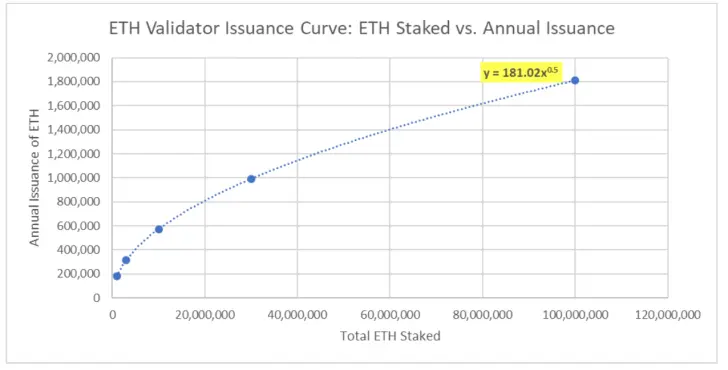
There are currently 13.4M $ETH staked. Assuming 15M ETH staked by the merge, validators would be earning ~0.7M ETH annually from staking issuance.
May 2022 saw two more successful Ethereum mainnet shadow forks; one on May 12 and another on May 20. Mainnet shadow forks simulate the PoS transition using the most intense, real-word conditions and are one of the final steps of testing. Ethereum's main public testnet, Ropsten, is set to undergo "the merge" ~June 8th in one of the final preparations before the main Ethereum blockchain can switch to Proof-of-Stake consensus. the first public testnet to run through.
Once the transition happens, Ropsten will be a full Proof of Stake network and no longer use Proof of Work to produce blocks. After Ropsten, Sepolia and Goerli testnets are set to be tested. While this is all happening, more ‘shadow forks’ will continue to run in parallel.
If all goes well with the public testnet merge transitions, it’ll be time to get both the consensus layer (the Beacon Chain) and the execution layer (“eth1”) ready for The Merge. The consensus layer will go through the ‘Bellatrix’ upgrade and the execution layer will go through the ‘Paris’ upgrade - these 2 upgrades get the respective layers ready for The Merge transition.
At the Permissionless conference, Ethereum developer Preston Van Loon mentioned the much-anticipated Merge of Ethereum to Proof-of-Stake from Proof-of-Work will occur in August should ‘everything go to pla’.’ “As far as we know, if everything goes to plan, August — it just makes sense. If we don’t have to move [the difficulty bomb], let’s do it as soon as we can.”





