
You are reading an excerpt from our free but shortened abridged report! While still packed with incredible research and data, for just $20/month you can upgrade to our FULL library of 50+ reports (including this one) and complete industry-leading analysis on the top crypto assets.

Becoming a Premium member means enjoying all the perks of a Basic membership PLUS:
- Full-length CORE Reports: More technical, in-depth research, actionable insights, and potential market alpha for serious crypto users
- Early access to future CORE ratings: Being early is sometimes just as important as being right!
- Premium Member CORE+ Reports: Coverage on the top issues pertaining to crypto users like bridge security, layer two solutions, DeFi plays, and more
- CORE report Audio playback: Don’t want to read? No problem! Listen on the go.
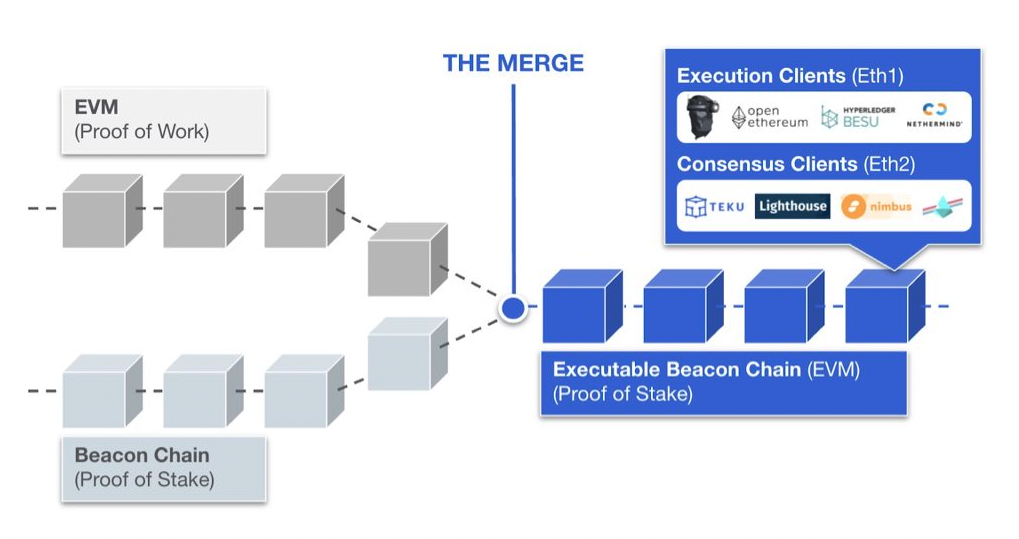
Transitioning from PoW to PoS (“The Merge”)
In Ethereum, blocks are “proposed” to the network by a distributed community of “validators,” and if enough validators come to the consensus that a given block is valid – meaning it contains only legitimate transactions – that block is added to the chain, and the process repeats
Overall, Ethereum can remain as secure but with a lower overall “energy budget” because less energy is required to achieve consensus. In PoS, stakers deposit capital rather than building giant mining farms. While a dramatic oversimplification, both approaches are risking capital, but PoS is simply more straightforward.
With PoS, the Ethereum base layer will be managed by validators rather than PoW miners. A validator is a person or entity who locks up (stakes) 32 ETH in order to run a validating node and secure the Ethereum blockchain. This means rather than relying on energy/electricity for security as is the case in PoW, Ethereum security will rely upon capital instead. With PoS and staking rewards, ETH becomes a productive capital asset with yield as well as a the money underpinning network transactions and executing smart contracts.

Beacon Chain Consensus
The Beacon Chain serves as the epicenter of the future architecture and network consensus. PoS aims to lower the cost of participating in securing the network by allowing anyone with ETH to stake rather than needing a giant million-dollar mining farm as is the case in most PoW networks.
 @CryptoPragmatist
Key takeaways from the early instantiations of the Beacon Chain are:
- Introducing the ETH Proof of Stake consensus layer;
- Tracks ETH validators and balances;
- One-way ETH deposit to stake on the Beacon Chain; and
- No state management (transactions, smart contracts).
The Beacon Chain (consensus layer) will be the center of Ethereum’s new consensus mechanism and is responsible for the liveness, veracity, and consensus on the new chain. Future sharded layers (shards) will all connect back to the Beacon Chain with many validators across all 64 shards. The Beacon Chain will provide the foundation for hundreds of thousands of validators distributed across thousands of nodes globally. It will organize validators into committees and apply the consensus rules that dictate the network.
Post-merge Ethereum is transitioning to a new consensus mechanism named Gasper. Gasper combines Casper FFG (how to determine finality) and LMD GHOST (determining fork-choice rules) to achieve consensus. Similar to its old Nakamoto-style consensus in which liveness was prioritized over safety, Gasper is also a liveliness-preferring consensus protocol. Consensus algorithms that prioritize safety (such as Tendermint) fail if they do not receive the required amount of votes (2/3 of the validator set). This leads to the chain halting (the opposite of "liveness"). Chains that prioritize liveness will continue to generate blocks based on their "heaviest/longest chain" rule set no matter what, even if bad actors have corrupted the majority of the hash power/votes.
Casper the Friendly Finality Gadget is the name of Beacon Chain's PoS-based consensus protocol. Casper is a partial consensus algorithm that combines PoS and BFT consensus models. Casper's core design was modeled after the PBFT consensus method but, similar to Nakamoto Consensus, still identifies the "true" chain as the one with the greatest attestations. Casper FFG decides on which blocks become part of the chain.
Casper reaches finality through periodic checkpoints after a sufficient number of votes from its 470,000+ validators. Checkpoints can be subdivided into slots and epochs. A slot is when a block is added to the Beacon chain, and in PoS, it occurs predictably every 12 seconds. A slot is divided into three equal parts, with each part spanning four seconds. At the commencement of each slot, a validator is selected at random to propose a block, hereby referred to as the 'proposer'. Concurrently, other validators are entrusted with the responsibility of attesting or casting votes for the block that they perceive as the chain head, guided by their local view and the fork-choice rule.

The attestation deadline at t=4 is a pivotal moment in the slot. Should a validator tasked with attestation not receive a block by the deadline, the validator would vote for the previously accepted head of the chain as per the fork-choice rule. The propagation speed of a block, therefore, plays a significant role in the number of attestations it receives. Simply put, the sooner a block is proposed, the more time it has to circulate, thereby accruing more attestations.Optimal network health is achieved when a block is published at t=0, as per the Ethereum specification. However, the value of a block increases steadily with time, thus incentivizing proposers to delay their block's publication, allowing for the accumulation of more Maximum Extractable Value (MEV).
A different validator is assigned to propose a new block in each slot ahead of time. 32 slots (6.4 min) are grouped into an epoch. Each slot also has a group of validators (minimum of 128) called a committee assigned to it. Committees verify and attest to the validity of each proposed block. After successfully verifying the block, the committee members broadcast a cryptographic attestation of the block to the other validators and network nodes. Based on the validator attestations, the fork-choice rule LMD GHOST decides the current head of the chain. Generally, finality is attained with the necessary votes after two epochs.
Epochs are what is considered in the periodic checkpoints and for chain finalization. An epoch becomes justified if> 66% of the validators attest during that epoch. If a second epoch with > 66% follows the first, it will finalize that epoch and make the transactions irreversible.
 Source: Consensys
The protocol contains a "correlation penalty" in which validators forfeit ETH rewards if they refuse to participate when called upon, and their existing stake is "slashed" if they propose numerous blocks in a single slot or submit contradicting votes. The quantity of ETH cut depends on the number of dishonest validators the protocol simultaneously slashes.
This penalty can result in the slashing of around 1% of a validator's stake if they are punished individually or approaching 100% of the validator's stake in the event of a mass slashing. The protocol imposes the penalty at the midpoint of a forced exit period that begins with an instantaneous penalty (up to 0.5) on day 1, followed by a correlation penalty on day 18, and then ejection from the network on day 36. In addition, the dishonest node incurs daily modest attestation penalty due to its presence on the network without submitting votes.
Additionally, PoS is a predecessor for sharding, another critical Ethereum protocol change that will separate the chain into many concurrent threads (discussed more below).





