
You are reading an excerpt from our free but shortened abridged report! While still packed with incredible research and data, for just $20/month you can upgrade to our FULL library of 50+ reports (including this one) and complete industry-leading analysis on the top crypto assets.

Becoming a Premium member means enjoying all the perks of a Basic membership PLUS:
- Full-length CORE Reports: More technical, in-depth research, actionable insights, and potential market alpha for serious crypto users
- Early access to future CORE ratings: Being early is sometimes just as important as being right!
- Premium Member CORE+ Reports: Coverage on the top issues pertaining to crypto users like bridge security, layer two solutions, DeFi plays, and more
- CORE report Audio playback: Don’t want to read? No problem! Listen on the go.
Overview
On March 2, 2023, the Ethereum Foundation deployed ERC-4337 on the mainnet to implement the proposed Ethereum Account Abstraction, which has been in development since September 2021. Account Abstraction does not require any modifications to the consensus layer, instead sits as a layer above it.
This deployment adds two new features: first, it combines the functionality of an Externally Owned Account (EOA) and a Contract Account (CA), enabling the execution of contracts and the issuance of transactions from a single account. Second, it supports ERC-20 fee payment and fee substitution functions. It also offers more flexibility in validating transactions on the blockchain by allowing programmable validity to verify and validate any blockchain transaction. Unlike the rigid requirements currently hard coded into the Ethereum protocol, AA enables multi-owner accounts via multisig signature verification, the use of post-quantum signatures, and the removal of signature verification entirely for a public account.
With AA, validity conditions can be programmed in a customizable way into a smart contract on a per-account basis rather than hard coding them into the Ethereum protocol, which would apply to all transactions in a generalized way. Overall, AA represents an important step in the evolution of the Ethereum network by offering greater flexibility and functionality for users.
Let's dig into what all that means. TL;DR, the Ethereum user experience and wallet ecosystem can now get a whole lot better.
Account Abstraction (AA) and ERC-4337
Account Abstraction (AA) is a new solution to combine user accounts and smart contracts into a single Ethereum account type. AA offers more flexibility in validating transactions on the blockchain by allowing programmable validity to verify and validate any blockchain transaction. Unlike the rigid requirements currently hard coded into the Ethereum protocol, AA enables multi-owner accounts via multisig signature verification, the use of post-quantum signatures, and the removal of signature verification entirely for a public account.
Current Externally Owned Accounts (EOAs), the conventional accounts in the Ethereum ecosystem, possess certain limitations, most notably their reliance on private keys for transaction signatures. The introduction of the ERC-4337 standard addresses this limitation head-on. In essence, an ERC-4337 wallet, colloquially referred to as a smart contract wallet, is designed to encompass all the roles an EOA serves without necessitating changes at the protocol level.
This advancement can be seen as a nod to Vitalik Buterin's envisioned transitions for Ethereum. Specifically, smart contract wallets offer:
- Simplified User Experience: This includes a streamlined wallet setup process, easier account recovery, user-friendly wallet operations, and an innovative address management system.
- Enhanced Security Measures: The flexibility offered by smart contract wallets to pay gas using any ERC-20 token, combined with measures that counteract human errors, has profound implications for ensuring user security.
- On-Chain Payment Reforms: With the ability to track various assets, from ETH to NFTs, and automate complex cross-chain transactions, smart contract wallets promise to redefine asset management and transfers.
With AA, validity conditions can be programmed in a customizable way into a smart contract on a per-account basis rather than hard coding them into the Ethereum protocol, which would apply to all transactions in a generalized way. One potential use case of AA is auto payments, but the broader goal of AA is to make Ethereum transactions more efficient and customizable by allowing users to deploy an account contract with any of the features described above or other features. Overall, AA represents an important step in the evolution of the Ethereum network by offering greater flexibility and functionality for users.
Account abstraction decouples the entity controlling an account within the Ethereum Virtual Machine (EVM) from the entity with the authority to move assets. This upgrade would turn all accounts into smart contract accounts, which can define their own valid transactions. This would bring programmability to transaction validity rules, allowing smart contracts to determine the effects of transactions and also whether they are valid. The implementation of account abstraction would involve designing an API to define specific functions that would enable smart contracts to act as accounts. Once implemented, Ethereum would become more customizable, flexible, and future-proof.
Benefits/Features of AA and its Risks
The benefits of AA are described in the table below.
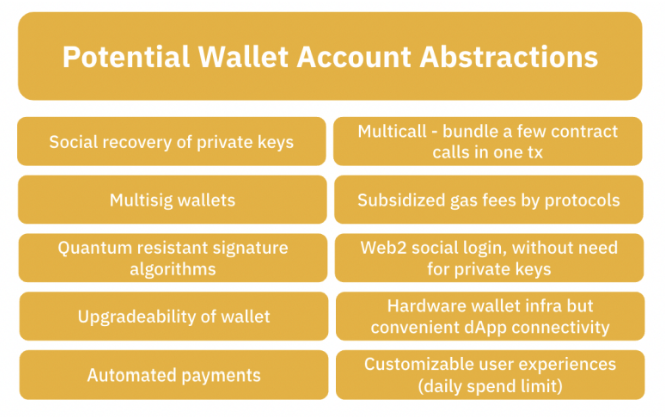
Source: Binance Research
Despite the many pros, like all things, there are tradeoffs/risks associated with AA. Account abstraction wallets are not currently supported at the protocol level and are implemented as smart contracts. While these wallets provide benefits such as improved user experience, the current implementation is not without issues. Firstly, there is a cost associated with deploying a smart contract wallet, and the gas cost for transactions is higher compared to EOA wallets. Secondly, each wallet needs to be audited before it can be used as a replacement for EOAs, as there are security concerns with smart contracts being hacked. Additionally, the infrastructure to support ERC-4337 is not fully established, as it heavily relies on Flashbots, which is specific to Ethereum. Lastly, smart contract wallets can only interact with decentralized applications that have implemented EIP-1271, raising questions about compatibility with other EVM chains. While these issues can be circumvented through Layer 2 networks, established smart contract wallets like Argent have deviated from ERC-4337 to implement protocol-wide changes.





