
You are reading an excerpt from our free but shortened abridged report! While still packed with incredible research and data, for just $20/month you can upgrade to our FULL library of 50+ reports (including this one) and complete industry-leading analysis on the top crypto assets.

Becoming a Premium member means enjoying all the perks of a Basic membership PLUS:
- Full-length CORE Reports: More technical, in-depth research, actionable insights, and potential market alpha for serious crypto users
- Early access to future CORE ratings: Being early is sometimes just as important as being right!
- Premium Member CORE+ Reports: Coverage on the top issues pertaining to crypto users like bridge security, layer two solutions, DeFi plays, and more
- CORE report Audio playback: Don’t want to read? No problem! Listen on the go.
Intro
Various rollups, including Optimism's Superchain, zkSync's Hyperchains, and Arbitrum's Orbit chains, have visions of multi-chain ecosystems with shared infrastructure to smoothen UX. However, these pursuits remain a work in progress and a final, complete vision could still be years away.
The Limitations of Many-Chain Visions
Most multi-chain visions, while ambitious, are fraught with challenges that could stymie mass adoption. Existing plans for many-chain ecosystems fall short in terms of delivering a user experience that can match the simplicity of single, shared states. Even when within the same ecosystem, interoperability issues can still arise. Moreover, the logistics of maintaining accounts across multiple chains can become an onerous task for users. The need for bridging and keeping track of multiple gas tokens adds additional layers of complication and cost. Reliance on infrastructure providers for operating and maintaining these multiple chains also poses challenges in terms of expense and technological maturity.
Solana’s Vision: A Shared State Machine
Solana offers a remarkably straightforward vision of a highly optimized, shared-state machine capable of handling a broad range of valuable use cases. Eclipse Mainnet posits that this vision can exist cohesively alongside a rollup-centric roadmap. The misconception that Solana's architecture is incompatible with rollups largely stems from the current nature of rollups themselves. Today's rollups predominantly utilize the single-threaded Ethereum Virtual Machine (EVM), often unchanged, to benefit from its early network effects.
The notion of dedicating a rollup's block space for a specific app is often seen as a solution to preventing fee hikes caused by high-activity events, such as NFT mints. However, this approach introduces unnecessary complexities, fragmented liquidity, and compromised UX. Solana’s parallelized Virtual Machine (SVM) with localized fee markets for state hotspots offers a more efficient solution.
Solana's SeaLevel
In addition to Gulf Stream, SeaLevel is a parallel smart contract-processing runtime solution. The implementation of SeaLevel creates a runtime that effectively processes tens of thousands of contracts in parallel. Parallel processing means the task is divided into smaller computable tasks, using as many avenues as each validator has available. This concept allows for non-overlapping transactions and multiple smart contracts to run simultaneously without impacting each other's performance.

The process of pipelining allows the Solana network to validate large blocks of transactions at high speeds. Pipelining is a common process within computing in which “multiple instructions are overlapped during execution.” Different stages are created and connected together to form a pipeline which then carries instructions from one end to another, increasing the overall throughput.
Solana uses this technique to maximize its processing efficiency. For Solana, the pipeline is referred to as the Transaction Process Unit (TPU), which greatly speeds up the network by preemptively fetching packets, verifying their signatures, and crediting tokens before the blocks are ever even sent to the corresponding validators.
Eclipse: A Little Bit of Everything
Eclipse has recently released its mainnet architecture that aims to harness the strengths of multiple, existing blockchain technologies. This unique amalgamation stands to revolutionize not just throughput and efficiency but also to offer cost-effective solutions for users and investors alike. Eclipse Mainnet aims to offer a cohesive solution that brings together Solana's high-performance architecture and the security, verifiability, and network effects of a rollup-centric model. This synergy is designed to optimize user experience, reduce costs, and significantly increase the platform's overall throughput.
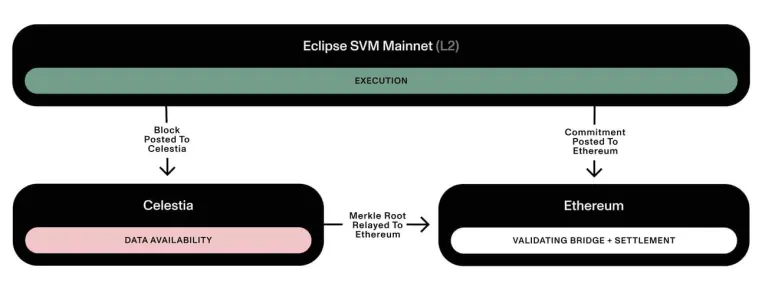
Eclipse introduces a nuanced, multi-faceted approach to blockchain architecture. The platform utilizes Ethereum's well-established settlement layer, incorporates Solana Virtual Machine (SVM) for transaction execution, adopts Celestia for data availability, and employs RISC Zero for fraud proofs. This combination draws from Ethereum's trusted financial infrastructure while benefiting from Solana's technological advancements in speed and cost-efficiency.
Ethereum's Monetary Layer: A Pillar of Stability
Ethereum, with its long-standing reputation as a secure and versatile blockchain, serves as the settlement layer within Eclipse's architecture. This alignment ensures that transactions on the Eclipse platform inherit the robustness and wide user trust that Ethereum has garnered over the years. Additionally, Ethereum's robust smart contract capabilities offer a flexible and programmable layer for complex financial transactions, making it an ideal foundation for Eclipse.
The Speed and Scalability of Solana Virtual Machine
When it comes to transaction execution, Eclipse opts for Solana Virtual Machine (SVM), a technology known for its high throughput. Unlike the Ethereum Virtual Machine (EVM), which processes transactions in a single-threaded, sequential manner, SVM enables parallel transaction execution. This aspect significantly enhances efficiency and allows Eclipse to deliver a performance level that outstrips many alternative rollup solutions.
One of the most innovative features of Eclipse Mainnet is the implementation of local fee markets, an idea borrowed from Solana's uniquely parallelized runtime. Unlike the typical global fee markets, where a surge in demand in one application could hike fees across the board, local fee markets allow for application-specific fee settings. This ensures that a fee spike in one app does not render the entire chain exorbitant for other users.
The Efficacy of Celestia's Data Availability Solutions
Cost-effectiveness is another area where Eclipse aims to distinguish itself. By integrating Celestia's data availability (DA) solutions, Eclipse offers a more affordable option compared to Layer 2 solutions that rely solely on Ethereum for DA. Celestia's specialized focus on ensuring data availability allows Eclipse to minimize transaction fees, thereby making it an attractive alternative for users sensitive to cost implications.
Celestia is a new modular blockchain that primarily serves as a "data availability network." By separating execution from consensus, Celestia can offer cheap transaction verification costs regardless of demand. Celestia can maintain high decentralization and scalability because it will enable users to launch light nodes from a basic mobile device.
Importantly, Celestia does not execute any transactions like typical rollups (Arbitrum, Optimism, zkSync, etc.). Validators on Celestia guarantee data availability for verifiers to authenticate the veracity of off-chain executions so as to eliminate any need for a challenge period like in Optimistic rollups. Data availability is critical in this regard because as long as all the execution data is made available on the mainnet, the chain does not require every node to execute every transaction in order to validate transactions and reach consensus.
It is a network that has the latest state of an L2 that can be leveraged by verifiers to assess whether or not data is available (and therefore can reconstruct the prior state to check if execution has been done appropriately in different intermediate states).
Eclipse Mainnet has selected Celestia as its data availability partner, opting for a system known for its high throughput and secure, scalable data availability. Unlike traditional Data Availability Committees (DACs), which bring with them certain honesty assumptions and limit user verification, Celestia plans to implement Data Availability Sampling (DAS) light nodes from the outset. These DAS light nodes serve two critical functions: enabling end-users to self-verify the availability of Eclipse block data and contributing to the scalability of the entire network. Celestia will become the first data availability layer to launch with DAS in production, setting it apart from more traditional systems that might entail greater risk or less user empowerment.
Eclipse Mainnet's goals for throughput and fees find little compatibility with Ethereum's existing bandwidth, an issue not slated for immediate resolution even after the forthcoming EIP-4844, colloquially known as "Proto-danksharding." Ethereum's post-EIP-4844 environment will offer around ~200+ transactions per second (TPS) for basic ERC-20 transfers and approximately ~75+ TPS for compressed swaps.
On the other hand, Celestia is expected to launch with 2 MB blocks, with a planned escalation to 8 MB blobspace as more DAS light nodes come online and the network proves its stability. The enhancement in blobspace will contribute directly to increased throughput, hence providing Eclipse Mainnet with the scalability it requires for its targeted transaction volume and fees.
Security Assumptions and Risks
While data availability is a cornerstone of blockchain security, it also introduces certain security assumptions, especially when assets are bridged from Ethereum Mainnet to any chain utilizing offchain data availability solutions like Celestia. Although it's theoretically possible for Celestia validators to withhold data while reporting its availability to Ethereum, such an action is considered a "slashable" offense within Celestia’s proof-of-stake consensus model, significantly mitigating the risk involved.
Although Eclipse Mainnet has committed to Celestia for its data availability needs, the team also expresses an openness to reconsidering Ethereum as it continues to evolve, especially post-EIP-4844. Advancements in distributed hash tables and other research could potentially offer high-throughput data availability solutions on Ethereum, triggering a reassessment of Eclipse Mainnet’s data availability partnerships.
RISC Zero: Fortifying Security
Security is a quintessential concern in blockchain technology, and Eclipse leaves no stone unturned in this regard. It employs RISC Zero for fraud proofs, bolstering the trustworthiness of transactions. This feature ensures an additional layer of security and validation, further enhancing the overall integrity of the platform.
For cryptocurrency investors and users, Eclipse's integrated architecture brings forth a compelling proposition. By seamlessly combining the reliability of Ethereum, the speed of Solana, the cost-effectiveness of Celestia, and the security measures of RISC Zero, Eclipse promises not just technological prowess but also potential financial advantages. Investors eyeing long-term gains may find Eclipse's innovative approach an important addition to a diversified crypto portfolio.
Conclusion
Eclipse’s mainnet architecture reveals the potent synergy achievable when different blockchain technologies are judiciously integrated. The platform successfully amalgamates Ethereum's financial robustness, Solana’s speed, Celestia’s data availability solutions, and RISC Zero's security mechanisms. The resulting entity is more than the sum of its parts; it signifies a new milestone in blockchain efficiency, cost-effectiveness, and security. Investors and users looking for a versatile and stable blockchain platform would do well to consider the myriad benefits that Eclipse's new mainnet architecture brings to the table.






